 The Basics:
- For ages 13 and up
- For 2 to 5 players
- Approximately 180 minutes to complete
Geek Skills:
- Counting & Math
- Logical & Critical Decision Making
- Strategy & Tactics
- Hand/Resource Management
Learning Curve:
- Child – Difficult
- Adult – Easy
Theme & Narrative:
- Build the most efficient route to deliver all the goods
Endorsements:
- Child Geek rejected!
- Parent Geek rejected!
- Gamer Geek approved!
Overview
The expansion of the United States’ railway system offered new opportunities for people to move around. And wherever people go, goods quickly follow. In this game, you’ll be challenged to build a railroad that optimizes efficiency to deliver goods as quickly as possible. You’ll have to leverage the growing needs with whatever means are available to you. Seek opportunities to capitalize on new railways and improve, squeezing every last opportunity to get what people want where they want it before the competition beats you to it.
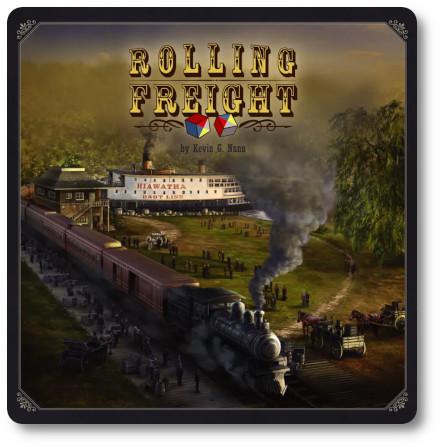
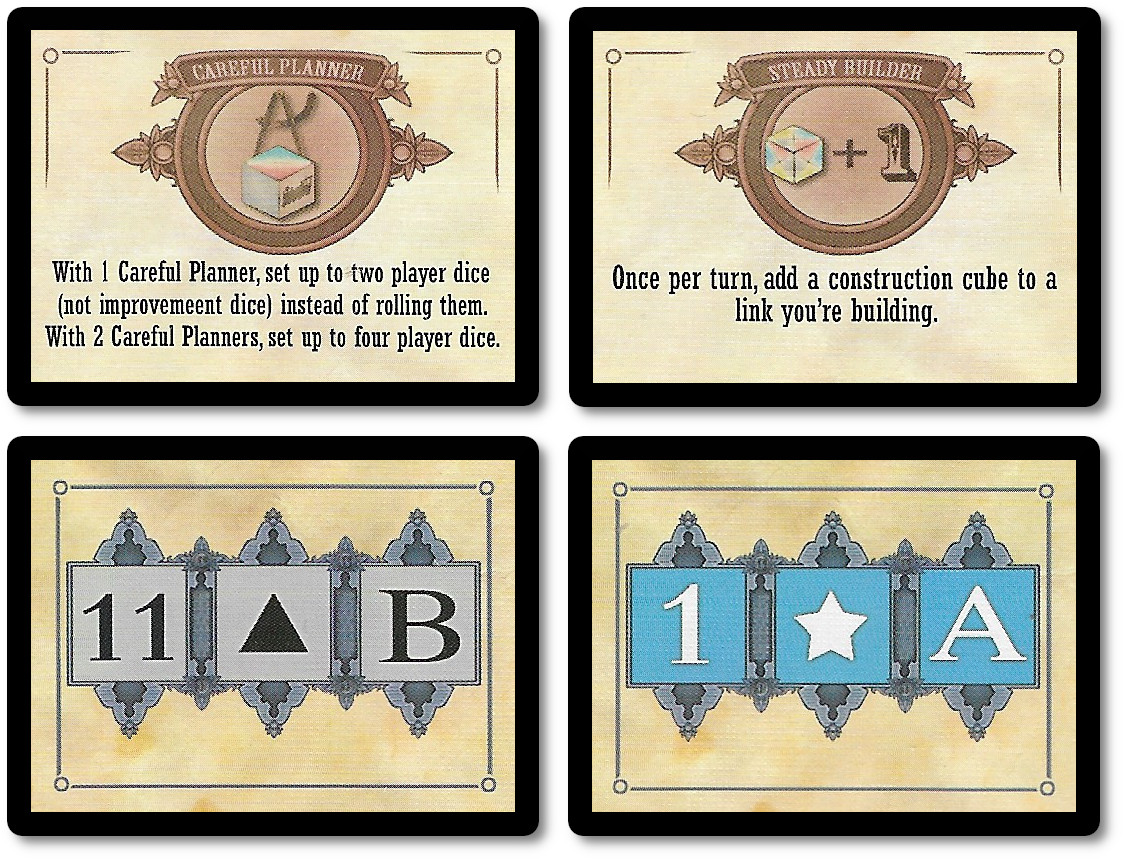
Rolling Freight, designed by Kevin G. Nunn and published by APE Games, is comprised of one two-sided board, 30 Basic dice (six each per player), eight Extra Resource Improvement dice (that come in different colors), 114 Contract cards, 18 Improvemetn cards, three End of Phase cards, four RR Xing markers (with stands), one Cargo bag that holds 65 Cargo markers, five Player mats, five Locomotive pawns, 105 Construction cubes, 170 Link sticks, 24 Stockpile markers, 62 Cargo Saturation markers, 10 “B” Phase markers, and 10 “C” Phase markers. Illustrations are fairly minimal, focusing more on information than on looks. The game board, however, is a visual feast that some of our players suggested was a bit too much eye candy.
Loading the Train
Note: Rolling Freight is best played with three to five players; however, there are rules for two players only. This review does not discuss differences or gameplay for two-player-only games.
To set up the game, complete the following steps:
First, give each player a Player mat and a Locomotive pawn, Construction cubes, Link sticks, and dice of the color of their choice. The Locomotive pawn is placed on the player’s first blank space on the “Switching” section of their Player’s mat. One Construction cube is also placed near the scoring track by the “1” valued space.
Second, determine which side of the game board to use during your session. One side depicts the United States during the California Gold Rush and the rapid westward expansion. This side is recommended for two to four players and is considered the easier of the two, allowing players to learn the game without fighting over control. The other side depicts the United States and the Reconstruction era in the South after the Civil War. This side is recommended for more experienced players and can easily sit three to five train enthusiasts. Ultimately, the side you choose is based solely on group preference.
Third, sort the Stockpile markers and place them in their designated spaces on the game board.
Fourth, find and place the Phase markers on the game board, covering the “B” and “C” Phase spaces.
Five, create the Improvement deck based on which side of the game board is selected. For example, if using the easier of the two sides, some of the Improvement deck cards will be returned to the game box.
Sixth, create the Construction deck by consulting the provided table in the game’s rule book.
Seventh, add cargo to the game board. Note that not all cities listed will receive cargo during the game setup.
Eighth, reveal the starting Contract and Improvement cards.
This completes the game’s setup. No need to determine who the first player is yet, as there is more to do.
The Opening Draft
At the start of each game, all players will participate in an opening draft. To begin with, all players roll their dice. This provides the player with clarity on their starting resources for the first turn of the game. All the players now decide who will be the starting player.
The draft now begins with the player to the right of the starting player and continues counter-clockwise. This means the starting player in the game will be the last player selected in the draft. Each player, in reverse turn order squence will select either one Contract or one Improvement card, placing it on their Player mat. Any cards not selected are moved to fill gaps. Then new cards are drawn.
The draft is then completed again, but the players must select a different card type. For example, if the player selects a Contract card in the first round of the draft, they must select an Improvement card in the second round.
Once the draft is complete, the game truly begins with the starting player taking the first turn, and the turn order now follows the traditional clockwise order around the table.
Rolling That Freight
Rolling Freight is played in turns and phases. A player’s turn is summarized here.
Step One: Take Actions
There are a number of actions available to a player on their turn. They are welcome to take all of them, some of them, or none of them, in any order, and actions can be repeated (except for delivering cargo). The only limiting factor is the dice the player has available. Each player’s dice pool is used to “power” actions. Based on the dice available to them – and the action that makes the most strategic and tactical sense – the player can do the following:
- Purchase a Contract card: This action allows the player to collect a contract to build tracks
- Construct a link: This action allows the player to complete a Contract card and score points
- Deliver cargo (this action is limited to only once per turn): This action allows the player to deliver goods as long as the destination and origin are linked by tracks (one of which must belong to the player)
- Build a switching station: This action allows the player to create more efficient links between destinations, reducing the cost of resources
- Purchase an Improvement card: This action allows the player to collect an Improvement card that reduces the cost and improves efficiency
Step Two: Stockpile Resources
If the player has unused dice, they may trade them in now for Stockpile markers. The player can use these markers in future turns.
Step Three: Refill Contract and Improvement Track
If Contract and Improvement cards were purchased during the player’s turn, they are now replaced.
Step Four: Roll the Dice
The final step in the player’s turn is to roll the dice in the player’s dice pool, including any dice earned through Improvement cards. The rolled results are the player’s available resources for their next turn.
This completes the player’s turn. The next player in the turn order sequence now goes, starting with step one.
Ending a Phase and Winning the Game
When a phase ends, and depending on what phase was just concluded, different actions will take place. This includes removing tokens and markers from the game board, rearranging cards, and determining the number of turns left in the game. It also includes several opportunities to score points.
At the end of the game, which is the end of Phase C, the winner is the player with the most points (as tracked by the Scoreing track). Ties are broken by the player with the most switching stations.
Final Word
 The Child Geeks had difficulty learning how to play this game. They were all familiar with other train-themed games, specifically Ticket to Ride and Last Spike, which had many of them excited to try a new train game. Rolling Freight, however, is not like other train games. This game doesn’t focus on building tracks, but rather on efficiency and delivery. Which, again, isn’t a foreign concept to many of our Child Geeks, but it never landed as a successful approach. According to one Child Geek, “I didn’t like it because it took too long, and I couldn’t just build my tracks to deliver goods. I had to wait for others or not do anything at all.” Another Child Geek said, “I like the other train games better, where all you want to do is build trains and tracks and have fun. This wasn’t fun.” When the games were over, the Child Geeks took a vote, and all decided to skip this train game going forward.
 The Parent Geeks learned the game fairly quickly but found it “fiddly” and “disjointed” from start to finish. They found the mechanics of the game interesting, but they were not really geared towards player fun. According to one Parent Geek, “This game is going to be great for those who want lots of bits to shuffle around and really dig deep into optimizing how they pick up and deliver goods. I would like that too if it didn’t take so damn long just to finish a game.” Another Parent Geek said, “This game just about broke my group and me. We had to get it to the table at least three times. Two of which were games that we technically did not really finish. The players were just worn out and not having fun.” When the last whistle blew, calling all passengers, none of the Parent Geeks got on board.
 The Gamer Geeks were a different story altogether. Turns out all the things that the Child Geeks and the Parent Geeks didn’t care for were either unwanted window dressing at worst or engaging mechanics at best. None of the Gamer Geeks thought that Rolling Freight was a “great game,” but they all believed – some more strongly than others – that it had a unique approach and was a welcome change at their gaming table. According to one Gamer Geek, “Boy, this is one of those games I think you’ll feel lukewarm about at most and plain despise at best. I know a few other players who have played this outside our group, and they either suggest it is the greatest attempt at a great train game or just the worst example of what a game could be if you just throw junk into it. I find both descriptions to be false. This is a good game that demands a different approach than most traditional train games. I found that refreshing.” Another Gamer Geek said, “I didn’t care for it in the first game and loved it during the second. I have no idea why, other than I think something clicked during my second game. I look forward to playing it again.” When the last bit of freight was dropped off, all the Gamer Geeks took a vote and agreed that Rolling Freight delivered.
 Rolling Freight is slow, tedious at times, feels chunky and fiddly in equal measure, and – if you’ll excuse the pun – on rails due to everything being highly influenced by what dice you roll. This is a game I’m glad I played, would play again with the exceptionally right audience, and would not necessarily recommend often. It is, however, highly unique in its approach, and for that reason alone, I have kept it in my collection. So many train games do the same thing, and in truth, many train games do exactly what Rolling Freight is trying to do so much better. But none of the games I have ever played do it like Rolling Freight. There is something very intriguing about that.
One aspect of the gameplay I’m sure you’ll see and hit quickly is the overwhelming feeling of “Oh, lord, what do I do now?” on your turn. There feels, at times, a lot that can be done with no clear indication of what you should do. For gaming elitists, this is exactly the kind of challenge they live for. For your average and casual player, it is a mood and entertainment killer. Lack of clear capitalization of certain moves and obvious wrong choices make every turn feel a bit stressful.
That said, Rolling Freight is not a light game and takes a pick-up-and-delivery approach, setting it slightly aside and bringing efficient route-building to the forefront. I liked that. An interesting approach that I didn’t hate. Then again, I don’t mind sitting at the same table with the same game for hours on end. This leads me to strongly believe that Rolling Freight is a good enough game for the gaming elitist, but players looking for a more conventional train game should let this one roll on by.
This game was given to Father Geek as a review copy. Father Geek was not paid, bribed, wined, dined, or threatened in vain hopes of influencing this review. Such is the statuesque and legendary integrity of Father Geek.