 The Basics:
- For ages 10 and up (publisher suggests 14+)
- For 2 players
- Approximately 20 minutes to complete
Geek Skills:
- Active Listening & Communication
- Counting & Math
- Logical & Critical Decision Making
- Reading
- Strategy & Tactics
- Risk vs. Reward
- Hand/Resource Management
Learning Curve:
- Child – Easy
- Adult – Easy
Theme & Narrative:
- Explore land and sea to find the lost treasure of the most temperamental pirate in nautical history
Endorsements:
- Child Geek approved!
- Parent Geek approved!
- Gamer Geek rejected!
Overview
What is known about the man who is believed to be the most temperamental pirate to ever sail on the blue waters of the Caribbean is one part myth and one part truth, although the truth of it is still highly suspect. One element of the stories told around tables and fires is always the same, however. There was a treasure found and then lost by the man known as the Irate Pirate. The riches acquired by the infuriated pirate are said to be too vast to count and too great to describe in full. Needless to say, once the treasure was lost and the pirate died (presumably due to his high blood pressure and anger-management issues), the legend and the greed for the lost treasure only grew. Now it is your turn to chase the gold and the fame. With just enough knowledge to get you started, you’ll need your wits about you to navigate land and sea to find the lost treasure before your opponent does.
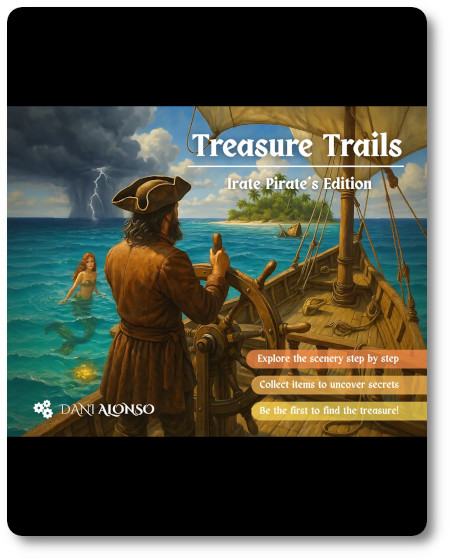
Treasure Trails, designed by Dani Alonso and published by The Game Crafter, is comprised of 66 cards, two pawns, and two small ships. The cards are as thick and as durable as your standard playing card. The pawns are plastic. Illustrations on the cards – as the game title suggests – depict pirates doing piraty things, as well as detailed locations on the high seas and forested jungle. The rule book is not included in the game and must be downloaded from The Game Crafter website, which is free.
Getting Ready to Treasure Hunt
To set up the game, complete the following steps.
First, take the 48 Scenery cards and separate them into “land/coast” and “ocean” piles. Then build the scenery by first constructing the land and shoreline, followed by the open ocean. The rulebook provides a visual example to assist. Once the scenery is completed, place the pawns at their starting position, giving each player their same-colored ship.
Second, find and place, face-up, the ten Resource cards by the scenery. This area of cards is called the “Resource Area.”
Third, find the eight Action cards. Separate them by the color seen on the ship’s flag. Once separated, shuffle each deck separately and give one deck to each player, matching the color on the ship flag to the player’s pawn’s color. From these four cards, each player must now, at random, discard one, placing it back in the game box and not showing it to themselves or their opponent. Once both players have only three Action cards, they can look at their available cards.
This completes the game setup. Determine who will go first and start the treasure hunt!
On Dry Land and High Seas
Treasure Trails is played in turns with no set number of turns per game. A player’s turn is comprised of three actions, which are summarized here. Actions must be taken in sequential order, but not all the actions are mandatory.
First Action: Exploration (Optional)
When players first start the game, they use the pawn found on the land. Later, once they reach the shoreline and acquire a boat, they can use the ship to navigate the waters.
The movement action allows the player to flip over and reveal any one Scenery card that is adjacent or diagonal to the Scenery card the pawn or ship is currently on. However, when using the pawn, only land can be flipped over. Similarly, when on the ship, only the ocean can be flipped over. This action reveals details about the Scenery card and is now available to explore.
Second Action: Movement (Required)
If the player completed the Explore action, they must now move their pawn or ship into the newly revealed Scenery card. However, if the player decided not to explore, they must now move their pawn or ship to any revealed adjacent Scenery card not occupied by the opponent’s pawn or ship.
Third Action: Resource Collection and Card Resolution
Once the player’s pawn or ship moves into the Scenery card, there are three possibilities depending on what the Scenery card shows.
If the scenery card is empty (only shows scenery), there is nothing for the player to resolve other than possibly remarking how beautiful the view is.
If the Scenery cards show a resource, it can either be taken freely, or the player will have to meet a requirement before they can take it. Free resources do not have any icons in the corner. When the player enters this Scecery card, they may take the Resource card from the Resource Area with the corresponding icon shown under the resource name, but only if it is available (i.e., not claimed by their opponent).
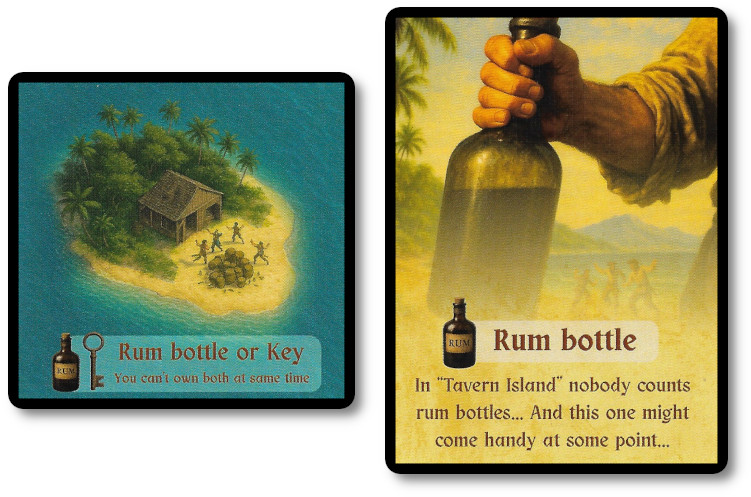
If the Resource card contains one or more icons in the corner, the player must have the Resource cards that provide the indicated resource. If they do, they put these Resource cards back into the Resource Area, essentially “paying” for the new Resource card. If they do not, they cannot take the corresponding Resource card.
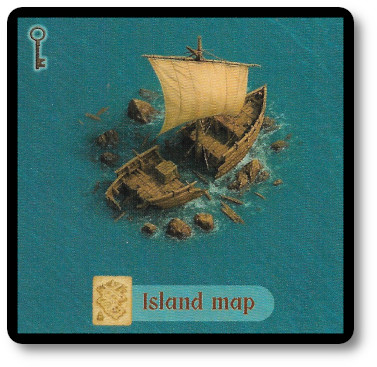
A few additional rules of note for the Resource cards.
- A player is never forced to take a Resource card.
- A player may only ever have two Resource cards at any time
- Players can exchange Resource cards for new ones by putting a Resource card already in their possession back into the Resource Area before collecting the new Resource card.
- If players lose Resource cards, they are returned to the Resource Area. Resource cards are never discarded.
Of special note is the Resource card with the ship icon. The Scenery card is resolved as noted above, but instead of taking a Resource card, the player exchanges their pawn for their ship, allowing them to now move to the water. It is worth noting that once the player is on the water, they can never return to land.
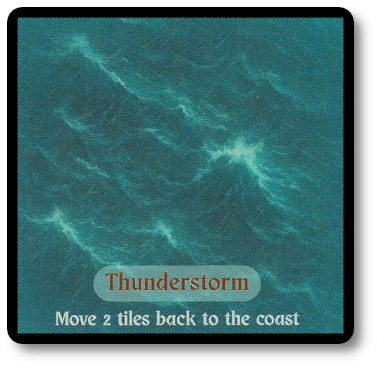
If the Scenery card contains written instructions, the player reads them outloud and resolves the described action.
This completes the player’s turn. The next player now takes their turn, starting with the first, and an optional action.
Using Action Cards
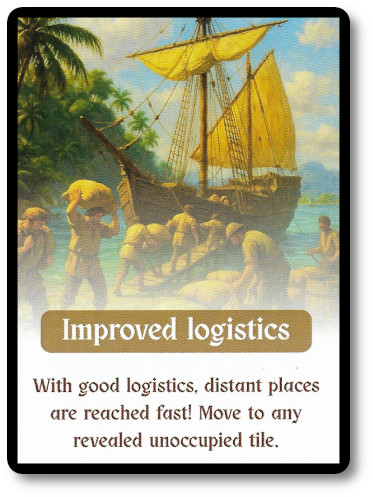
The three Action cards available to the player can assist them in their treasure hunt, but at the cost of losing them for the duration of the game. Action cards are powerful, allowing for speedy travel, peeking at cards, and turning the tables on your opponent. If the player wants to use them, they must announce which of the Action cards they are using, read it outloud, set it aside for the duration of their turn, and then take their three actions. Once the player’s turn is over, the used Action card is returned to the game box for the duration of the game.
Finding the Treasure
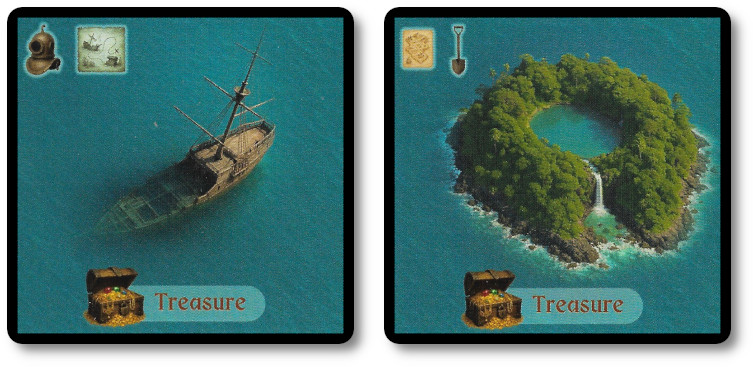
The game continues as described above until one player collects one of the two treasures found on a Scenery card, fulfilling the Resource card requirement. This player wins the game.
To learn more about Treasure Trails – Irate Pirate’s Edition, visit the game’s webpage.
Final Word
 The Child Geeks really enjoyed themselves, finding it fun and exciting to explore the land and surrounding ocean waters to discover new resource nodes and the treasure. Due to the way the game is set up, the treasures can be found relatively early or later. Really, it doesn’t matter, however, as the needed Resources must also be available to the players. This kept the Child Geeks on track and excited to explore each Scenery card, ensuring they saw it all. According to one Child Geek, “I really liked this game. I didn’t like that I couldn’t go back on land once I got on my ship, but you don’t really need to go back, either.” Another Child Geek reported, “A lot of fun! I really felt like a pirate captain with my crew looking for the lost treasure!” When all the Child Geeks had returned to port, they took a vote and agreed that Treasure Trails was worth its weight in gold.
 The Parent Geeks found the game to be entertaining, light, and engaging, but not in the least bit difficult. According to one Parent Geek, “You don’t need much in the way of gaming experience to play this game, as your choices are minimal and nothing ever feels terribly complicated. You still need to think through your turn, though, and the subtle resource management needed makes for some interesting last-minute choices to zoom across the ocean to capture a resource you suddenly need.” Another Parent Geek said, “I liked the game with my kids and with my partner. It was light and casual and really perfect for a quick game before we started another one. My only complaint is that I couldn’t attack and pillage my opponent’s ship for their Resources, but then again, they couldn’t attack me either.” When all the sails were secure and the anchor dropped, the Parent Geeks took a vote, and all agreed that Treasure Trails was a fun and casual game they’d play again.
 The Gamer Geeks were not impressed. According to one Gamer Geek, “The only thing to do here is to flip over a card and hope you want it, or go to another card you already know about that might be halfway across the table. The game took too long, the resource collecting wasn’t entertaining and felt like a chore, and I really didn’t like that I couldn’t blow my opponent’s ship out of the water. What kind of pirates are we if we don’t shoot things?” Another Gamer Geek said, “A good game for younger and less experienced players, as it introduces troubleshooting, resource management, and exploration, but for a seasoned vet like me, this game does nothing. I would have enjoyed the game when I was ten. At 48, there is nothing for me here.” When the treasure chest was finally found, the Gamer Geek eagerly looked inside but found nothing to get excited about.
 This game is gorgeous to look at and fast to play. A great deal of the game’s fun comes from flipping over the Scenery cards to discover what lies beneath. Only a few times did the treasure reveal itself early, but even then, it just caused the two players to double down on their exploration in hopes of finding the needed resources first. In all respects, this game is about outsailing and outexploring your opponent, giving the player an actual task and limited time to complete it. While none of our players reported it as stressful, it was clear they were constantly engaged and eager for their turn.
While I enjoyed this game, finding its approach simple to follow and highly replayable, I will not endorse it because it does not include the rules. Yes, they are freely available and online, but you don’t get the entire game when you get the game. If you want to print them off and add them to your game box (thus making the game complete), you are out of luck, as the rules are too large to fit in the box. I understand the need to keep costs down, but if I am to buy a game, I expect it to be complete, including all components and the rules. It’s like ordering a burger and not getting the bun or a bowl of Mac and Cheese, but not getting any cheese.
If, however, you are very much not like me and don’t see much need to get emotional about missing rulebooks, I highly encourage you to go ahead and try this game! Our groups really enjoyed themselves (except the Gamer Geeks, of course), and each game felt different. So, set sail and go forth to explore this pirate treasure hunting game. Just don’t expect to find any instructions on how to actually do that in the game box.
This game was given to Father Geek as a review copy. Father Geek was not paid, bribed, wined, dined, or threatened in vain hopes of influencing this review. Such is the statuesque and legendary integrity of Father Geek.