 The Basics:
- For ages 8 and up
- For 2 to 6 players
- Approximately 10 minutes to complete
Geek Skills:
- Active Listening & Communication
- Counting & Math
- Logical & Critical Decision Making
- Reading
- Strategy & Tactics
- Risk vs. Reward
- Cooperative Play
- Hand/Resource Management
- Self-confidence
- Imagination
- Bluffing & Misdirection
Learning Curve:
- Child – Easy
- Adult – Easy
Theme & Narrative:
- Work together to get the pizza you want (but sadly have to share)
Endorsements:
- Child Geek approved!
- Parent Geek approved!
- Gamer Geek approved!
Overview
It’s game night with your friends! You have the games picked out, the various drinks purchased, and the family kitchen table setup for five straight hours of board game goodness! But before you can set up the first game, you need to order the pizzas. The problem is that you and your friends are on a fixed budget. You can only get one very large pizza with a few select toppings. When you speak to your friends about what pizza to buy, it’s clear that they all have their own secret agenda on what to put on it. I guess ordering food will be your first game of the day.
Pizza Roles, designed by Thomas Mathews and published by Pet Roc Games, is comprised of 59 cards. The cards are as thick and as durable as your standard playing card. Illustrations are cartoonish and colorful.
Prepping Your Order
Note: Pizza Roles has two game modes, Versus and Cooperative. In this review, we’ll discuss the Versus mode in greater detail. We’ll summarize the Cooperative mode.
To set up the game in Versus mode, complete the following steps.
First, find and place the “On the Pizza” card in the middle of the playing area. At the same time, find the “Not On the Pizza” card and set it aside. Then place the eight “Toppings” cards on the “Not On the Pizza” card. A picture is included in the rules to illustrate this part of the game setup. All you really need, however, is a very clear understanding of what is and isn’t on the pizza.
Second, shuffle the “Conversation” cards and deal five to each player. Then shuffle the “Secret Role/Reminder” cards and deal one to each player, as well. Any of these two types of cards not used should be returned to the game box. Players should look at the cards they were dealt, but keep them hidden until played.
That’s it for game setup. Determine who will be the first player by either flipping the “Decision Dough” card provided in the game or by any other means you prefer.
Protecting Your Pizza Turf
Pizza Role is played in turns with no set number of turns per game. On a player’s turn, they have two possible actions, which are summarized here.
Action Option One: Play a Conversation Card
There are two types of Conversation cards. These allow the player to move the Topping cards from “On the Pizza” to “Not On the Pizza”.
From their hand of Conversation cards, the player can select one, play it by reading its description, and resolve it according to the card’s rules. Opponents cannot block these actions, but they are welcome to look on approvingly or scornfully, keeping in mind that it’s in everyone’s interest to keep their private objective (as described on their “Secret Role/Reminder” card) hidden at all times.
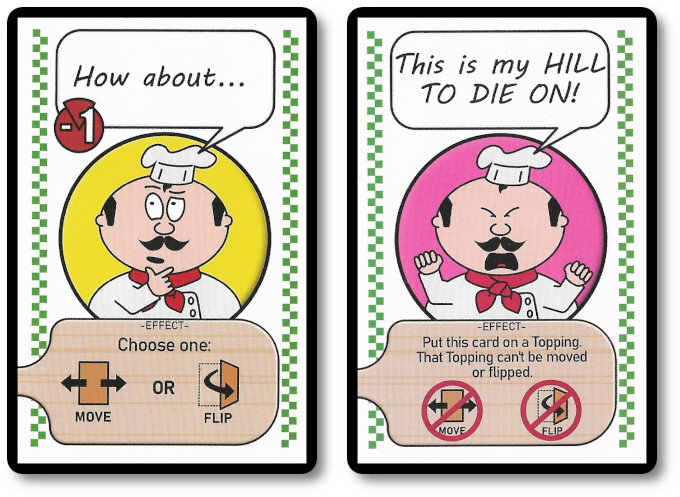
Conversation cards will allow players to do the following, depending on the card played:
- Move one Topping card between the “On the Pizza” and “Not On the Pizza” cards
- Flip a Topping card over (increasing or reducing the topping quantity)
- Force an opponent to take an action out of turn
- “Lock” a Topping card so it can no longer be moved or flipped
Players might have been dealt a Conversation card that cannot be played. These provide additional bonuses at the end of the game.
Action Option Two: Pass
If the player doesn’t want to take an action (or can’t because they don’t have a Conversation card), they announce to the table that they “pass.”
The player’s turn is now over, and the next player in the turn order sequence now takes their turn.
Placing the Order and Ending the Game
The game continues with each player taking a turn until the “majority” of players all pass in a row. For example, in a four-player game, three players in a row would need to pass for the endgame to be triggered.
All players now reveal their Secret Role. Each “Secret Role/Reminder” card shows the player (and later their opponents) what they wanted on their pizza. The back of the card (the “Reminder” side) includes a table showing the distribution of liked and disliked toppings to assist players during the game. What all players want to focus on is the reverse side of that card, which clearly shows the likes and dislikes of the player’s Secret Role.
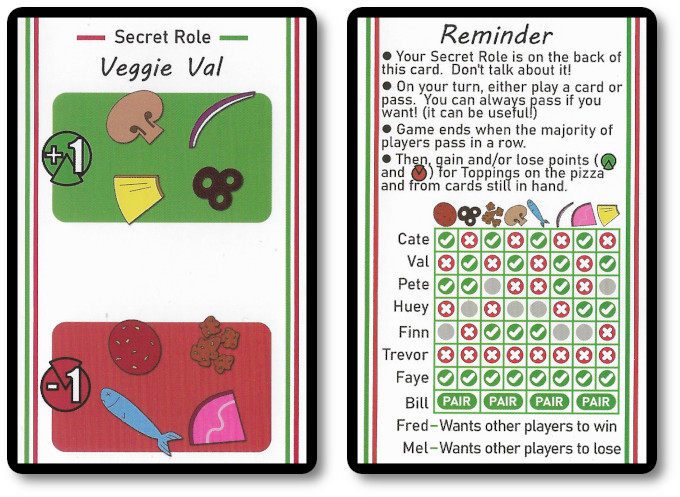
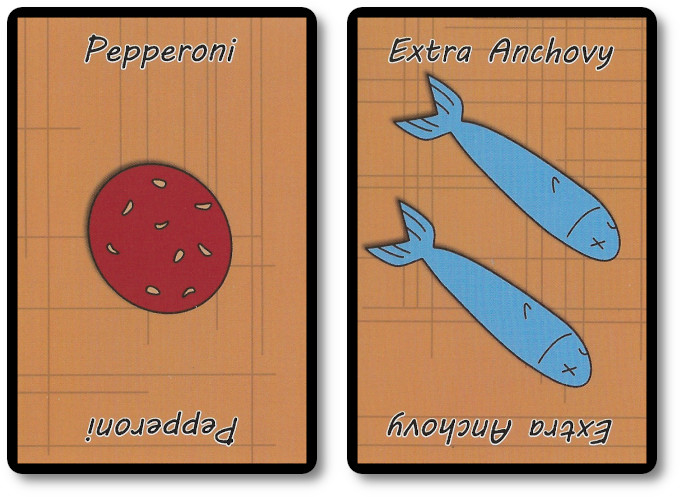
Compare the toppings that are “On the Pizza” and “Not On the Pizza”. Each player will score points based on their objective. In addition, Conversation cards still in the player’s hand will reduce or increase the player’s points. Topping cards that are flipped to their “Extra” side will score double points.
After everyone counts their points, the player with the most points wins and has a pizza they will truly enjoy.
If playing multiple games, the player with the most points gets the Mustache card, signifying them as the next game’s first player.
Going Cooperative
If plotting and planning for your favorite pizza isn’t your thing, you can play Pizza Roles as a cooperative game. The rules are largely the same except that all the players win or lose together. Victory will go to all if every player scores at least one point. This is a very different approach to playing a game from a social standpoint. The Versus game mode tasks players with being coy about what they want or don’t want, challenging them to say just enough to manipulate without giving away their preferences. The Cooperative mode takes the same concept and flips it on its head. Players must be as expressive as possible without giving away specifics. It’s a real treat to see players creatively try to clarify what they want or don’t want using only clues.
To learn more about Pizza Roles, visit the game publisher’s website.
Final Word
 The Child Geeks had a great time with Pizza Roles. Conceptually, even our youngest Child Geeks understood the importance of keeping their pizza wants and not-wants hidden. This is an important point, as many games require players to keep their identities hidden, which affects gameplay. For example, Are You a Werewolf? where a player’s role not only shapes their victory conditions but also their interactions with other players. Pizza Roles removes that level of complexity without diluting the meta game in all hidden-roles games, which is basically manipulation. The Conversation cards are key as they direct, but do not order. The end result was a fast game that all the Child Geeks enjoyed. According to one Child Geek, “The game made me laugh and hungry at the same time.” Another Child Geek reported, “I liked the game a lot because it was about my favorite food and I had to be sneaky about what I wanted.” When the pizzas arrived, the Child Geeks all took a bite and agreed that the game was, indeed, tasty.
 The Parent Geeks also enjoyed the game, finding it fast, fun, and very engaging from start to finish. As one Parent Geek put it, “I am a fan of hidden role games, and I think the game’s title is a delicious pun. I am also a huge fan of how little time it took. I think we played three games in less than 30 minutes. That’s fast, but each game was a great time.” Another Parent Geek said, “We enjoyed it. We played it with my family and with other adults. At no time were the kids left behind or the adults bored. Lots of requests for pizza after we played, too.” When all the plates were cleared and cleaned, the Parent Geeks took a vote, and all agreed that they were ready for seconds.
 The Gamer Geeks approached this game differently, aiming to test its limits and depth. Being very familiar with hidden role games, they immediately jumped in, did their best to dominate the pizza, and left each game feeling satisfied. As one Gamer Geek put it, “This is a fast game and can be rather intense if you are playing with others who want nothing more than that suculent taste of victory. The game’s depth was not hindered by its speed. In fact, I think the game is better off for it. The fast game play only makes each decision all the more important.” Another Gamer Geek said, “I think the game is super silly and light, but it was also perfect for our game night opener and the closer. So good, in fact, that we’ll be looking to do it again at our next gaming gathering.” When all the pizza boxes were put away, the Gamer Geeks took a vote, and all agreed that the game was very much worth their time.
 Each game of Pizza Roles was different than the last. Yes, you are always trying to get your pizza your way, but the randomly dealt Conversation cards presented new limitations and advantages. During my first game, I was very frustrated that I couldn’t get the pizza perfect. After the second game, I realized that the intent to get the perfect pizza shouldn’t be taken so seriously. It’s really all about making the pizza good enough to put you in a position to win. If you take this tactic, the game really opens up, and conversation without the use of cards is a stronger play. Several times, I observed players making deals with each other openly, without saying anything. Fascinating stuff. And it all worked.
Do try this small game. It’s silly, it’s fast, and it won all of us over. Every player enjoyed it and wanted more when the game was over. You couldn’t ask for a stronger compliment as a game designer than hearing those at the table asking for “seconds” when they just finished their first game. Seconds were had, along with thirds and fourths. Slap this gem on your table to see if it satisfies your gamer group’s hunger.
This game was given to Father Geek as a review copy. Father Geek was not paid, bribed, wined, dined, or threatened in vain hopes of influencing this review. Such is the statuesque and legendary integrity of Father Geek.