
 The Basics:
- For ages 14 and up
- For 2 to 6 players
- Variable game play length
Geek Skills:
- Active Listening & Communication
- Counting & Math
- Logical & Critical Decision Making
- Reading
Learning Curve:
- Child – Easy
- Adult – Easy
Theme & Narrative:
- Explore a spooky mansion and escape with your soul by solving puzzles
Endorsements:
- Child Geek rejected!
- Parent Geek mixed!
- Gamer Geek rejected!
Overview
The world was introduced to the puzzle adventure game, The 7th Guest, in 1993. Those who played it were excited to find the gameplay included an interactive movie and puzzles, all heavily laced with a feeling of unease, mystery, and the supernatural. The puzzles were always heavily themed, and the eerie atmosphere of the manor explored by the player always left a feeling that they should play the game with all the lights on. This is not that game, far from it. The mouse and keyboard are replaced by dice and cards. The puzzles remain, but none of the fun.
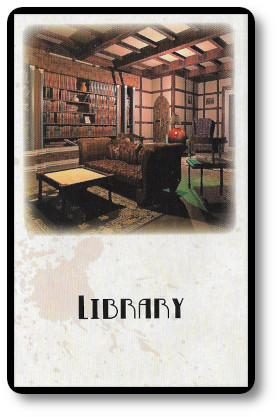
The 7th Guest: The Board Game, designed by Rob Landeros and published by Trilobyte Games, is comprised of one game board, 108 Destination cards, 300 Puzzler cards, 36 Mystery cards, one custom six-sided die (referred to as the “Magic Die”), one Magic Decoder, and seven character minatures. The component quality is excellent. The only item that is somewhat flimsy is the Magic Decoder. Other than the back of the cards and the mansion layout on the gameboard, there is no real artwork to speak of. What dominates most of the cards are image captures from the video game.
Arriving At the Mansion
To set up the game, follow these steps.
First, place the game board in the middle of the playing area and within easy reach of all the players. The gameboard displays the layout and various rooms in the haunted mansion for players to explore.
Second, shuffle the Destination, Puzzler, and Mystery cards in their separate decks, setting them aside and within easy reach. Deal to each player a set number of Destination cards, face down. The number used is based on a predetermined number agreed to by the players. The number of Destination cards dealt to each player determines the length of the game. For example, the lowest number of Destination cards suggested (referred to as the “Nickel Tour”) gives each player five Destination cards. In comparison, the long game (the “Grand Tour”) provides each player with 18 Destination cards. When dealing the Destination cards, ensure they are kept face down.
Third, let each player select one character miniature of their choice. Each player now flips over their top-most Destination cards. This indicates the player’s first destination in the mansion they will visit.
This completes the game setup. Have each player roll the Magic Die. The player with the highest number goes first.
Exploring the Mansion
A player’s turn is comprised of several steps, which are summarized here.
Step One: Roll the Magic Die or Don’t
The first thing the player does on their turn is roll the Magic Die. The resulting rolled value determines the number of “steps” the player can take to explore the mansion. Steps are counted as small squares.
If, however, the player moved to their Destination on a previous turn and still has not successfully answered a Puzzler, they skip this step.
Step Two: Move Your Character or Don’t
The player now moves their character through the mansion, following the available paths if they rolled the die. A player may never double back on a path once they start their turn, and they cannot enter into a room until it is listed on their current Destination card.
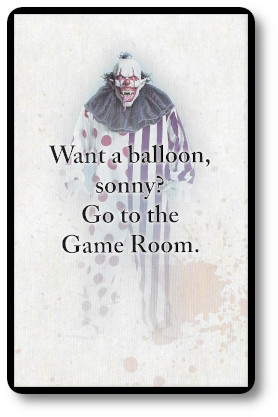
If the player ends their turn on a “Mystery Spell” space, they draw a Mystery Spell card and resolve it.
Again, if the player moved to their Destination on a previous turn and still has not successfully answered a Puzzler, they skip this step.
Step Three: Solve Puzzle or Don’t
If the player ends their turn in the room noted by their Destination card or is still in the same room as their current Destination card, they must now attempt to solve a puzzle. The previous player draws a Puzzler card at random, reads it aloud, and shares it with all the other players. The answer to the Puzzler card is on the reverse side and can only be read by using the Magic Decoder.
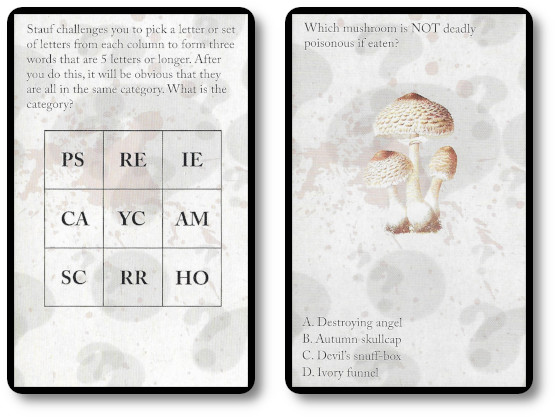
The player now attempts to answer the Puzzler, which may be a puzzle or a trivia question. Some Puzzlers have clues that the player can take; however, if they do so, the rolled Magic Die values will be reduced by the number of hints taken. For example, if the player takes three hints, their Magic Die roll will be reduced by three. This reduction lasts until the player visits the next room on their Destination card after having successfully solved the Puzzler for their current Destination card.
If the player answers the Puzzler correctly, they discard their current Destination card and draw a new one.
If the current player is unable to answer the Puzzler correctly, each player in turn order sequence now has a chance. If they successfully answer the Puzzler, they may discard their current Destination card and draw a new one.
The Final Puzzle
The game continues as noted above until a player has successfully visited each of their Destinations. As soon as they discard their final Destination card, they move their character miniature to the “Little Room at the Top.” They must now answer another Puzzler. If the answer is successful, they win the game. If they fail to answer it, they will remain in the little room and attempt to answer a new Puzzler on their turn, but they will not be able to leave the little room for the duration of the game.
The game ends when a player who is currently located in the “Little Room at the Top” successfully answers a Puzzler. This player is the winner.
Game Variants
The players can include rules in the game that allow them to introduce a ghost, a role taken on by one of the players temporarily. Players become ghosts in two different ways. Either they draw a Mystery Spell card that “tags” them as the ghost, or an opponent who is currently the ghost enters a space (not a room) occupied by another opponent. There is no advantage to being the ghost, and introducing this game variant increases the game’s length, but it also adds an element of the traditional game of Tag to the gameplay.
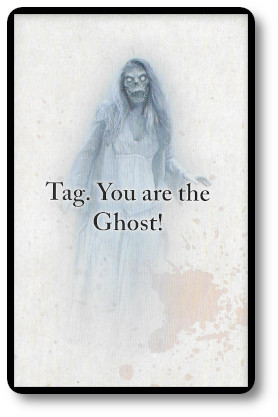
In addition to playing with the ghost, players are also welcome to create teams. This allows more than one player to assist in solving the puzzle, introducing a cooperative experience that easily accommodates larger groups.
To learn more about The 7th Guest: The Board Game, visit the publisher’s website.
Final Word
 The Child Geeks did not enjoy this game. The puzzles to be solved were all either too tricky or too ambiguous to understand. Even when played in teams, the game’s length and enjoyment level suffered due to The 7th Guest’s focus on trivia and logic puzzles, which are not intended for younger audiences. This was undoubtedly supported by the recommended minimum age (14 years old) and by the commentary from our Child Geeks. One Child Geek said, “I thought the game would be scary, but it wasn’t. It was just confusing. I didn’t know the answers to the questions, and neither did my friends.” Another Child Geek said, “I didn’t like the game. It made me feel dumb, and it was frustrating not seeing anyone get close to the end.” The game was so long – even on “easy mode” – that the Child Geeks elected to have the first player to solve a puzzle win the game. When the final vote was taken, the Child Geeks all agreed The 7th Guest was not welcome at their gaming table again.
 The Parent Geeks had a completely different take and experience with the game, finding it to be an entertaining trivia and puzzle game that they enjoyed in teams rather than as individuals. The puzzles, as well as the trivia, were found to be somewhere between “easy” and “just plain confusing.” According to one Parent Geek, “The game reminded me a little of Trivia Pursuit, where you roll the dice, move your piece, and answer questions. Instead of collecting pie pieces, you are collecting rooms. It was an interesting take on a trivia game.” Another Parent Geek said, “I was a big fan of the computer game when it came out, and I was sad to see that nothing about the computer game is present on the board game. If you set that aside, you have an entertaining party game.” When the last vote was counted, the Parent Geeks couldn’t agree if the game was worth their time or should have remained in the shadows.
 The Gamer Geeks were not pleased with the game at all. They found the gameplay to be boring, the puzzles to be too obtuse, and the game’s speed to be absolutely abysmal. Even their short games lasted much longer than any of them wanted. The result was a lot of laughing at how bad the game was, along with many great conversations reminiscing about how great the computer game, on which the board game is extremely loosely based, was to all who had the chance to play it. One Gamer Geek said, “This is a horrible game. I like the puzzles, but the gameplay is just horrible.” Another Gamer Geek said, “This game is laughably bad. I had high hopes with its title, but the only good thing about this game is its box cover art.” Clearly not a game for gaming elitists.
 The 7th Guest computer game will always have a special place in my heart. Right next to it is Myst, another computer game. What they both have in common is an approach to immerse the player in a rich, atmospheric puzzle-solving experience. I believe that, to this day, both games did well. While I never found The 7th Guest particularly scary, I always found the navigation around the home, the weird little things that popped up, and the mysterious atmosphere to be very engaging, making the puzzle-solving a rich and rewarding experience.
None of that is found here. This is a trivia and puzzle board game that lacks originality and engagement. All of the players we played with – at most – lightly engaged with the game, finding it to be little more than a roll-and-move game that eventually allowed you to reach the room you wanted to. And once there, you ultimately were dealt a Puzzler card that was either easy to answer, or you had enough hints to make it easier to answer. And that’s it. Very little in the way of motivation to do anything on your turn, as the game’s pacing is so slow, every turn felt like a chore rather than fun.
Oh, boy. What a game. Not for me and not for many folks. I enjoyed some of the puzzles and thoroughly appreciated the reminiscing I shared with fellow players about the video game, but that’s about it. The 7th Guest: The Board Game was just dull. No frights and no fun. I suggest you refrain from inviting this guest to join you at your family gaming table.
This game was given to Father Geek as a review copy. Father Geek was not paid, bribed, wined, dined, or threatened in vain hopes of influencing this review. Such is the statuesque and legendary integrity of Father Geek.