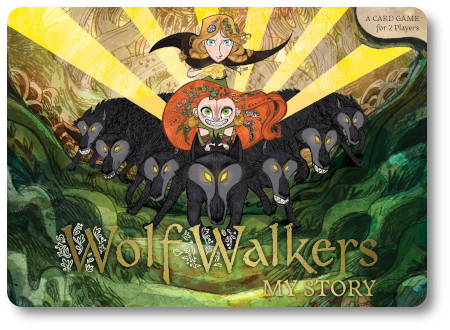
 The Basics:
- For ages 8 and up
- For 2 players
- Approximately 30 minutes to complete
Geek Skills:
- Active Listening & Communication
- Counting & Math
- Logical & Critical Decision Making
- Reading
- Pattern/Color Matching
- Strategy & Tactics
- Risk vs. Reward
- Visuospatial Skills
- Hand/Resource Management
Learning Curve:
- Child – Easy
- Adult – Easy
Theme & Narrative:
- Complete a puzzle in reverse as you build your tableau, one card at a time
Endorsements:
- Child Geek approved!
- Parent Geek approved!
- Gamer Geek approved!
Overview
In the movie Wolfwalkers, the story focuses on finding oneself and exploring cultural beliefs and misconceptions. In this game, you won’t be challenged to do any deep, introspective thinking of your own motivations, but you will need to be focused fully on the larger picture of what you are trying to accomplish. One card at a time. It creates an interesting puzzle in reverse as you build your tableau and work toward a possible victory.
Wolfwalkers: My Story, designed by Maja Milavec and published by Cartoon Saloon, is comprised of 110 cards. The cards are as thick and as durable as your standard playing card. Illustrations are lifted directly from the movie on which the game is based. Which is to say, they are exceptionally well done and bring a great deal to the table – so to speak – when it comes to reinforcing the game’s theme and narrative. Not included with the game, but very handy to have, is a pen or pencil and something to write on to record players’ scores at the end of the game.
Finding Your Pack
Note: There are two different ways to play Wolfwalkers. We will describe the basic game in this review and summarize the Advanced game at the end.
To set up the game, complete the following steps:
First, find and set aside the Story/Objective cards and – optionally – the Reference cards if you’d find them useful. Leave all remaining cards in the game box.
Second, ensure that all the Story/Objective cards have the “Story” side face-up and the icons are on the lower-left corner when looking at the card. Orientation matters as it helps the gameplay. Shuffle this deck and place it within easy reach of all the players.
Third, draw six cards from the Story/Objective deck and place them in the middle of both players. Four of the cards will remain with the “Story” side face-up. Two of the cards will be flipped to show the “Objective” side. These cards are now in an area called “the Market.”
That’s it for game setup. Determine who will be the first player and begin.
Running With the Wolves
Wolfwalkers: My Story is played in turns, with each player getting exactly 25 turns per game. A player’s turn is summarized here.
Step One: Take a Card from the Market
As noted, there are two different types of cards in the Market. The card type is determined by its facing side. Cards never change their sides when dealt to the Market. That is to say, a card dealt to the Market with the Objective side face-up remains an “Objective” for the duration of the game.
The “story” side of the card depicts a scene from the movie. While visually interesting to inspect, the scene has no impact on gameplay. Each “story” side will show one or more icons that will be used at the end of the game to determine the player’s score.
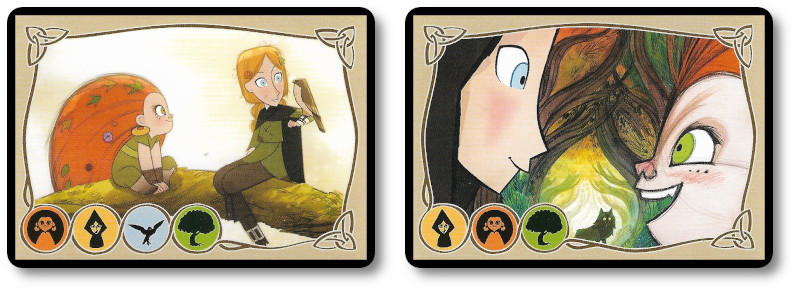
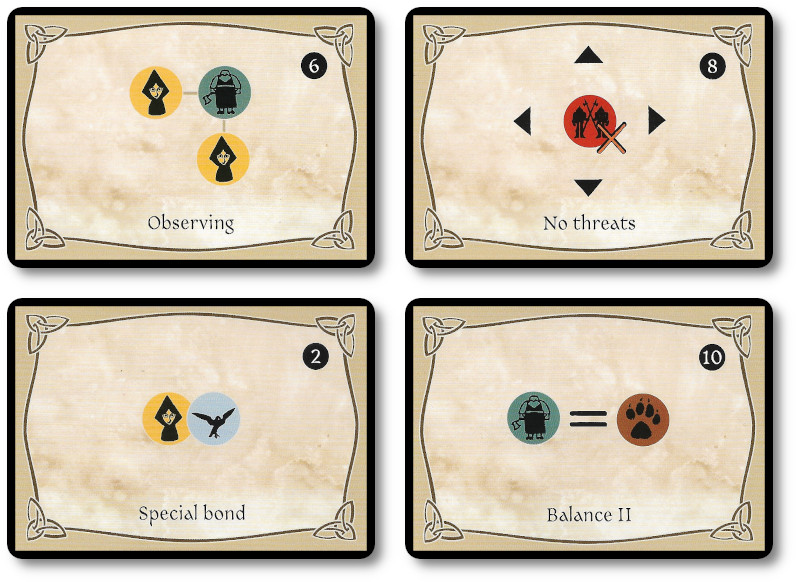
The “objective” side of the card displays one of four goals for the player to achieve. Achievements are based on the icons shown on the “story” side of the cards.
- Shapes: The player scores points if they can create the objective shape
- Arrows: The player scores points for every matching icon adjacent to the objective per the arrow’s pointing direction
- Doubles: The player scores points for the same icons in their grid
- Balance: The player scores points if they are able to successfully match the objective equation
Step Two: Place a Card
The player now places their selected card, without changing its facing, to their “grid.” The player’s grid is the area directly in front of them. The player is welcome to place their card wherever they like, but they must maintain at all times – and will have at the end of the game – an area that will contain no more and no fewer than 25 cards comprised of a 5 x 5 grid. For the first card, the player may place it wherever they like to start their grid. Their second and all subsequent cards must be placed in their grid by placing the new card adjacent to a previously placed card. Diagonal placement is not legal.
As the player continues to play cards to their grid, they’ll start to create their own 5×5 placement area. Once cards are placed, they cannot be moved.
Step Three: Refill the Market
The player takes a card from the Story/Objective deck and replaces the card they took. The card’s face should match the card taken. For example, if the player took a card from the Market with the “story” side, the new card will also show the “story” side. In this way, there will always be four stories and two objectives for the player to choose from.
Step Four: Announce End of Turn
Once placed, the current player’s turn is over. The other player now takes their turn.
Ending the Game and Scoring
The game continues as noted above until both players have completed their 5×5 grid, which will consist of stories and objectives.
Each player now evaluates and resolves the objectives in their grid, one card at a time. Each objective can only be scored once. Keep track of each objective’s total points and then add all of the objectives together to determine the player’s final score. The player with the highest score wins the game.
Going Advanced
If you are looking for a more complicated game, the Advanced play is for you. Advanced gameplay is similar to the basic game, but includes Permanent cards and Opportunity cards. Permanent cards change the game rules for the players, introducing new obstacles and challenges. Opportunity cards give each player a special action they can take during the game, but only once, allowing players to explore different approaches to creating a grid that provides the most points.
To learn more about Wolfwalkers: My Story, visit the game’s webpage.
Final Word
 The Child Geeks really enjoyed the game, finding the “story” side of the cards engaging and the “objective” side meaningful. One Child Geek said, “The cards are a lot of fun to look at and easy to understand. My biggest disappointment with the game is that I don’t know enough about the story!” Another Child Geek said, “I liked it! I played it with my mom and my dad. I lost to my dad, but I still had a lot of fun!” The biggest takeaway from observing the Child Geeks was how quickly they were able to score their own tableau (the grid) using the objectives. I thought for certain this would slow the game down, but the Child Geeks surprised me once again with how quickly they understood the game’s concepts and gameplay. When the last game was played, the Child Geeks took a vote, and all howled with great delight.
 The Parent Geeks also enjoyed the game, finding it an intriguing puzzle. Placing each card took up space, and each space was a potential point to be earned or lost. This kept all the Parent Geeks glued to their chairs and leaning forward from the first play to the last. As one Parent Geek put it, “This was a really interesting game. I felt like I was building a puzzle backwards and enjoyed every second of it.” Another Parent Geek said, “Both game play and scoring were easy to understand and fun. I particularly liked how the abstract nature of the game was visually interesting at all times.” When the Parent Geeks were done, they took a vote, and the results were clear: Wolfwalkers: My Story was a game they would gladly play again.
 The Gamer Geeks were mixed about Wolfwalkers: My Story, with roughly half of our elitists finding the game to be exceptionally interesting with its spatial puzzle and multiple ways to score points. The other half, not so much; most negative comments focused on the game’s lack of energy and excitement. According to one of the Gamer Geeks who enjoyed the game, “A very interesting game that was a real treat to engage with. I found it to be surprisingly deep and enjoyed the spatial puzzle element a great deal. A real winner in my book.” Another Gamer Geek, who was not all that into the game, said, “It’s fine, but not anything that kept my interest. I get what is being attempted, but it falls flat. I take a card, place it, and try to score it eventually. I think what I disliked least was not being able to take a card for later. I felt a bit pushed in the corner as a result.” All of this changed when we introduced Advanced gameplay. Every Gamer Geek who was on the fence or wasn’t much interested changed their minds in favor of Wolfwalkers: My Story. To put it bluntly, one Gamer Geek said, “Yes. Now the game is fixed.” When the votes were cast and counted, the Gamer Geeks were mixed about their love for the game at first, but all smiled with delight when the game lived up to their advanced expectations.
 You absolutely do not need to have watched the movie, or even know that this game is based on one, to enjoy it. The illustrations beg for further explanation (since the scenes are very interesting), but the movie’s characters and their adventure have no impact on the choices the players will make during the game. That said, if you play this game with your Child Geeks, expect to get a lot of requests to see the movie.
I enjoyed this game, finding it to be much more involved and “thinky” than I originally anticipated. In truth, I didn’t think the game would be much more than “pick a card, place a card,” leaving me with a bit of underwhelming anticipation to get it to the table. Boy, was I wrong. Easy setup and fast gameplay made this a real winner for the majority of us. Of particular delight was the Child Geeks’ involvement and happiness. Good thing, too, as I’ve had them play a number of games lately that have really tested their tolerance, both for me and for the games I’ve asked them to play.
But I digress…
Do try Wolfwalkers: My Story the first chance you get. You’ll need some table space, but that’s about it. Everything else, including the fun and engagement, is provided to you in abundance in a tiny little box. And see the movie. It’s fantastic.
This game was given to Father Geek as a review copy. Father Geek was not paid, bribed, wined, dined, or threatened in vain hopes of influencing this review. Such is the statuesque and legendary integrity of Father Geek.