 The Basics:
- For ages 8 and up (publisher suggests 13+)
- For 8 to 20 people
- Variable Game Play Length
Geek Skills:
- Active Listening & Communication
- Logical & Critical Decision Making
- Emotional Coping Skills
- Memorization
- Strategy & Tactics
- Cooperative & Team Play
- Self-confidence
- Bluffing and Misdirection
Learning Curve:
- Child – Moderate
- Adult – Easy
Theme & Narrative:
- Lie and manipulate to survive or root out the bad guys
Endorsements:
- Child Geek approved!
- Parent Geek approved!
- Gamer Geek mixed!
Overview
The Citizens have had enough. Enough of the violence. Enough of the fear. Enough of the Mafia. The Mafia, as you might have guessed, doesn’t much care for the ordinary Citizens suddenly standing up for themselves. But crime out in the open is easy to catch. The Mafia Bosses have decided that this little uprising needs to be put down, but quickly. Each night, an outspoken “troublemaker” needs to be put into the ground. In the morning, the Citizens will find another dead body, but their resolve only grows stronger. It’s only a matter of time until the Mafia Bosses are brought to justice, but time is limited.
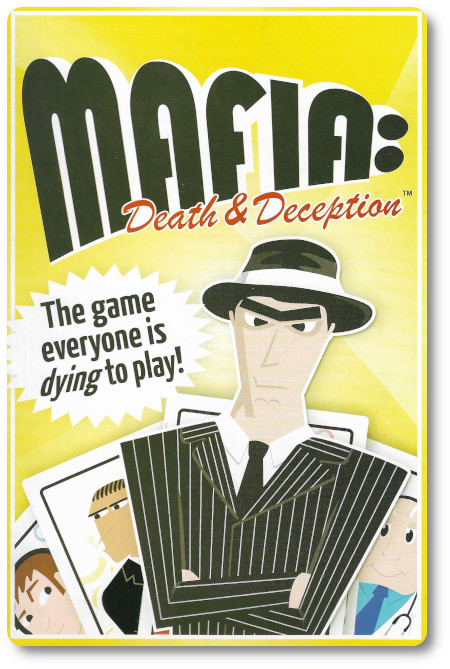
Mafia: Death and Deception, designed by Blake Hasenmiller and published by Bullet Hole Games, is comprised of 26 Profession cards, 26 Trait cards, one Yes card, one No card, a pad of 50 Narrator sheets, and eight Profession Description sheets. Illustrations by Chazse Goddard are colorful and do a moderately good job of depicting the game’s professions and traits, but the art style feels outdated and unprofessional.
The Quiet Before the Dawn
Mafia: Death and Deception offers several play styles. Summarized here is the “basic” game. The Game Variant section of this review summarizes other styles of play. The basic gameplay is recommended for new players and is the best way to teach the game, in real time, to a large group.
To set up the game for basic play, complete the following:
First, select one player to be the “Narrator.” This individual runs the game and moderates player interaction. This individual will not be playing the game, however. It is recommended that the Narrator be familiar with the game and all of its rules.
Second, the Narrator takes Profession cards and sets aside the needed number and type based on the number of players. For example, if playing with 11 players, the Narrator would set aside six “Civilian,” three “Mafia,” one “Doctor,” and one “Sheriff” Profession cards. Any Profession cards not used should be returned to the game box.
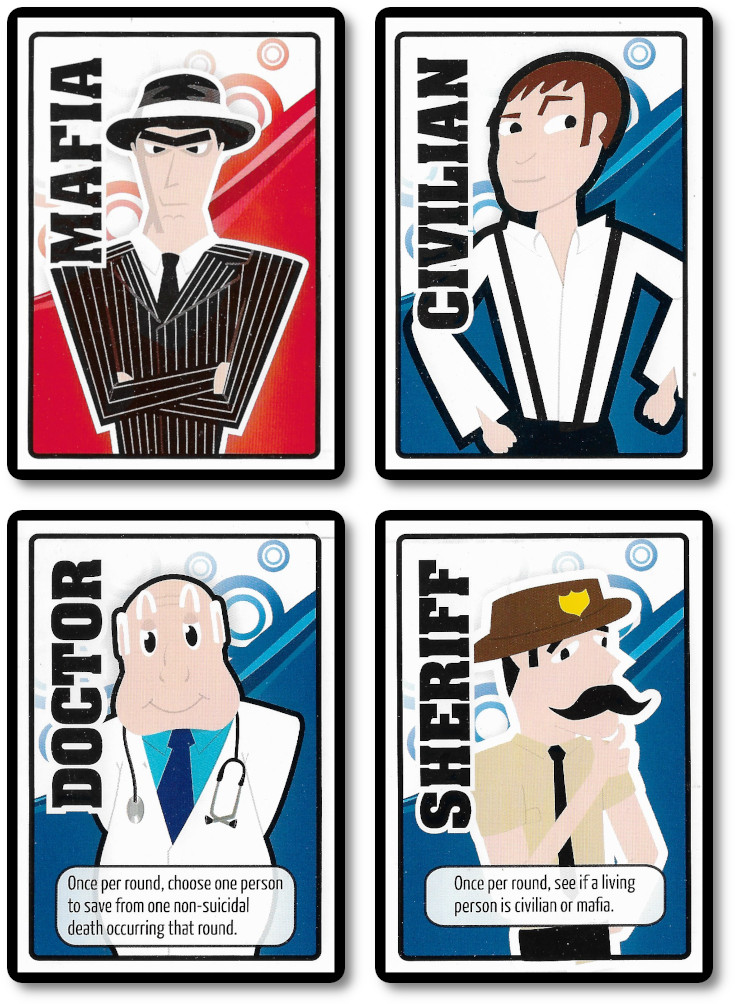
Third, the Narrator shuffles and deals one Profession card to each player. Players should look at their cards but keep them hidden at all times. The card represents the role the player will take during the game and determines how they win. In general, a player will either be a member of the mafia or a civilian. The “Doctor” and “Sheriff” are considered civilians, but have a few extra rules.
Fourth, the Narrator should take a moment to let all the players look at their dealt cards, then explain how each Profession wins the game.
That’s it for game setup. Let’s get down to business!
Murder, Mystery, and Mayhem
Mafia: Death and Deception is played in rounds with no set number of rounds per game. Each round is separated into two phases: a nighttime phase and a daytime phase. A single game round is summarized here.
Phase One: Nighttime
During this phase, the Narrator tells everyone to “close their eyes and go to sleep.”
The Narrator will then tell the Mafia to “wake up.” Only those players with the “Mafia” Profession card now look up, and as quietly as possible, agree to eliminate one player. This is best done by players pointing – as quietly as possible – to different players until all the Mafia players agree.
Once the Mafia players agree, the Narrator instructs them to go back to sleep.
The Narrator will then instruct the “Doctor” and the “Sheriff” to wake up (even if they have been eliminated), one at a time. The “Doctor” player will point to one player (including themselves if they like). This player will be saved from forced elimination during the daytime phase of this round. In contrast, the “Sheriff” player can be told by the Narrator if a player of their choice is a member of the mafia or a civilian by making a “C” or an “M” hand sign as a response. It is essential that the “Sheriff” and the “Doctor” never be awake at the same time.
After the “Doctor” and “Sheriff” have been asked to go back to sleep, all players should now have their eyes closed and heads down. The nighttime phase is now over.
Phase Two: Daytime Phase
This is where the game really takes place during the daytime phase.
The Narrator instructs everyone to wake up, then identifies which player has been eliminated from the game. However, if the “Doctor” pointed to this player, the Narrator will state there was an attempt, but it failed.
Any player eliminated must now leave the game. They can still observe, however, but cannot be part of either phase of the remaining rounds. Nor should they reveal their Profession.
All players currently in the game can discuss who they think is the guilty party in a successful or unsuccessful attempt to eliminate a player. This is primarily a free-for-all, with players pitching their ideas, accusations, and demands. Players are even welcome to lie, telling others that they “know” someone is the doctor or tell others they are the sheriff (when they really aren’t). Remember that the “Sheriff” Player does have insider information, but they should be careful how they use it so as not to draw too much attention from the wrong people.
There is no time limit for this phase, but the Narrator should do all they can to keep it moving so that all the players are ready to vote for whom they believe should be eliminated. Typically, this is done when there are two people who most players believe are members of the mafia.
The two people identified have an opportunity to speak (i.e., plead) to the group one last time to convince them of their innocence. After each player has had one last chance to proclaim their innocence, every player votes for one of the two accused. Players being accused can vote, but not against themselves.
The player who receives the most votes is eliminated from the game.
This marks the end of the daytime phase and the round. The next round now begins.
Surviving Till the End
The game continues until the victory condition has been met.
- The Civilians win if all the Mafia players have been eliminated.
- The Mafia wins if all the Civilians have been eliminated.
Game Variants
There are, of course, additional rules for the game that can be added, all of which fall under the umbrella term “advanced.” This game comes with an additional rulebook dedicated to the various opportunities and ways players can interact. Indeed, the “advanced” rulebook is larger than the standard rulebook. A few advanced rules of note are as follows.
Additional Professions
Included with the deck are additional Professions that give the owning player a special ability that can be used during the game. These go beyond the standard “Sheriff” and “Doctor” Professions. For example, the “Thief” will allow players to steal cards from an opponent, and the “Godfather” can appear to be a “legit businessman” if the “Sheriff” investigates them.
Traits
Traits are additional abilities that are given to the player. They can belong to any Profession and provide each player with even more options during gameplay. For example, the “Assassin” can eliminate one player of their choice per game, and the “Witch” can force players to trade cards for a single round.
Final Word
 The Child Geeks have all had experience with Werewolf and other hidden role and social deduction games. Their skill level and ability to compete are primarily based on their age and emotional intelligence. The younger Child Geeks tend to shy away from games like this as soon as other players start eliminating them or the gaming table shifts into a debate club. For those Child Geeks who did stick around, they had a few observations they wanted to share. According to one Child Geek, “The game is OK and just feels like Werewolf to me, but with mobsters. I’d play it again, but really only because I like these kinds of games.” Another Child Geek said, “Fun and a different way to play Werewolf. I like Werewolf better, though.” When the votes were in, the Child Geeks would all prefer to play the game with villagers and lycanthropes, but didn’t feel particularly negative towards this game either, giving Mafia: Death and Decption their approval.
 The Parent Geeks played Mafia without any issue. They all enjoyed it, and most of them recalled playing this game in their early years at gaming conventions. They all found it fascinating that Mafia was the original game of this type, with Werewolf being the later version. This additional bit of trivia only heightened the Parent Geeks’ appreciation for the game. According to one Parent Geek, “I really enjoyed these types of games, and it was a joy to play the original. I think the game has aged well, and it’s a shame it doesn’t get more love with gamers anymore.” Another Parent Geek reported, “A solid game. As solid as it ever was. I enjoyed it, would play it again, and can’t imagine the game ever getting better or worse.” When the votes were counted, the Parent Geeks all agreed that Mafia: Death and Deception was enjoyable enough to want to play it again.
 The Gamer Geeks played the game, laughed, shared memories, and all concluded the same thing: this game was fun when they were younger and less experienced. According to one Gamer Geek, “It’s the same old game I remember with nothing much in the way of improvement. Werewolf has taken over this space and now rules it with an iron paw. I remember liking this game, but when we played it, it just felt dry. I don’t think it’s the game’s fault. It’s tried and true and – well – old.” Another Gamer Geek said, “I enjoyed playing the game mostly out of nostalgia. It hasn’t changed, but my tastes in games have. I still think this is a solid game, but there have been improvements to these types of games, making Mafia feel inadequate.” When the final vote was counted, it was clear that the Gamer Geeks had mixed thoughts on the game.
 Mafia: Death and Decption, if introduced to the right crowd, is sure to be a big hit. The game, which relies on social deduction and player elimination as its primary mechanics, will leave a player feeling invigorated or infuriated. There really is no middle ground, which is also a significant aspect of the game’s charm. There are few games available today that put the players in such a raw state of emotion or engagement. I’ve played this game and games like it for years. I’ve seen players laugh and cry, shout in anger, and curse with happiness. It is a game that can – and most of the time will – bring out the best and the worst in a gamer.
Do I recommend the game? Uff, that’s a tough one. I feel more comfortable talking about the game in great detail with someone before I suggest they play it. You can figure out pretty quickly, just by talking to an individual, if Mafia and games like it will really please a person or make their face melt. If, however, you are an individual who enjoys a mystery, brisk conversation, emotionally fueled decision-making, and, in general, stress, then Mafia: Death and Deception is for you and your tribe! For everyone else, you can – and really should – give this game a miss.
This game was given to Father Geek as a review copy. Father Geek was not paid, bribed, wined, dined, or threatened in vain hopes of influencing this review. Such is the statuesque and legendary integrity of Father Geek.