
 The Basics:
- For ages 12 and up
- For 2 to 5 players
- Approximately 45 minutes to complete
Geek Skills:
- Active Listening & Communication
- Counting & Math
- Logical & Critical Decision Making
- Reading
- Strategy & Tactics
- Risk vs. Reward
- Hand/Resource Management
Learning Curve:
- Child – Easy
- Adult – Easy
Theme & Narrative:
- Rule your neighborhood with an iron cat paw (and the softest of toe beans)
Endorsements:
- Child Geek approved!
- Parent Geek approved!
- Gamer Geek mixed!
Overview
Cats live extraordinary lives. They roam a world we wouldn’t recognize, full of adventure, drama, and danger around every corner. They also sleep a lot and have zero willpower when it comes to a warm sunbeam. Regardless, the domesticated house cat and the savage lion of the savannah are both majestic creatures, each hunting in their own unique jungle. In this game, you take on the role of a young cat hellbent on dominating the neighborhood. To do so, you enlist a group of eager (and eccentric) cats. You now wage war against a select few, with each property a piece of your future kingdom to claim and rule.
Cat Conquest (complete 2nd edition), designed by Matthew David Mogle and published by Mogle Games, is comprised of 18 Property cards, 18 Tomcat cards, 167 Play cards, 12 Strategy cards, one Deated Tom scorecard, one Time Cycle mat, and a mix of tokens, counters, and pawns. The component quality is excellent, with sturdy cards and counters. Illustrations are bright, hilarious, and dripping with pop-culture references.
Setting Up the Neighborhood
To set up the game, complete the following steps.
First, shuffle the Play deck and place it face down in the middle of the playing area within easy reach of all the players. This is the Play card draw deck for the duration of the game.
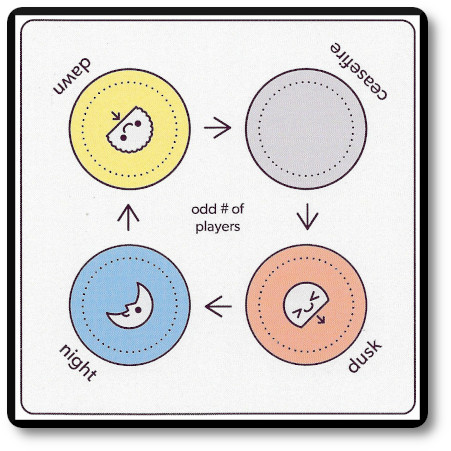
Second, place the Time Cycle mat next to the Play card draw deck. The Time Cycle mat has two sides. The face-up side to use depends on whether the game being played has an even or odd number of players. Place the black pawn on the “Dawn” space of the Time Cycle mat.
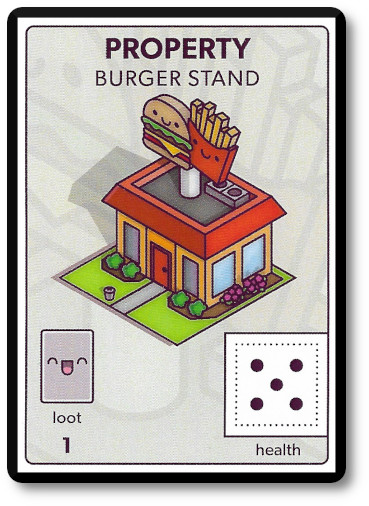
Third, take the Property cards and deal three face-up cards for every player in the game. It helps to organize the Property cards in a grid-like fashion. Any Property cards not used are returned to the game box. Place the score card, counters, and coins next to the face-up Property cards.
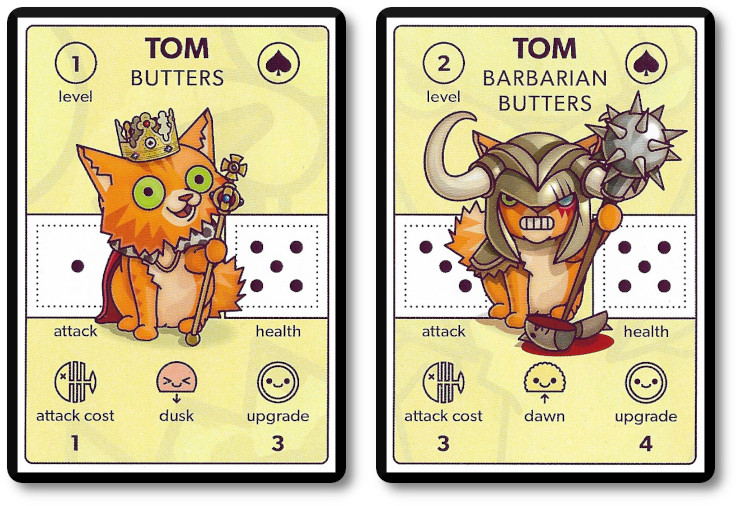
Fourth, deal each player one Tom card, which they place in front of them showing “Level 1.” Note that not all Tom cards are created equal. Each has a small advantage in one aspect of gameplay, but not to a degree where the advantage isn’t easily exploitable by another Tom’s advantage. Players should place their Tom card face-up in front of them (with “Level 1” showing). Leave room next to the Tom card for future Colory cards. Give each player a set of Strategy cards and a pawn to keep track of the selected strategy to be used. Leave room for collected resources during the game.
That’s it for game setup. Determine who will go first and begin.
Cat Fight!
Cat Conquest is played in turns with no set number of turns per game. On the player’s turn, they take their pawn and place it on one of the six available actions (referred to as “strategies”). Players cannot select the same action used during their previous turn. It’s also worth noting that not all actions are “actionable” based on the time of day and required resources.
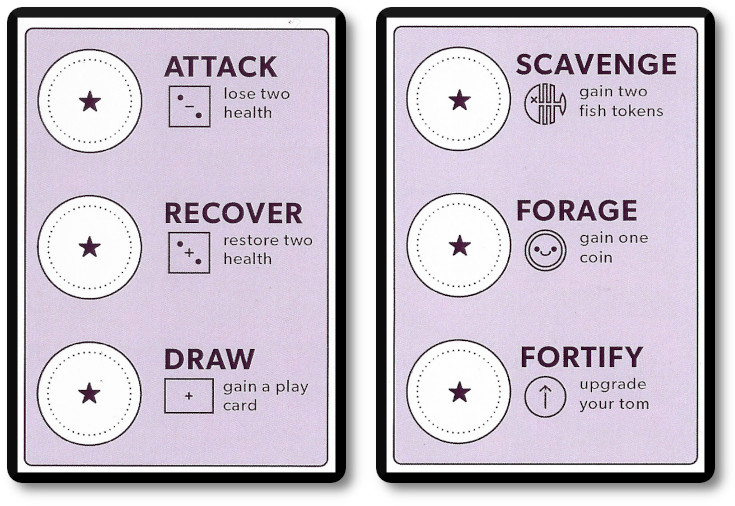
The six actions are as follows:
Attack
The most basic of actions and the most brutal. Before a player can attack, they must meet three conditions: the current time of day must match the card that is attacking, and there must be enough Fish tokens to pay for the attack cost. Each card the player has can attack once per turn if the player meets the above-mentioned requirements. If the attack is successful, the player announces the amount of damage they are inflicting based on their card. Players can attack anything with health, which includes other Tom cats, Colony cards, and Property cards. However, if the player attacks, their Tom or Colony card takes two damage, even if they have a shield or other defensive card in play. Cards that run out of health during an attack are considered “sacrificed” and discarded. All damage is tracked on cards using the available tokens.
If the player is able to reduce the health of their target to zero or less (which is then discarded), they collect the noted “loot” on the target’s card.
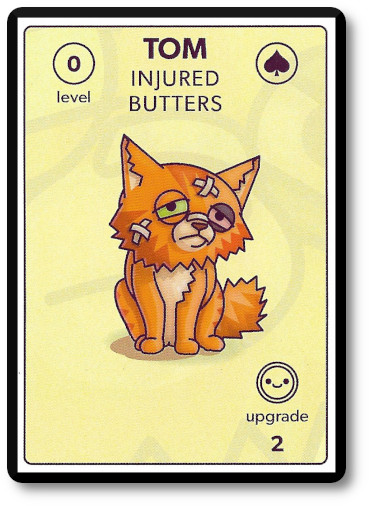
Tom cards are never sacrificed. They can, however, be heavily injured. This is displayed by flipping a Tom card over so it shows “Level 0.” Dropping an opponent’s Tom to zero or less awards the player with a Control token, which is placed on the Defeated Tom scorecard. Similarly, if the player reduces a Property card to zero, they also get to place a Control token, but they do so after they collect the loot noted on the Property card and flip it over, face down. The Control token is then placed on the Property card.
Recover
Recovering as your action heals two points of health to only the Colony card or the player’s Tom card. Players can never heal beyond the maximum unless a Buff card is in place that increases the total health.
Draw
Another action a player can take is to draw one card from the Play deck. Players should only do so knowing that not every card drawn will be a benefit. Shuffled in the Play deck are cards that will help as well as hinder.
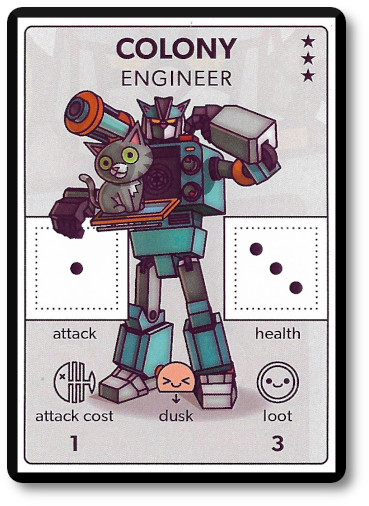
Colony cards, once drawn, and immediatly put in play. These cards represent other cats in the surrounding area that are aligning to the player’s cause. Think of them as your army.
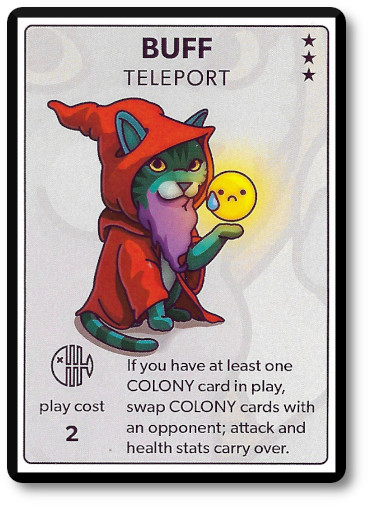
Buff cards are kept in the player’s hand once drawn and can be played on the player’s next turn if they like, during any action that makes sense. Buff cards, once played, will be immediately discarded unless the Buff card has a counter. It’s also possible for players to bring into play multiple Buff cards, but only if they have enough Fish tokens to pay for the privilege.
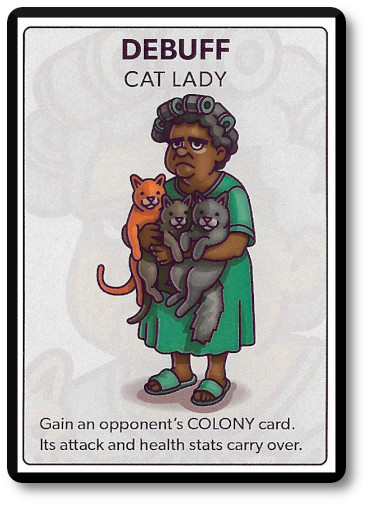
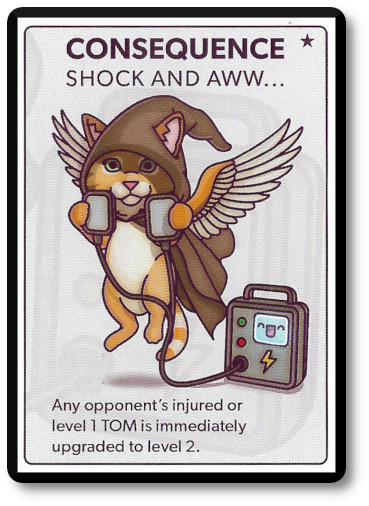
Debuff and Consequence cards, once drawn, are immediately resolved. If the resolution doesn’t impact the player, the card is ignored.
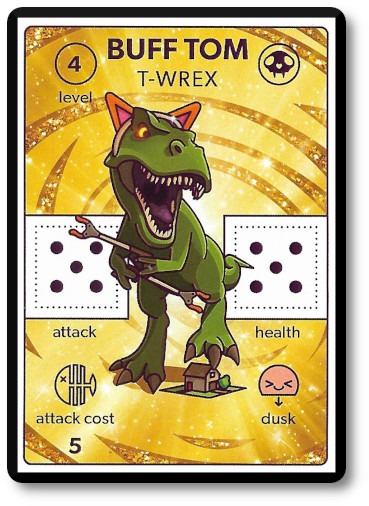
Buff Tom cards, once drawn, are also immediately played (unlike the normal Buff card). A player’s Tom card is immediately upgraded and healed, with all of its states reset. Unfortunately, only one Buff Tom card can be in play at a time, so if the player already has a Buff Tom card on the table, the new Buff Tom card is discarded.
Scavange
This action allows the player to collect two Fish tokens, which are the only legitimate currency in the game that cats all over the world will honor. Fish tokens can also be earned by drawing Buff and Debuff cards.
Forage
If the Forage action sounds very similar to the Scavange action, you are not wrong. The outcomes, however, are very different. Instead of finding fish, the player collects one Coin token. Despite the fact that fish are the only legal tender worth a damn in the cat world, coins still have a place when it comes to upgrades and meeting objective requirements.
Fortify
This is where the Coin tokens come into play. As an action, the player can upgrade their Tom card by paying the noted total number of Coin tokens to increase their level by 1. Upgrading the Tom card upgrades its stats.
After the player takes their action, they move the Day pawn to the next logical time cycle on the Time Cycle mat. The next player in the turn order sequence now takes their turn.
King of Cats
The game continues as noted above until one player at the end of their turn meets the following conditions:
- Has eight or more Coin tokens
- Has their Tom card at level one or higher
- Has captured three objectives (which are from defeating cats and properties)
This player is now the rightful ruler. Long may they reign in the neighborhood.
To learn more about Cat Conquest, visit the game’s web page.
Final Word
 The Child Geeks very much enjoyed this engine-building card game, finding it easy to understand what they could and could not do, thanks to the very clear direction provided by the Time Cycle Mat and Strategy cards. They also were overjoyed with the artwork, finding each unique cart illustrated (that’s right, each cat is unique – no duplicates) to be a lot of fun to look at and talk about. When I was finally able to take them aside to get their thoughts, two quotes stood out. According to one Child Geek, “I don’t get a lot of the engine-building card games that I’ve played before. I am not good at Magic and get really frustrated when I cannot get a card I know I need into my hand to play. This game was a lot of fun for me, and I always felt like I knew what I wanted to do and how I should do it.” Another Child Geek screamed with great enthusiasm, “I LOVE THE CATS! I LOVE THEM SO MUCH! I WANT THEM AS A STUFFY!” For those of you who do not speak the rich language of an excited 12-year-old geeky gal, a “stuffy” is a stuffed animal. Once my ears stopped ringing and all the cats were safely at home, the Child Geeks took a vote, and all agreed that the game was purrfect.
 The Parent Geeks also enjoyed the game, finding each turn full of thoughtful, useful actions that yielded meaningful results. According to one Parent Geek, “This is a great little game that takes the traditional card game where you build your deck and puts it all in front of you. It reminded me of the other card games I played as a kid and the battle games we’d create using our own deck of cards. A little like Pokémon, too. Lots of fun and a great idea for a theme.” Another Parent Geek said, “Great game! My entire family really enjoyed it, and you know you have a wonderful game when the kids – and my husband – open up the box just to look at the cards. A real winner in our home and our hearts.” When the last cat was safely tucked in their warm little box, the Parent Geeks took a vote, and all agreed that Cat Conquest was worth every battle.
 The Gamer Geeks were overjoyed by the many pop-culture nods and obvious 80’s cartoon and action-movie references scattered throughout the game. The game itself left them lukewarm once their geeky enthusiasm, fueled by nostalgia, cooled. According to one Gamer Geek, “I really appreciate how much of the game is laid out in front of you with the handy turn action cards and the rotating times of day to help keep track of what could and could not be done. It is clear that the game designer was leaving nothing to chance when it came to leaving the player scratching their head, wondering what they should do next. And I also think that is why the game fell a bit flat for me. There’s a lot you can do in the game. And all that possibility is hampered by a rotating time cycle that leaves your amassed army either ready to fight or sitting in a corner. Even worse is the feeling you get when the time cycle is just right and you realize you are out of needed fuel to get your engine – and you’ll please forgive my pun here – purring.” Another Gamer Geek said, “A fun game with a fun theme, rich with humor and interesting game mechanics. I love how much there is to do, but the game starts to feel a bit heavy with all the needed requirements and limitations built in. A great challenge to work with strategically and tactically, but the game’s play struggled to tickle my fancy fully as a result.” When the last kitty roared, the Gamer Geeks gave it a vote which resulted in a mixed endorsement. The Gamr Geeks really couldn’t determine if they liked it or hated it. Most agreed the game was “good enough to talk about.”
 This is an interesting game. There’s a lot to do in theory and little to do in practice. Your biggest headache will be building an army of cats that can attack just about whenever, while still trying to maintain a constant need to stockpile resources. The duality of the game’s focus – raising an army and banking goods – is all supported by building the perfect engine with cards that always allow you to get something meaningful out of your turn. Which you can do with little effort, because we observed that even the worst player in the group still had beneficial turns that supported their objectives. The game wants you to win, you see, and it gives you all the chances in the world to do so.
The same chances are being given to your opponent, as well.
This all works out, of course, because if everyone is being treated like a king, no one is really in charge. Each benefit you gain is subdued in its importance because the next player in the turn order sequence gets a benefit, too. And around and around you go, accumulating goodness in hopes that you will soon be able to rain down pain. Attacking, ironically, was one of the hardest things to do because of the limitations of what you could do with your cats at the time of day. Mechanically frustrating, but thematically brilliant. Cats do not do things on command. They are not there to take orders. They will always act in their best interests, and their owners must learn how to navigate that. The same goes here, but instead of owning a cat, you are owning an army of cats.
I personally really liked this element, as it gave me opportunities to explore different sides of the game and work on tactics to fill the gaps left by lazy-ass kittens. The end result was a game that was both incredibly engaging and highly frustrating, given the neighborhood’s time of day. All worth it, however, as not once did I leave a game not feeling like it was time very well spent.
Do try this game when you have a chance. It has many elements you’ll recognize and a few leaving you scratching your head in curiosity more than outright confusion. Unlike cats, your curiosity won’t kill you.
This game was given to Father Geek as a review copy. Father Geek was not paid, bribed, wined, dined, or threatened in vain hopes of influencing this review. Such is the statuesque and legendary integrity of Father Geek.