
 The Basics:
- For ages 10 and up (publisher suggests 14+)
- For 4 to 20 players
- Variable Game Play Length
Geek Skills:
- Active Listening & Communication
- Counting & Math
- Logical & Critical Decision Making
- Reading
- Emotional Coping Skills
- Strategy & Tactics
- Risk vs. Reward
- Cooperative & Team Play
- Self-confidence
- Imagination
- Bluffing and Misdirection
Learning Curve:
- Child – Easy
- Adult – Easy
Theme & Narrative:
- In space, no one can hear you scheme…
Endorsements:
- Child Geek approved!
- Parent Geek approved!
- Gamer Geek approved!
Overview
The starship Ecliptica was hailed as mankind’s most outstanding achievement. Outfitted with the latest in technology and crewed by a mix of highly trained humans, aliens, and robots, it launched into space with a single mission to explore the farthest reaches of our galaxy. Unfortunately, things are not going well right from the start. Turns out not all the supplies were loaded, a few critical systems were not fully brought online, and life support is already in the red. All the calculations indicate that the spaceship can turn around and make it home safely to Earth, but with limited resources, only one crew member will survive. Time to decide who that will be.
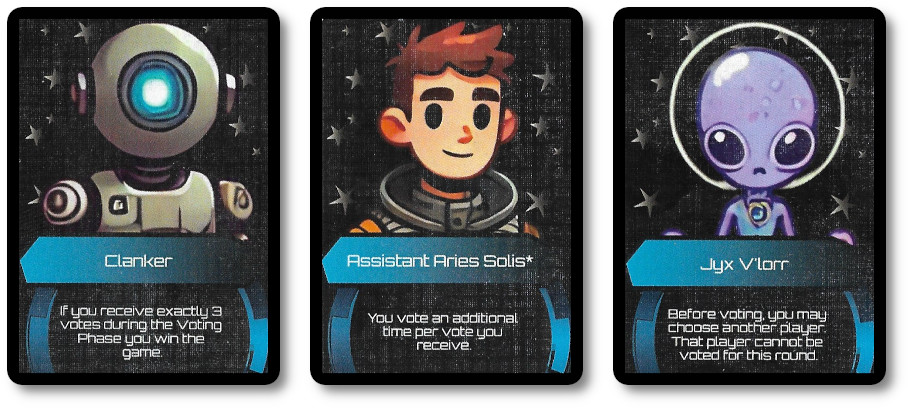
Echoes in the Airlock, designed by Reece Weitzel and published by Clipped Studios, is comprised of 20 Role cards, 40 Voting cubes, one Start card, and six Rule cards. Game components are excellent, with durable cards and hard plastic cubes that all fit easily in a small mint tin game box. If you are familiar with the “curiously strong mints,” Altoids, you can easily picture the mint tin I’m talking about. The illustrations are thematic and colorful, adding nicely to the game’s theme.
And There Goes Life Support…
To set up the game, follow these steps.
First, shuffle and deal to each player one Role card. Role cards are kept visible throughout the entire game. Make sure each player understands their Role and the other Role cards currently in use, as each has a special ability to help the owning player win the game. Any Role cards not used should be returned to the game box.
Second, place the Voting cubes in the middle of the playing area and within easy reach of all the players.
That’s it for game setup. Determine the first player and give them the Starting Player card.
Surviving a Doomed Ship
Echoes from the Airlock is played in rounds and phases with no set number of rounds per game. A single game round is summarized here. Note that the Role card rules take precedence when it comes to the standard game rules.
Phase One: Pre-Vote Abilities
The first phase of the game gives any player with a Role card that lists an ability as “Before Voting” an opportunity to resolve it. Beginning with the current Starting Player and going clockwise, have each player announce their ability and resolve it.
Phase Two: Make Your Case
Every active player now tries to persuade their fellow opponents that they should not be voted out of the airlock. There are no hard-and-fast rules here. Players can lie, cheat, make promises, threaten, or simply stay quiet. Regardless, each active player only gets 30 seconds to make their case!
Phase Three: Vote
After hearing all the arguments (or only the loudest), all the players now take one Vote cube and place it on their opponent’s Role card they believe should be the next out of the airlock. Players are welcome to place a Vote cube on their own Role card if they like.
Phase Four: Post-Vote Abilities
The fourth phase of the game gives any player with a Role card that lists an “After Voting” ability an opportunity to resolve it. Beginning with the current Starting Player and going clockwise, have each player announce their ability and resolve it. Unless the ability uses the word “may” in its description, the player must resolve their ability.
Phase Five: Eliminate Players and Pass the Starting Player Card
If any player has five or more Vote cubes on their Role card at this time, they are ejected out into space, forever to float in the cold and empty abyss. But they are not out of the game. Flip the ejected player’s Role card over and return their Vote cubes to the center pile.
Any ejected player now becomes an “Echo” and joins the rest of the Echoes. Echoes can participate in the discussion (phase two), but cannot be the target of any votes or used to resolve any abilities from active players. In addition, Echoes get to vote, but not as individuals. Echoes are now part of a collective consciousness that is rightly pissed off. As a group, they get to determine where one Vote cube goes to an active player during voting (phase three).
The Starting Player card now moves to the next active player in the turn order sequence. This ends the round. A new round now begins. Leave all the Vote cubes in their current position.
Triggering the Endgame and Surviving Spiteful Spirits
If there are only two active players left in the game after the round ends, the endgame is triggered. It’s time for the final round! This round has two steps (not phases), and the active players cannot use their Role card abilities.
Remove all the Vote cubes from the two surviving active players and place them in the center pile. Get ready for the final confrontation and democratic reconing.
Endgame Step One: Make Your Final Case
This is it. Your last chance to make your case to save your ass. As this is the last time players can speak on their own behalf (or an opponent’s demise), they are given 1 minute each.
Endgame Step Two: Final Vote
Here’s a great twist! Only the Echoes get to vote! That’s right, baby! KARMA! All of those poor souls who were kicked out into the vacuum of space have the final say! Before the endgame was triggered, the Echoes had to vote as a group. Not any longer. Each Echo now has a single vote.
The two active players have none.
The active player who receives the most votes is dragged out into oblivion by the Echoes, leaving the single active player the winner with a lifetime of needed therapy (it’s not every day you see the ghosts of the dead manifest and drag a person into space). If there is a tie, however, both active players lose, meaning no one wins—maybe just the Echoes, purely out of spite.
Game Variants
The base game, as summarized here, is a lot of fun. There are game variants available; however, if the players want to spice things up a bit.
Sweet Votes
Instead of using the plastic Vote cubes, consider using candy pieces. Each piece counts as one vote. If the player is kicked out of the airlock, they can eat their votes. A nice touch to help take a bit of the sting out of being jetisoned into the great black beyond. Please never put the plastic Vote cubes in your mouth. I know they look like they could be berry flavored, but they are not.
Two-Headed Horrors
Give each player two Role cards instead of one. The player uses these as a single collective, meaning they are combined into one role: a neat way to mix and max Role abilities into new and terrifying ways.
To learn more about Echoes in the Airlock, visit the game’s webpage.
Final Word
 All of our Child Geeks are familiar with hidden role games where players vote each other off the proverbial island. For example, Are You a Werewolf is a favorite at parties or when camping. They had no problem quickly learning the game and understanding how to participate to win. The single most important aspect of the game that all the Child Geeks cheered for was that eliminated players were not out of the game. According to one Child Geek, “Being voted out of the game never feels good, but in this game, you actually look forward to it! Less stress being an Echo and so much more fun, too!” Another Child Geek said, “I like the artwork, and I like all the characters with their abilities. I think I like this game better than Werewolf because you are never out of the game.” When the last vote was taken and only a single survivor remained—the winner, according to all the Child Geeks—was Echoes in the Airlock.
 The Parent Geeks also appreciated the game. Like the Child Geeks, they praised that eliminated players were still involved in the game, leaving no one out in the cold (of space). According to one Parent Geek, “I really like how the game designer kept eliminating players in the game. In many respects, I think an Echo is more powerful than an active player. They get to vote and discuss, but don’t need to worry about votes against them. Gives the game an exciting twist.” Another Parent Geek said, “This is one of those games I could play with my classroom and not worry that any of the kids felt left out. I played it with a group of five, twelve, and eighteen. Each game was smooth and took the right amount of time. A real hit!” When the last body was sucked into space, all the Parent Geeks approved and gave the game a loud round of applause.
 The Gamer Geeks were not at all thrilled to be playing “yet another voting game,” finding this particular gametype overplayed and lacking in surprises. They were pleasantly surprised by Echose in the Airlock, with the unique twist of having eliminated players still actively participating in the game —and, in many respects, even more potent than the active players. According to one Gamer Geek, “I’ve seen what this game includes as a core game mechanic as an option in others. A mistake, I believe. Having the eliminated players continue in the game allows everyone to play and learn. Plus, I think changing the driving focus of survival to pure spite is brilliant. Makes you think real hard how you are treating people and how they are treating you.” Another Gamer Geek said, “Not much new here, but it was exciting. A fun and fast player elimination game I would play again in a heartbeat.” When the spaceship returned to Earth, the Gamer Geeks all agreed that the only winner was the game, inviting it to join them at their elitist table anytime.
 Echoes in the Airlock is more than just your typical “vote a player off the island” type of game. Players need to think carefully about their relationships, both with the living crew and with those they might have ejected into space. It creates a unique dynamic tension where the decision you make now can – figuratly speaking – come back to haunt you. This “pay now or pay later” decision-making made each vote a serious assessment of the collateral damage one might incur. For example, if you vote off a strong player into space, they become a strong voice for the Echos. Do you want that kind of person going against you? Or do you keep them around and or make it as obvious as possible that “it isn’t you, it’s them,” in hopes of shielding yourself from negative consequences?
Uff. Lots to consider.
And that is really what makes Echoes in the Airlock such an interesting game. Consequences. Who you vote for or against has both a short-term and long-term impact. You don’t just simply vote a person off, create alliances lightly, and you most certainly don’t want to lose track of who has it out for you. This is a dynamic game of survival with a deep meta game that can cause players to second-guess themselves and create very real opportunities to shift the power at the table dramatically.
Do play Echoes in the Airlock at your next big group gaming or family event. It will amaze you how quickly friends can become foes and vice versa. In this game, it’s about playing the short game to win it all at the very end—a challenging and engaging opportunity for everyone, regardless of age or gaming experience.
This game was given to Father Geek as a review copy. Father Geek was not paid, bribed, wined, dined, or threatened in vain hopes of influencing this review. Such is the statuesque and legendary integrity of Father Geek.