 The Basics:
- For ages 7 and up
- For 2 to 4 players
- Approximately 30 minutes to complete
Geek Skills:
- Counting & Math
- Logical & Critical Decision Making
- Reading
- Hand/Resource Management
Learning Curve:
- Child – Easy
- Adult – Easy
Theme & Narrative:
- Play your cards wisely and never forget the power of the almighty veto
Endorsements:
- Child Geek approved!
- Parent Geek rejected!
- Gamer Geek rejected!
Overview
The ability to veto something simply means you elect to block whatever someone suggests you should do. In politics, it’s about blocking legislation. In games, it’s about canceling a card. In this game, no votes are taken, but you do have the ability to duck, dodge, and flat-out cancel other players’ cards played against you. The entire goal of the game is to quickly get rid of your cards, but you’ll quickly discover that such a simple objective is no simple feat to pull off.
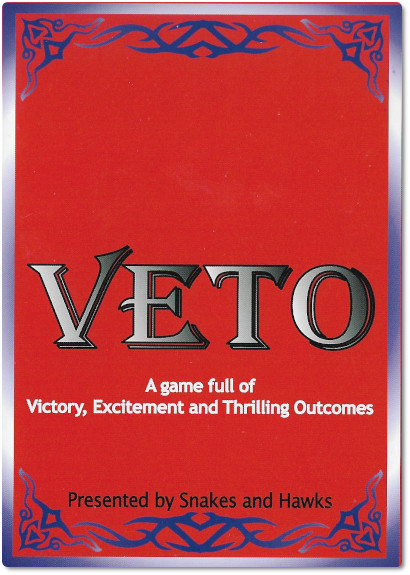
Veto, designed by Carey Suber and published by Snakes and Hawks, comprises 112 cards. The cards are as thick and as durable as your standard playing card. No illustrations to speak of, as the game focuses on numbers and brief rule changes.
Prepping the Game
Complete the following steps to set up the game.
First, shuffle all the cards. Especially important if you have played the game before or are playing the game for the first time out of the box.
Second, deal out several piles of cards. From these piles, players will select one and create in front of them four piles of cards of four cards each (16 cards in total). These are referred to as the player’s ground piles. From the remaining cards, the player draws four to create their starting hand. Any cards not used are returned to a central pile, placed face down, and become the community draw deck for the duration of the game.
To determine who goes first, have each player select one of their ground piles and flip over the topmost card. The highest card shown is the first player. Then, all the players flip over the topmost card of their remaining ground piles.
The first player selects any card from their hand and discards it. This counts as the first player’s turn.
The game is ready to play!
Playing the Veto
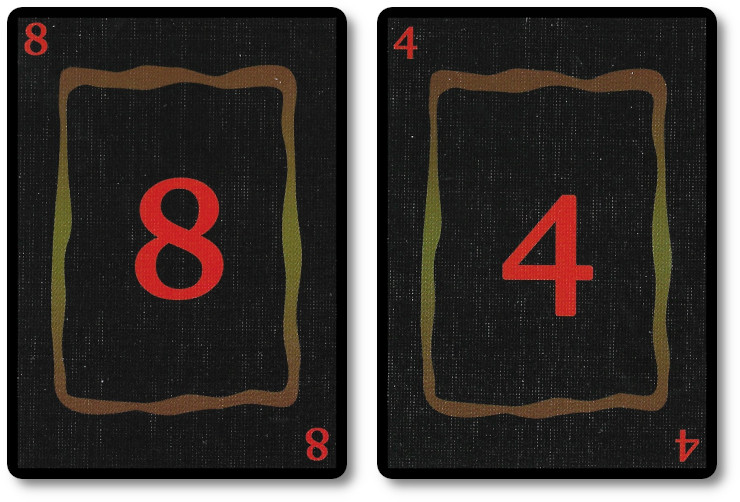
Veto is played in turns with no set number of turns per game. On a player’s turn, they must attempt to discard a card or cards from their hand that are of equal or higher value than the last card played to the discard pile. That is, until another card reverses that, which would then require the player to play a card of equal or lesser value.
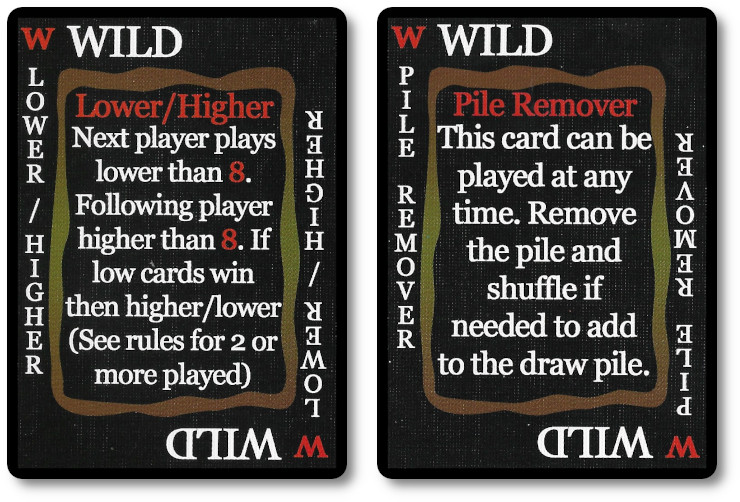
Wild cards can also be played that will change not only the value, but possibly the rules of the game (as described on the Wild card).
If a player has multiple cards of the same value, they can elect to play one, some, or all of them.
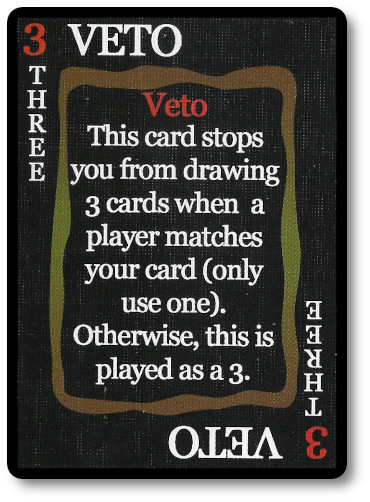
Once a player plays their card, their turn is over, and the next player takes their turn, playing to the discard pile. However, if the next player in the turn order plays a card of the same value as the previous player, the previous player must draw 3 cards from the draw deck and place them in their hand. Unless they have a Veto card, which excuses them from the penalty.
Using The Ground Piles
Only after a player has played all the cards in their hand can they use their ground piles. To do so, the player can play any of their face-up cards on their ground piles. After which, any cards that remain face down will continue to remain face down, forcing the player to play blind. If the blind card revealed is valid, their turn is over. If not, they must pick up the discard pile and play it as their new hand before returning to their ground piles.
Winning the Game
The game ends when a player finishes playing all of their cards, including those in their hand and their ground piles. The first player to do so is the winner.
To learn more about Veto, visit the game’s web page.
Final Word
 The Child Geeks enjoyed the game, finding it similar to other card games they liked. Specifically, War and Uno. According to one Child Geek, “I liked the game because it was easy to learn and fun to play. I also liked the ground cards I had to play, but it was always frustrating when my cards didn’t work, and I had to pick up the discard pile.” Another Child Geek said, “I thought it was fun because I love it when my dad had to pick up the discarded cards and made a funny face. I also like that the game is really fast, and I like how it always feels like I could win at any time!” When the last card was played, the Child Geeks took a vote, and all agreed that the game was a lot of fun.
 The Parent Geeks were not excited about the game, finding it frustrating to play cards blindly, even though they also liked the giddy little thrill of playing a blind card and “surviving” for another turn. As one Parent Geek put it, “The game is silly and pointless, but I cannot help but always smile with an evil grin when my blind card from my ground pile fits the current rules. Of course, my grin turned immediately upside down when it didn’t. I really disliked picking up the discard pile when it had something like 20 cards in it.” Another Parent Geek said, “A fun enough game with the kids, but it didn’t feel much like a game I wanted to play with adults. I played it with only my husband, and we thought it fell flat. A great family game, I think.” When the games had finally come to an end, the Parent Geeks took a vote and decided that Veto wasn’t getting their love.
 The Gamer Geeks didn’t care for this game whatsoever. According to one Gamer Geek, “A total nonsense game. The only control you have is what is in your hand, and as your hand has fewer cards, your options become fewer as well. Even worse is playing the game blind, which means you can get all the cards in the discard pile as a reward for doing nothing but flipping over a card you are forced to use. Dumb.” Another Gamer Geek said, “The decisions that are suggested are doubtlessly easy choices to make, as in always playing all your cards as quickly as you can. The Wild cards throw in unneeded shenanigans of card swapping, and the hit in your gut you feel when you have to pick up a bunch of cards because the blind card you were forced to play didn’t do the trick automatically makes me want to put the game away. No, thank you, to this game. I’m giving it a pass.” When the Gamer Geeks took a vote, they vetoed any chance of Veto making it to their elitist gaming table ever again.
 I didn’t much care for this game. While I found that picking up the discard pile always felt like a slap in the face, there were never so many cards in it that it suddenly felt like I was starting over. But playing blind from my ground piles was an absolute deal breaker. You spend the majority of the game ducking and dodging, only to suddenly have to run into the fray with your head down and a prayer on your lips. The game requires you to think smart, then play super dumb. Not great.
The Child Geeks liked the game, however. Still playing it as often as they can. In fact, it has replaced their love of Uno, which is great, as that is another game I find really frustrating. This just goes to prove, once again, there is a game for every player and a player for every game.
In this case, the game is not for me, nor do I want to play it again. The Child Geeks are welcome to it. Try the game for yourself and see if it gets your vote, or you elect to veto it from ever showing up at your gaming table again.
This game was given to Father Geek as a review copy. Father Geek was not paid, bribed, wined, dined, or threatened in vain hopes of influencing this review. Such is the statuesque and legendary integrity of Father Geek.