 The Basics:
- For ages 8 and up
- For 2 to 4 players
- Approximately 20 minutes to complete
Geek Skills:
- Logical & Critical Decision Making
- Pattern/Color Matching
- Strategy & Tactics
- Visuospatial Skills
Learning Curve:
- Child – Easy
- Adult – Easy
Theme & Narrative:
- None: It’s Tic-Tac-Toe, but with towers
Endorsements:
- Child Geek approved!
- Parent Geek approved!
- Gamer Geek rejected!
Overview
Whether you know it as Tic-Tac-Toe, Noughts and Crosses, or X’s and O’s, you have played the game at least once in your life. Most likely, it left you feeling either deeply frustrated or arbitrarily awesome. This game has existed, with little change to its basic premise, since ancient Egypt (around 1300 BC). It continues to be played to this day in the sand with sticks, on notebooks, and pub tables around the world. Its basic premise is easy to understand, and the gameplay is fast enough to make it worthwhile, regardless of your personal tastes in gameplay. In this game, the primitive approach of matching rows, columns, and diagonal lines is enhanced by introducing another dimension to the game’s strategic and tactical thinking.
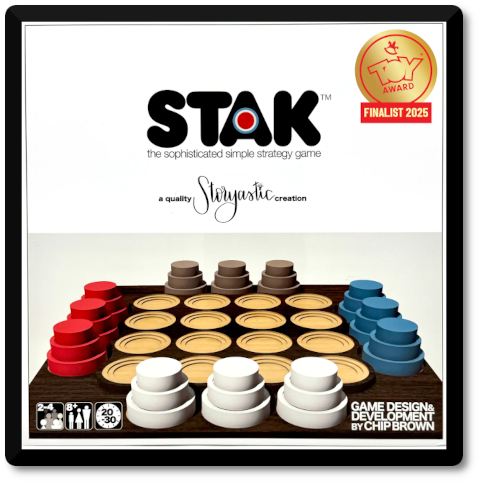
STAK, designed by Chip Brown, Dana Brown, and published by Storyastic, consists of one game board and 36 player pieces, each in a different color (nine per color). The component quality is excellent, with a wooden board and player pieces that fit snugly together. The packaging is also outstanding, featuring a plastic cover for the player pieces when they are in the box, ensuring they remain stationary regardless of how you place the box for storage. The rule book is hilarious, with only two pages explaining how the game plays (which is overkill) and another eight pages summarizing other games available from the game publisher.
Tic-Tac-Toe with A Twist
STAK has three different methods of play. Regardless of the method chosen, the game board always starts the same, with each colored player piece staked on one side of the square game board, with the smallest player pieces on top and the largest on the bottom, creating a tower of three player pieces. Each of the gameplay methods is summarized here.
Basic Play
The basic play is the “default mode” for the game, which can accommodate two to four players. On a player’s first turn, they move one piece from their stacked player pieces to the game board. Any piece that belongs to the player can be moved as long as it comes from the top of their stacks.
There are a few restrictions when placing player pieces.
- Only the top-most player piece can be moved, either from their starting position off the game board or when they are on the game board.
- No restriction on moving a player’s piece to an empty position on the game board.
- Smaller player pieces may be placed on top of larger player pieces on the game board, but never pieces that are the same size or smaller.
In the basic play, the player will win if they have four of their player pieces on top of a stack in a row, column, or diagonal line.
Corner Quadrant
The first of two different game play methods uses the same rules as described in the basic play. Victory, however, is won when a player has their player pieces on the top of the stacks in the four adjacent columns on the game board, creating a two-by-two quadrant.
Four Corners
The second of two different gameplay methods (again, using the same rules as described in the basic play) is similar to Corner Quadrant. Victory is won when a player has their player pieces on the top of the stacks in the four corners of the game board.
To learn more about STAK, visit the publisher’s website.
Final Word
 The Child Geeks very much enjoyed STAK, finding it to be fast, intuitive, and engaging. They also quickly found that playing without thinking through their moves was an automatic loss. According to one Child Geek, “You have to think about each of your moves. Not a lot. Like the same amount you’d use if you were playing Tic-Tac-Toe, but it’s harder. You have to think in all directions: up, down, left, and right. I liked it.” Another Child Geek said, “It is a hard game to win, but a lot of fun to play. I played five times and only won once. I still liked it, though.” Of particular note was the level of delight the Child Geeks had moving their player pieces around the game board to “block” opponents from taking spaces. This made the game more aggressive, but not to a point where any of our Child Geeks felt they were being attacked themselves. That is to say, there were no tears, only grunts of disapproval. When the final piece was in place, the Child Geeks took a vote, and all agreed that the game was a lot of fun.
 The Parent Geeks also enjoyed the game, finding it to be an entertaining exercise in strategy and tactics with their younger players, as well as with their peers. They did comment, however, that this was a game that always went to the player who was able to think through their moves and see the game board as a “whole” rather than just a place to decide their next move. No different from Checkers or Chess, however, which made the game highly approachable. According to one Parent Geek, “A really nice little strategy game that played quickly and felt genuinely difficult at times. I really enjoyed watching my kids figure out their next move and purposely take their turn to be offensive or defensive. Made me a proud papa when my youngest beat me fair and square.” Another Parent Geek reported, “Fun right from the start. It’s a good deal more thinking than Tic-Tac-Toe, and not nearly as much needed for Checkers, but the game still kept all of us engaged.” When the last game was won, the Parent Geeks took a vote and found they agreed with their Child Geeks.
 The Gamer Geeks found the game’s component quality to be excellent, and that’s about it. As mentioned, STAK is really nothing more than a derivative of Tic-Tac-Toe, which (not surprisingly) is a game not enjoyed in the slightest by our gaming elitists. They were not unkind in their remarks, however, as they readily all agreed that the game was good for “what it was” as long as it was put in front of casual players or younger children. As one Gamer Geek put it, “It’s not a game for gamers who have a lot of experience. It is a game suitable for younger players or anyone seeking a light game that combines strategic thinking and tactical moves. Too light for any serious gamer.” When the game was put back in the box, the Gamer Geeks agreed that the game was not for them.
 STAK is a great game to have on your shelf as an alternative to the basic games many of us grew up with as kids and have purchased for our children, as well. It’s too advanced for the youngest of players and too simplistic for anyone who has graduated to what is commonly referred to as the “gateway games.” The game doesn’t so much serve as a gateway itself, but rather as an alternative for those looking for more to do on their gaming table beyond the most basic gameplay. It is also a fun little puzzle to ponder without blowing a mental fuse, which makes it perfect for younger players and families with younger players. For anyone else, I would suggest passing over this game, as you have long since advanced your gameplay to make STAK nothing more than a brief moment of interest, but not engagement.
If you are the right crowd, do try STAK when you have the opportunity. I think you’ll find that it will meet your expectations, as long as you keep those expectations simple.
This game was given to Father Geek as a review copy. Father Geek was not paid, bribed, wined, dined, or threatened in vain hopes of influencing this review. Such is the statuesque and legendary integrity of Father Geek.