 The Basics:
- For ages 10 and up
- For 2 to 5 players
- Approximately 20 minutes complete
Geek Skills:
- Active Listening & Communication
- Counting & Math
- Logical & Critical Decision Making
- Strategy & Tactics
- Hand/Resource Management
- Bluffing and Misdirection
Learning Curve:
- Child – Easy
- Adult – Easy
Theme & Narrative:
- Bribe a giant dragon to spare your village and burn your competition’s to the ground
Endorsements:
- Child Geek approved!
- Parent Geek approved!
- Gamer Geek approved!
Overview
The dragon came out of nowhere, landing in the middle of your village. It demanded to speak to you, the village leader, and told you it would return and burn your town to the ground, utterly destroying everything. Maybe. At which point, the dragon raised an eyebrow and let the unasked question hang in the air until you realized what the dragon wanted: treasure. Now you are charged to collect as much treasure as possible to satisfy the dragon’s greed, satiating its desire to destroy. But so too are other village leaders, and the dragon has no intention of playing favorites. Quickly find all the treasure you can and hope it is enough to appease the great beast before the time is up!
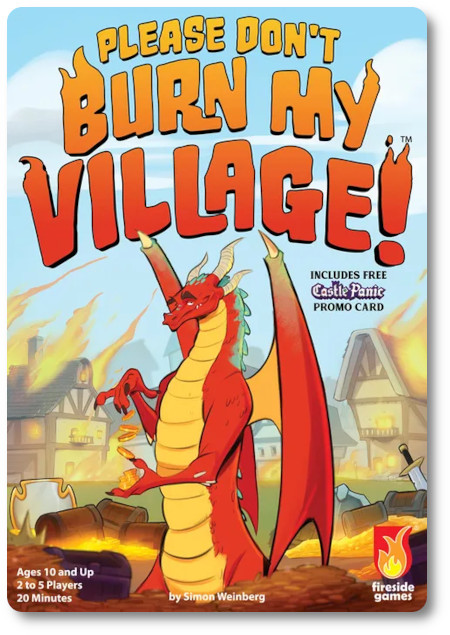
Please Don’t Burn My Village, designed by Simon Weinberg and published by Fireside Games, is comprised of 84 Treasure cards, 20 Wild cards, six Treasure tokens, one board, and five Player Aid cards. The component quality is excellent, with durable cards and thick cardboard. Illustrations by Tad Lambert are colorful and detailed, providing visuals that further the game’s theme and narrative. Also included with the game (at least in our copy) was a promotional card for Castle Panic, which is unrelated to Please Don’t Burn My Village, but serves as a nice nod to another game by Fireside Games set in the same “game universe.”
HOLY CRACKERS! A DRAGON!
To set up the game, follow these steps.
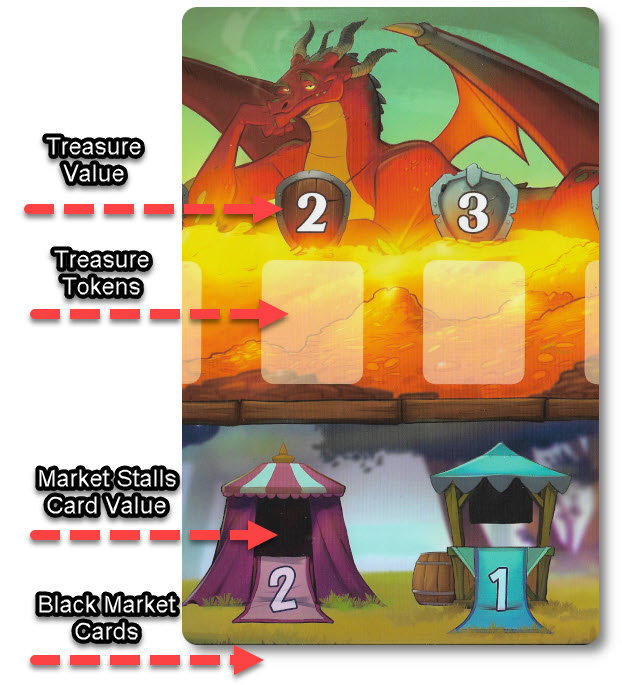
First, place the board in the middle of the playing area and within easy reach of all the players. The board will track Treasure and card values.
Second, remove the Wild cards and only add back to the deck a specific number based on the player count at the table. For example, in a two-player game, you would use nine Wild cards, and in a five-player game, you’d use all of the Wild cards. Removed Wild cards can be placed back in the game box.
Third, shuffle all the cards (Treasure and used Wild cards) together. Deal seven face-down cards to each player. Players should keep their cards hidden from their opponents until they are played. Then draw and place a face-up card underneath each of the Market Stall tents on the board. This area is referred to as the “Black Market.” Place the deck of cards face down next to the Black Market, being sure to leave room for a discard pile. This is the draw deck for the duration of the game.
Fourth, randomly place one Treasure token in each of the Dragon’s Favor spaces on the board.
This completes the game setup. Determine who goes first and begin!
Pleaseing the Dragon
Please Don’t Burn My Village is played with players taking turns, and there is no specific number of turns per game. On a player’s turn, they can take one of three possible actions. These actions are summarized here. Once the player has taken their action, the next player in turn order takes their turn.
Action Option One: Bribe the Dragon
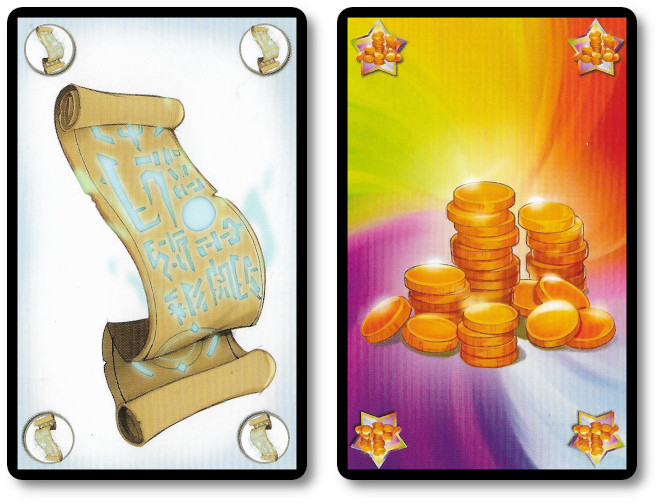
The player attempts to persuade (read: “bribe”) the dragon not to burn their village. This is done by first making a bribe by selecting one or more Treasure cards of the same type from their hand. Treasure comes in the form of enchanted weapons, magical scrolls, magical potions, magical items, and even the King’s crown. The player can also use the Wild card (illustrated as a stack of coins) that represents any Treasure type, but it can never be played on their own when creating a new Bribe.
The player can either create a new Bribe or add to an existing Bribe previously played.
To create a new Bribe, the player uses Treasure cards not previously played, placing them face-up in front of them as a set, ensuring that the number of cards and the Treasure type are visible to the player and the player’s opponents.
To add to a previously made Bribe, the player adds one or more cards of the same Treasure type already on display in front of them, including one or more Wild cards.
Regardless of whether the player is creating a new Bribe or adding to an existing Bribe, the dragon is most pleased. The Treasure token that matches the Treasure card type played is now moved one space to the right for every card the player just played. Treasure tokens will always be shifted to the left to make room for the newly favored Treasure token. The Treasure token can never move beyond the track on the board, regardless of how many cards the player uses.
Finally, the player adds to the Black Market. The first card drawn goes immediately under the left-most Market Stall space, the second card drawn goes to the next Market Stall to the right, and so on. Once the last Market Stall has a card, the player draws more cards, adding them back to the first Market Stall and continuing down the row to the right. As soon as the player draws a Treasure card that matches the Bribe, or a Wild card is drawn, the card is placed, and the player’s turn ends.
Action Option Two: Visit the Black Market
There’s always time to shop, right? The player decides which Market Stall they will visit and must discard a number of cards from their hand equal to the Market Stall’s number value. For example, if the Market Stall number value is “3,” the player must discard three cards of their choice from their hand to the discard pile. However, the player should give this some thought. The top-most card that is shown on the discard pile identifies what Treasure type is “cursed” and can never be a Wild card. The player then takes all the cards from the Black Market that are under the Market Stall visited by the player. There is no limit to the number of cards a player may have in their hand.
Now the player resolves the cursed Treasure type by moving the Treasure token to the left on the track a number of spaces equal to the number of cards they discarded. Note, again, the only Treasure to be moved to the left is the Treasure type shown on the top-most discarded card.
The player’s turn is now over.
Action Option Three: Draw One Card
The player draws the top-most card from the draw deck, adding it to their hand. Again, there is no hand-size limit. The player’s turn then ends.
Times Up! The Dragon Returns!
The game ends as soon as any player must draw a card and cannot do so. This means the game can end when a player is visiting the Black Market or wants to draw a card.
All players now play any cards still in their hand to existing Bribes they have in front of them. No new Bribes can be created at this time. The Treasure token does not move. Any cards not played to Bribes remain in the player’s hand.
Points are now calculated.
- Each card in Bribes is worth the same number of points as the Treasure token’s current position.
- Each card not in a Bribe reduces the player’s total by the same number of points as the Treasure token’s current position.
- Each Wild card still in a player’s hand reduces their total by two points.
To assist with scoring, Fireside Games has granted permission to game owners to copy the score sheet illustrated in the game rulebook or download it for printing.
After each player’s total is determined, the player with the most points wins and saves their village!
To learn more about Please Don’t Burn My Village, visit the game’s web page.
Final Word
 The Child Geeks quickly grasped the game and the need to manipulate the market as often as needed, without ignoring the very real impact their set collecting made on their opponents. To be clear, the game was thoroughly enjoyed, but the moves made by players were not. According to one Child Geek, “I like the game and really don’t like it when players curse treasure, I am clearly trying to score. Feels like they are purposely targeting me.” Another Child Geek said, “I like how you are trying to make friends with a dragon by giving him stuff, but I don’t like how other players are trying to make my stuff less important to the dragon. I liked the dragon who burned my village more than I like the other players!” When the last Bribe was made and the dragon burned villages, the Child Geeks took a vote, and all agreed that the game was a favorite.
 The Parent Geeks very quickly understood the sometimes not-so-subtle market manipulation and Treasure value shifting right from the start. Like the Child Geeks, the Parent Geeks were none too pleased when opponents shifted Treasure values around, but this just served to quickly inform each Parent Geek that the objective was to speculate and cover possibilities, not necessarily control the market itself. According to one Parent Geek, “I really liked the game. It was easy to learn, but not at all easy to play. You have to pay close attention to the market, as it can be quite volatile, especially towards the end. I won only one of my five games, but I enjoyed them all.” Another Parent Geek said, “Boy, this game can be brutal. It simply doesn’t matter how much you try to keep treasure values up, as players can always reduce the price of the Treasure you are playing with. The trick is to play to them all, and when the game starts getting down to the end, curse everything you have little of!” When the dragon counted its treasures, so too did the Parent Geeks count their vote, which showed that Please Don’t Burn My Village was a winner.
 The Gamer Geeks found a way to make a casual card game of light market manipulation and set collecting into a bloody battlefield for dominance and control. Which is to say, they enjoyed it, emphasizing every aspect of the game’s play, transforming even the most mundane action into a renewed declaration of war. It was pure joy to watch. According to one Gamer Geek, “This is not a game to be taken seriously, but a game to play seriously. If you watch your opponents, you can see where they are looking to score points, and that is all you need to know to either partner up with them or leverage their futile attempt to win to be their downfall. I had a great time playing this game as a light filter before we started our game night. Good stuff.” Another Gamer Geek said, “I was surprised at how much thinking I had to do to attempt to win the game. I think that game is a bit too chaotic at times, and the treasure values can shift dramatically at the drop of a hat, but I still had fun, and I think the chaos only added to my enjoyment. I was always burned by the dragon, but it was a good heat.” When the last village stopped smoldering, the Gamer Geeks took stock of the devastation and all cheered.
 Make no mistake, if you’re a gaming elitist, this game is lightweight. Light and exceptionally engaging. You need to watch the market constantly as good cards come and go, the treasure values shift up and down, and the game races ever closer to the end. Best of all, every player knows what every other player is doing. This would suggest that you should hold on to your cards as long as possible, which is a valid strategy, but you lose out on the bluffing aspect of the game, too. For you see, when you play cards to your Bribes, you are also playing your opponent’s. They’ll think to themselves, “Oh, is she collecting Battle Axes now?” or “He had a lot of Crowns, so why is he cursing the treasure?” Lots of opportunities to manipulate the market, the treasure, the outcomes, and your opponents.
Which all equals great fun and a lot of frustration at times. However, the frustration often stemmed from players not achieving what they wanted from their plan. Which is to say, they simply backed the wrong treasure horse. To win this game, you must be exceptionally fluid in your tactical approach to victory. This makes our Gamer Geeks happy and frees up our youngest players to act and react in equal measure, without ever feeling like they’re being put in a corner. The end result was a game that everyone enjoyed. The declaration of colorful words and several finger gestures in the game only served to enhance the experience.
Do play Please Don’t Burn My Village when your time allows, to determine for yourself if the game is worth saving or should be burned to the ground.
This game was given to Father Geek as a review copy. Father Geek was not paid, bribed, wined, dined, or threatened in vain hopes of influencing this review. Such is the statuesque and legendary integrity of Father Geek.