
 The Basics:
- For ages 12 and up
- For 2 – 4 players
- Approximately 30 minutes to complete
Geek Skills:
- Active Listening & Communication
- Counting & Math
- Logical & Critical Decision Making
- Reading
- Memorization & Pattern/Color Matching
- Strategy & Tactics
- Risk vs. Reward
- Hand/Resource Management
Learning Curve:
- Child – Easy
- Adult – Easy
Theme & Narrative:
- Do your part to create the perfect bee sanctuary and remove invasive weeds!
Endorsements:
- Child Geek approved!
- Parent Geek approved!
- Gamer Geek mixed!
Overview
As a kid, I was terrified of bees but also loved them. I knew that these little insects had the ability to hurt me with their stinger, but they also made honey, which was so sweet! It was a conundrum. Years and years later, as an adult, I was paying closer attention to bees to help me keep track of which flowers were pollinated and to take note of how the world around me was doing. More bees and more flowers were always a good thing. In this game, players will learn about bees, flowers, and the important role they play. Plus, they get to compete in a fast game of picking, matching, and saving bees while cursing the dreaded Knapweed.
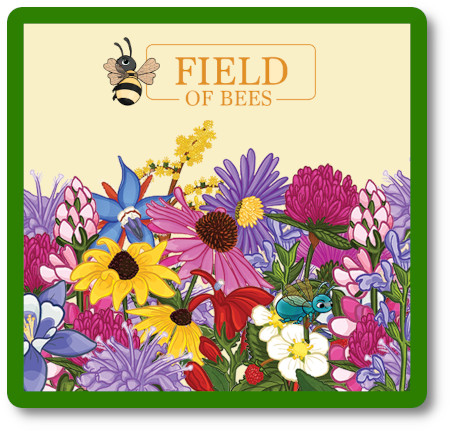
Field of Bees, designed by Autumn Ramirez and published by Kindheart Games, is comprised of 124 cards, four Player Reference cards, and four Player mats. The cards are as durable as your standard playing card, with the Player Reference and Player Mats being about twice the size of the playing cards. Illustrations, also by Autumn Ramirez, are colorful, detailed, and, according to every Child Geek we put the game in front of, “cute.” Which is to say, the adults loved the detail and color of the various flowers depicted on the cards, and the Child Geeks focused all of their admiration on the adorable bees.
Planting Flowers
To set up the game, complete the following steps.
First, find the “Kanpweed” Flower cards and separate them from the rest of the Flower cards. Take five of the “Knapweed” Flowers and form a face-up pile. Shuffle the remaining back into the Flower cards. This is the Flower deck for the duration of the game.
Second, draw 12 Flower cards and place them face down in a 3 x 4 grid pattern. This grid is referred to as the “wildflower field.” Place the face-down Flower deck and the face-up “Knapweed” Flower cards by the grid and within easy reach of all the players. Be sure to leave room for a discard pile.
Third, separate the bees by type from the Bee deck. Create a face-up pile for each bee type, arranging them in whatever manner works best for the playing space.
Fourth, give each player a Player Reference card and a Player mat.
This concludes game setup. As a group decide if you’ll be playing a long or short game (determined by the number of needed bees to be collected in order to win) and who will be the first player to get buzzing.
Making a Buzz
Field of Bees is played in turns with no set number of turns per game. On a player’s turn, they can take one of four different actions. Note that some Bee cards grant the player an additional action when activated.
Collect Flowers
Players can collect Flower cards in two ways: by flipping or by trading.
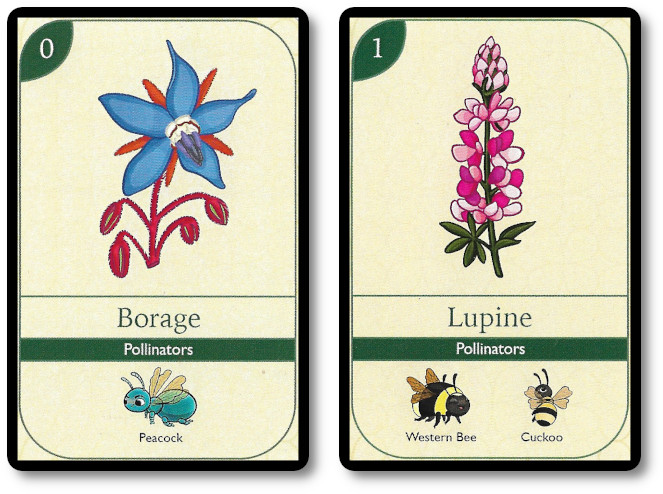
To collect a Flower card by flipping, the player flips over one face-down card in the wildflower field. If the Flower card shows a value of “0”, it is immediately collected. If, however, the revealed Flower card has a number value of “1”, the player now flips over one more card. If the second card matches the first, the player collects both and places them in their “garden” space on their Player mat. However, if the flowers are different, the player only takes one and flips the one they left back face down. Similarly, if the first card they flip has a value of “2”, the player flips over two additional cards, keeping those that match, or only one. The wildflower field is replenished with new cards when there is an open space.
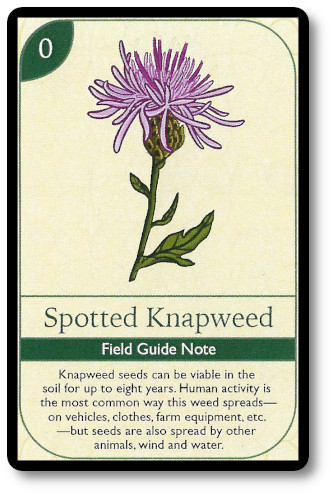
The “Knapweed” Flower card is not what players are looking for. Knapweeds are considered invasive, disrupting the natural ecosystem – and as a result, our beloved bees. While having Knapweeds won’t hurt the player’s final score, they are highly intrusive. If a player collects Knapweeds, they will need to manage them. Even worse, if there are enough Knapweeds in play (meaning they are located in the player’s personal gardens), they will lose bees and flowers!
To collect a Flower card by trading, the player forces a trade with an opponent. This is done by the player offering one of their Flower cards from their garden to another player, asking for a specific flower from that player. If their opponent has it, they must give it up, and the exchange is made. However, if the opponent does not have it, they can give the active player whatever card they like.
Remove a Knapweed
Knapweeds can be removed by the player using their turn to “wilt the weed,” which rotates it. On their next turn, the weed is removed. If it isn’t obvious, Knapweeds are really, really bad.
Collect a Bee
Each Flower card will show one or more Bees it will attract. If the player has the required Flower cards, they can redeem up to 3 matches to collect the corresponding Bee cards. The Flower cards used are then discarded.
Or, if the player likes, they can “lure” Bees in an opponent’s garden. This is done by providing the needed cards and taking the Bee card. In return, the opponent gets to keep one of the Flower cards, discarding the rest.
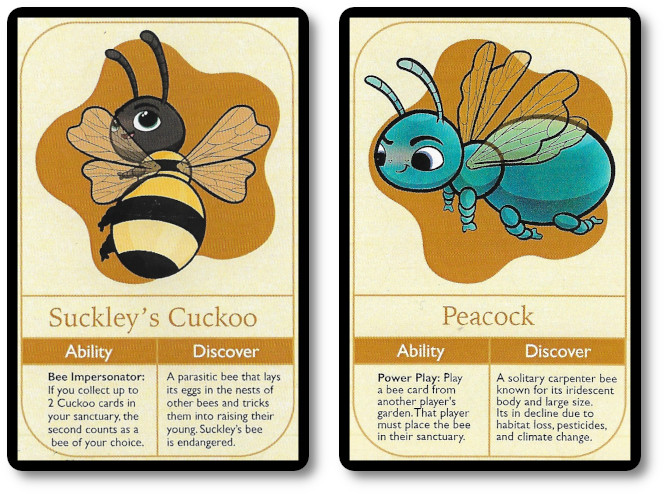
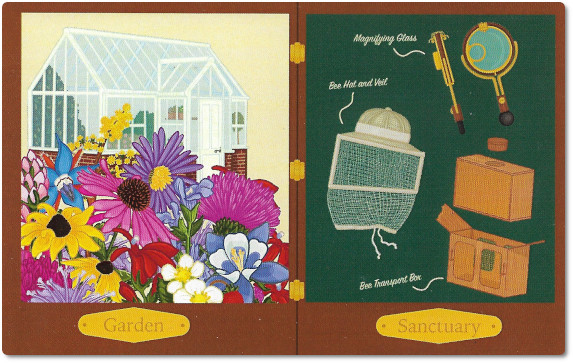
Collected Bees can be placed in the player’s garden or sanctuary. Any Bee card in the player’s garden may be used for the Bee’s special action; however, they are also vulnerable and can be lost. Alternatively, a Bee card placed in the player’s sanctuary is safe and will remain with the player until the end of the game.
Play a Bee Action
Bee cards in the player’s garden can be used for their special ability. Doing so allows the player to resolve the ability and then move the Bee card to their sanctuary, where it is now safe. Special actions include, but are not limited to, trading cards, keeping extra cards, and revealing more cards.
Winning the Game
The game continues, as summarized here, until one player has collected the required number of different bees in their sanctuary to win, as specified in the game setup.
Game Variants
The game summarized here is the basic approach to playing Field of Bees. There are several suggested different methods to play that address the needs and skills of younger players, and add additional levels of strategic and tactical gameplay. For example, stealing an opponent’s Bee cards can be removed as an option (no chance to lure a bee to your own garden), different ways to match Flower cards, which gives players a different dimension on how they need to remember location in the wildflower field, as well as a cooperative approach and special rules for only two players. Our personal favorite was adding the drafting rules that reduce the need to memorize card locations and let us play the game in a much smaller space.
To learn more about Field of Bees, visit the game publisher’s website.
Final Word
 The Child Geeks loved this game. Absolutely loved it. They were engaged right from the start and had no issues saving the bee population. They even went so far as to advise their opponents to ensure more bees were placed in sanctuaries. This goes against the competitive aspect of the game, but the Child Geeks were more focused on saving bees rather than making points. According to one Child Geek, “This is a really fun game with really cute bees. I learned a lot about different flowers and how we can help the little bees. I feel sorry for them. We need to do all we can to help!” Another Child Geek said, “I like that the game is competative but you are also helping out the planet. I want to plant these flowers this Spring, and my mom has already said yes!” The Child Geeks took a vote – and to no one’s surprise – all the Child Geeks enthusiastically endorsed Field of Bees.
 The Parent Geeks also enjoyed the game, finding it casual, engaging, challenging, and, best of all, promoting a positive message. As one Parent Geek put it, “Games that are intended to teach a lesson or push a narrative can often come across as heavy-handed or simply unwelcome. That is not the case for this game. The gameplay is a lot of fun, and the message of preservation and stewardship of our planet comes across as a reinforcing principle that helps players become more competitive. I’ve learned a lot from this game as well as had a great time.” Another Parent Geek said, “I loved this with my family and immediately asked if I could borrow it for my class. I teach kids science, and this game did just that. All my students really enjoyed how the game was played and what they learned from it. Now all my students want to learn using games instead of textbooks!” When the last bee was safely tucked away in the sanctuary, the Parent Geeks took a vote, and all agreed that Field of Bees was – truly – the bee’s knees.
 The Gamer Geeks appreciated the game’s intent and gameplay, but were not all that thrilled with its depth. As one Gamer Geek put it, “This game has all the makings of being much more and is certainly close to being a game I would enjoy at my table with fellow gamers. My only reason not to give it my vote of approval is that the game isn’t aggressive enough. The forced trades just feel annoying, and there is only one path to victory. If all the players are doing the same thing, it feels like a quick sprint rather than a worthwhile race.” Another Gamer Geek said, “I was pleasantly surprised with this game! I was expecting something entirely different, but it strikes a great balance of memorization, action, and decision-making. Very light, but enjoyable. I would play this again.” When the Gamer Geeks took their final vote, the results were mixed. Every Gamer Geek appreciated the game, but not everyone thought the game was for them.
 As stated, this game was given – as a temporary loan – to one of the Parent Geeks to try with their middle school class. As a result, the game was given up and didn’t return to me for several months. While it was very worthwhile for me to learn more about how well the game was received, it did result in this review being very, very late. So late, in fact, I made certain to apologize to the game designer. I just didn’t have the heart to take the game away from the students.
That said, it’s worth mentioning two things. First, the Parent Geek, a science teacher, is now making game-playing part of her lessons going forward. Second, and even more exciting, she plans to plant a bee garden with her students this year. All thanks to Field of Bees. I can think of no higher praise for a game that not only entertains players but also educates and inspires them to do great things to better themselves and their planet.
This is all fine and good, but how is the game? I mean, really, how good can it be?
Simply put, pretty damn good. I really enjoyed myself. It’s simple, but it is clear the game designer knows what a good game looks like. Do try this game, which I guarantee is under your radar. Which is a shame, because this game deserves a lot more buzz.
This game was given to Father Geek as a review copy. Father Geek was not paid, bribed, wined, dined, or threatened in vain hopes of influencing this review. Such is the statuesque and legendary integrity of Father Geek.