
 The Basics:
- For ages 8 and up
- For 1 to 4 players
- Approximately 25 minutes to complete
Geek Skills:
- Counting & Math
- Logical & Critical Decision Making
- Pattern/Color Matching
- Strategy & Tactics
- Risk vs. Reward
- Visuospatial Skills
Learning Curve:
- Child – Easy
- Adult – Easy
Theme & Narrative:
- Design the most optimal path to every destination, one line at a time
Endorsements:
- Child Geek approved!
- Parent Geek approved!
- Gamer Geek approved!
Overview
My first experience of the London Underground was one of confusion, excitement, and anxiety. Lots of people, lots of signs, and lots of energy. I was told – repeatedly – that London’s rapid transit system was one of the world’s best and the only way to get around the city. With passport and ticket in hand, I jumped aboard, being reminded – repeatedly – to “mind the gap”. What followed was an adventure and newfound admiration for traveling by train. So much so that when I returned to the States, I looked at my car with disdain. It was with great joy that I learned to play this game, which reminded me not only of the adventures I had but also of the system’s complexity that always got me to my destination.
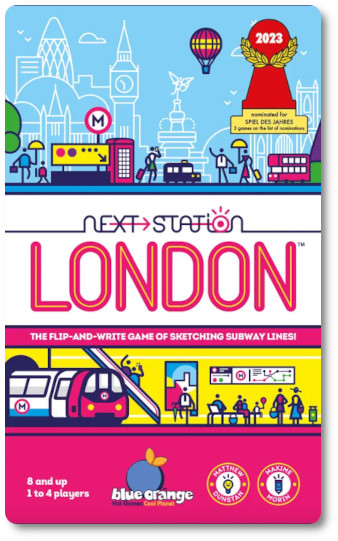
Next Station: London, designed by Matthew Dunstan and published by Blue Orange Games, is comprised of 200 scorepad sheets, 20 cards, and four color pencils. The component quality is excellent, with durable cards and stylized, colorful artwork by Maxime Morin.
Buying Your Ticket
Note: Next Station: London can be played with up to four players, with slightly different rules for three-, two-, and one-player games. There is also an advanced gameplay mode for those hungry for a bigger challenge. Summarized here is the setup for a four-player game. Games with three or fewer players and the advanced game play mode are summarized in the Game Variant section of this review.
To set up the game, complete the following steps:
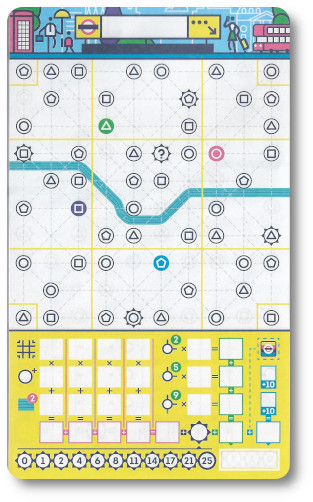
First, give each player a fresh (not previously used) scorepad and a pencil of any color. The pencils provided come in four different colors. Throughout the game, players will use all four pencils, so don’t get attached to any color. The scorepads are all the same, so no need to try to find an easier version than your opponent. On a sidenote, the scorepad depicts a map of London that is only slightly less confusing than the real one.
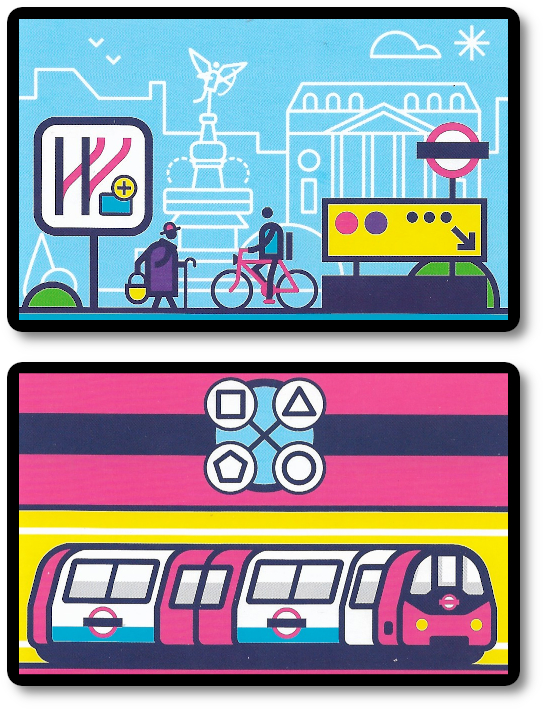
Second, shuffle the Street and Underground cards together (the blue and the pink cards) to create your draw deck. Place the deck face-down in the middle of the playing area where everyone can see it.
That’s it for game setup. Flip the first card and start the game!
Mind the Gap!
Next Station: London is played in four rounds. The number of turns all players have at the same time during a round is variable (anywhere from five to ten) and dependent on what cards are revealed. Regardless, every turn during a round is completed as follows:
Step One: Reveal a Card
The first step in every turn is to identify the departure station. When you start the game, and at the start of every round, the starting location from which you must first originate your line is the symbol that matches your colored pencil. So, if you are using the blue colored pencil, you’d start your line for the current round from the score pad’s blue pentagon. These are referred to as the players’ departure station.
Flip the top face-down card over from your draw deck. The card will be either a blue Street card or a pink Underground card. These cards do the same thing, inasmuch as they identify a station by using one of the four symbols (triangle, circle, pentagon, or square). There is also a “wild” card that shows all four symbols and splits.
If the drawn card shows a shape or all four shapes, proceed to the next step.
If, however, the card shown is a split, then draw the next face-down card. This card goes with the split and will be resolved in the next step.
Step Two: Draw Your Line, Maybe
Given the card or cards drawn, the player must now make a choice. They can decide whether to draw a line, creating a permanent route.
Most of the time, the player will be asked to draw a single line. When doing so, they must continue their current line color, extending it at either end. Of course, there are a few rules that are summarized here. Refer to the rule book for visual examples and a deeper explanation.
- Drawing a line is always optional. It is in the player’s best interest to do so, but for reasons that will quickly become obvious, there are some lines you won’t want to complete because they will greatly reduce possible lines in the future. There is only so much space in London, after all.
- Each line drawn must be a single, horizontal, diagonal, or vertical line. There are dotted lines on the score pad to help players connect the lines.
- The first line drawn must connect the player’s departure station to whatever the card’s revealed symbol shows.
- All subsequent lines must increase the line’s length by adding it to the current line’s color at both ends.
- Each line drawn must connect two stations without crossing any other station or any line already drawn. You also cannot go through a station that is already part of the same line.
The split card (referred to as the “Railroad Switch”) allows the player to draw a line from any of their current stations, breaking a few of the above-stated rules, but just this once and only when the split is revealed during the first step.
Worth mentioning are two special stations. The first is one with a question mark (?), which indicates that the station can be connected to using whatever symbol is currently shown. The second are the tourist site stations that awarded the player bonus points at the end of the game.
After all the players have drawn their line (or decided to skip drawing the line), the turn is over, and the next card is drawn, but only if the round hasn’t finished.
Finishing the Round and Ending the Game
The current round ends when the fifth pink Underground card is drawn and revealed. All players finish their turn as normal, then determine the points earned for that round. This is done by calculating how many routes were taken, how many times the lines crossed under the river (specifically the Thames River), and how many tourist spots were visited. These are all recorded on the player’s scorepad and added together to record how many points the player made that round.
If the players have completed four rounds, the game ends, and final scoring takes place. Otherwise, the colored pencils are passed to the next player to the left (meaning each player is given a new colored pencil), and the cards are shuffled. Start the next round as already described.
If the fourth round is finished, all players now determine their final score by adding their last-round score to the previous three and applying any bonuses from connecting stations with multiple splits. If playing with the advanced rules, completing objectives can improve the player’s score.
The player with the most points wins the game.
Game Variants
As mentioned, Next Station: London can be played solo. The gameplay is more or less the same, with a few specific changes, including your overall victory, which is determined by comparing your total points scored to the rule book’s definition of how well you did. When playing with two to three players, each colored pencil will still be used, but one or two are set aside until each player uses them during the game.
The advanced game play mode introduces Objective and Pencil Power cards. Objective cards give players additional goals that they all share. If the player can achieve them by the end of the game, additional bonus objective points are won. The Pencil Power cards give each of the four pencils a unique power that each player will be able to use during their turn with that specific pencil.
To learn more about Next Station: London, visit the game’s webpage.
Final Word
 The Child Geeks enjoyed the game a great deal, but were frustrated at the end because the points were not as high as they had expected. This has everything to do with the fact that the Child Geeks understood how to score points but not how many they had at any given time. According to one Child Geek, “I like this game a lot and will always play it again. I don’t like that I don’t know all of my points until the very end.” We helped with this by taking a moment every other round to help the Child Geeks understand how they earned their points. This certainly reduced some of the anxiety and unknowns, but the Child Geeks never really understood the scoring. Not that it mattered. As one Child Geek put it, “I don’t care if I win or lose. I just want to play.” And play they did, again and again. When the last train left the station, the Child Geeks took a vote, and all agreed that Next Station: London was an excellent time.
 The Parent Geeks had no problem with the point calculation and took their route-building to a new level of intensity, attempting to squeeze every possible point to win. According to one Parent Geek, “What I like so much about this game is how much creative freedom you have and what that means when building out your subway line. I found it fascinating to look at how other people drew their maps at the end of the game.” Another Parent Geek said, “Really good game. I love train games, and this was no exception. My only dislike was some of the restrictions, but those just meant more creative problem-solving on my end. I would definitely play this again.” When the votes were counted, it was clear that the Parent Geeks would gladly buy a ticket to play this game again.
 The Gamer Geeks took a very different approach to this game. Instead of the intensity they normally bring to the table, their games were very relaxed and casual. A weird turn considering that this group goes out of its way to be as aggressive as possible. One Gamer Geek said it best when they reported, “The game is very relaxing and casual, but not in a boring kind of way. Each line is very important. Every decision essential to your plans to win. But never to a point where it was stressed. I took my time. So did the other players. We all thought it was very chill.” Another Gamer Geek said, “I think this is a great game to play while you wait for others or when you want to play a game with serious people, but also want to be very casual and visit with each other. A great way to just relax with your fellow gamers.” When the last whistle blew, every Gamer Geek climbed on board and was happy with the ride.
 Fun fact, and not at all surprising, this is one game in a series. There is also a version that covers the Paris Métropolitain and the Tokyo Metro. I haven’t had the pleasure of playing these two games, and I’m only mentioning them because you might want to explore this game series further or start with a specific railway system that has special meaning to you. For example, I’ve used the London Underground a number of times and haven’t had a single issue. I have horror stories about how lost I became trying to navigate the Paris Métropolitain. Buy me a coffee, and I’ll regale you with my stories of multiple panic attacks and a little bit of (manly) crying.
As groups reported, Next Station: London was a great success. A casual game filled with important choices and immediate results. While the scoring tripped up our youngest players, everyone understood the game and enjoyed it from their first line to their last. A great new take on train games that everyone enjoyed and wanted to play again and again. Good thing the game comes with a large scorepad.
Do try Next Station: London when the next opportunity presents itself. I think you’ll enjoy the ride.
This game was given to Father Geek as a review copy. Father Geek was not paid, bribed, wined, dined, or threatened in vain hopes of influencing this review. Such is the statuesque and legendary integrity of Father Geek.