Please note: This is a review of a demo/prototype game. The game is being reviewed based on the provided components and rules, with the understanding that “what you see is not what you might get” when the game is published. If you like what you read and want to learn more, we encourage you to visit the game publisher’s website or the Kickstarter campaign page.
 The Basics:
- For ages 8 and up
- For 2 to 6 players
- Variable Game Play Length
Geek Skills:
- Active Listening & Communication
- Counting & Math
- Logical & Critical Decision Making
- Reading
- Pattern/Color Matching
- Strategy & Tactics
- Risk vs. Reward
- Cooperative & Team Play
- Hand/Resource Management
Learning Curve:
- Child – Moderate
- Adult – Easy
Theme & Narrative:
- The great space race to the furthest edges of the galaxy to find glory or alien invaders has begun
Endorsements:
- Child Geek approved!
- Parent Geek approved!
- Gamer Geek approved!
Overview
Humanity has discovered a means to travel through space fast enough to reach distant galaxies. The great space race has begun, with captains taking to their ships and probing the furthest reaches, finding adventure and riches. But there is danger. Others covet treasure and will take any opportunity to gain an advantage. There is also the threat of a new alien species that is growing increasingly interested in Earth and its resources. It is a new age of adventure and danger. Space is open to all to explore. Just cross your fingers you don’t find something that wants to blow you to atoms.
Space Nexus, designed by Karl Batdorff and to be published by Batdorff Games, will reportedly be comprised of 48 Space Nexus tiles, 24 Earth Ships (in six different colors), 24 standard six-sided game dice (in six different colors), one First Player Nexus die (which also acts as the Earth Defender die), three Nexus Trophy information boards, two Alien Special Ability information boards, one Combat board, 75 Nexus Trophy tokens, 60 Alien Ship tokens, 14 Defender of the Earth Medalian tokens, one Combat marker, and 160 Space Nexus cards (that cover events, exploration, combat, defenders, goals, and movement). As this is a review of a prepublished game, I cannot comment on the game component quality, nor can I provide much of a review of the finished artwork.
One Game, Multiple Ways to Play
Space Nexus includes many components, but not all are used. What is used depends on the game variant. You have the option of two game variants to choose from, which not only determine how the game is set up and the components used, but also determine the nature and the length of the game. Each game variant is summarized here.
To Boldly Go
A competitive game variant where each player is the captain of their spaceship. The objective is to race to the end of the known galaxy, taking shots at opponents’ ships, and reach one of the goal cards before anyone else. This is one of the faster game variants, taking only about 45 minutes to complete. It also happens to be the easiest to teach, due to minimal game components and the straightforward objective before each player. I recommend you play this game variant when first learning how to play or playing with younger or inexperienced players.
Victory goes to the first player to have each of their Space Ships reach one of the goals. The first player to do so immediately ends the game.
Alien Onslaught
A cooperative game variant where the players are now protecting Earth after drawing too much attention to the human race with their reckless space travel and exploration. Combat is heavy, requiring players to devise empowering strategies and thoughtful tactics to stay alive and push back the alien invaders. Due to the game’s larger scale and depth of play, this variant can take up to three hours to complete. This game variant is not recommended for younger or inexperienced players.
Victory goes to the players only if they survive the aliens. The aliens win if a number of Alien Ships reach Earth. This number is twice the number of players. For example, in a six-player game, the players lose if 12 Alien Ships reach Earth.
Challenging and Impossible Mode
The two game variants offer different experiences, but some players might find the cooperative variant’s gameplay too easy. Good news! Included in the rules are two game difficulty modes to choose from. These are “Challenging” and “Impossible.” As their names suggest, the cooperative game variant becomes significantly more difficult.
Challenging mode invites players to add additional Alien Ships, changing the roll values in combat, and placing key locations known as “Invasion Points” closer together, allowing the Alien Ships to form massive battle fleets much faster.
Impossible mode introduces rules that really do make the game almost impossible to win. To date, none of our players have won the cooperative game variant with the adoption of the impossible mode game rule changes, but they all reported that the game was a much more intense and enjoyable experience for the most elite of our Gamer Geeks. Rules that include even more Invasion Points, changing the roll values in combat to a greater degree, and faster groupings of Alien Ships. Don’t try this game mode unless you are truly in the company of exceptional gamers.
The Role of the Components
As mentioned, the components used in the game depend on the game variant. Summarized here are a few of the more noteworthy components.
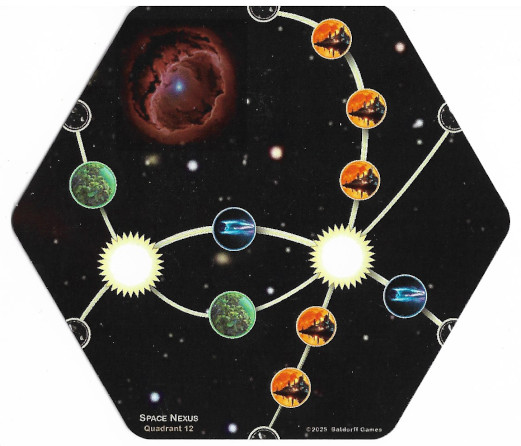
Space Nexus Tiles
These represent different quadrants of space. Most of them have interconnecting space lanes that the player’s Space Ships will travel on. A few have wormholes that allow for travel to different points in space.
Earth Ships and Alien Ships
The Earth Ships represent the player’s fleets in the game, traveling through the game’s quadrants via space lanes and wormholes. The Alien Ships represent the different types of spaceships in the alien fleet.
The Dice
The standard six-sided game dice are used for movement. The color of the die determines where the player’s Space Ships can land. You want to roll big to take down the Alien Ships when in combat. The First Player dice is a customized six-sided die shaped like a spaceship that, depending on the game variant, either assists with movement or combat.
The Cards
There are several different cards in the game.
Nexus Event cards: These represent different events that unfold in space. Not all of them are good.
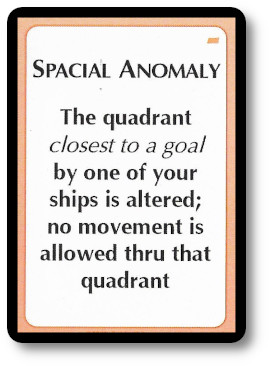
Explorer cards: A set of five cards available to the player. Each card provides the player with a special ability. These cards are limited in use, making them a handy resource that should not be foolishly wasted.
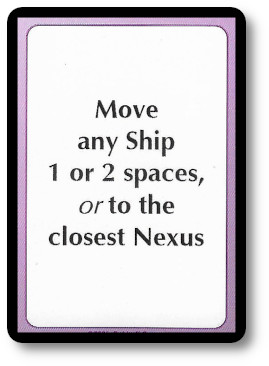
Defender cards: These cards are used when defending Earth against the alien invasion.
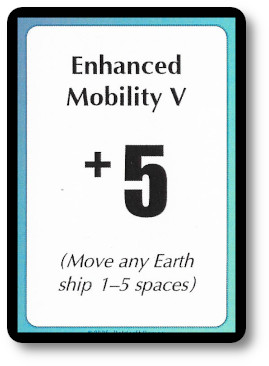
Combat cards: These cards change the space around combat, adding additional twists and rules. The outcome of these cards could be beneficial or harmful to the players.
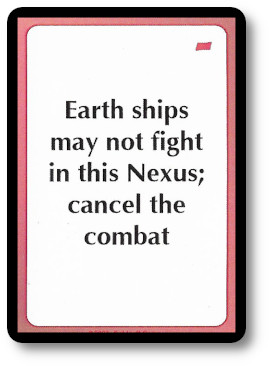
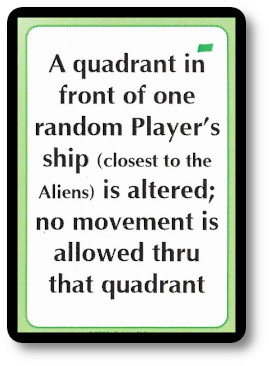
Movement cards: These cards change the standard rules and laws of space travel. The outcome could benefit the players or the alien invaders.
To learn more about Space Nexus, visit the game publisher’s website or the Kickstarter campaign page.
Final Word
 The Child Geeks had a great time with Space Nexus, as long as they were playing the competitive game variant. It must be noted that this is a radical change from what we normally see from our youngest and most inexperienced players. Usually, games where players can “attack” each other are less enjoyable than cooperative games where everyone works as a team. Not the case at all here. According to one Child Geek, “My favorite version of the game was when we all raced to different locations in space. I liked how you had to use the dice to match where you wanted to go, and you could always zap an opponent as they flew by. I didn’t like the cooperative game because the Aliens were hard to attack.” Another Child Geek said, “I thought the cooperative version of the game was fun, but I liked the competitive game version much better. I think it’s because I was able to make my own choices instead of having to listen to others tell me what I should do. Also, it didn’t take as long as the cooperative game.” When the last spaceship landed safely, the Child Geeks took a vote, and all agreed that Space Nexus was a lot of fun.
 The Parent Geeks also enjoyed the game but found the cooperative variant much more interesting and engaging than the competitive one. According to one rather excited Parent Geek, “So much fun! Helping each other and coordinating our attacks as we fought to save Earth was not only exciting but also felt really good when we drove the aliens back into deep space.” Another Parent Geek said, “Both of the game variants were a lot of fun, and the Challenging mode rules certainly kick it up a notch, making the cooperative much more intense. I think both of the games were great, but I preferred the cooperative game due to the way we all worked together.” When the last alien was driven back, and Earth was once again safe, the Parent Geeks took a vote, and all agreed that Space Nexus was worth their time at the gaming table.
 The Gamer Geeks didn’t much care for the game as a whole until all of the Challenging and most of the Impossible modes were introduced. That’s when the Gamer Geeks sat up, took notice, and worked hard not to get their butts kicked. According to one Gamer Geek, “The game is straightforward to teach and to play. Too easy, in my opinion. There isn’t much that is new or terribly exciting. However, once you add different game modes, the game gets really difficult without adding a bunch of new rules. I liked this. It gave us a sliding scale of difficulty, allowing us to tailor the level of pain we wanted to endure.” Another Gamer Geek said, “A fairly hollow game in my opinion. Not much to get excited about when looking at the components and the gameplay described to me. When you pitched it, it didn’t sound all that interesting or inventive. Of course, all of that changed once we introduced the different game modes. I liked this additional challenge and made the game-playing experience with my fellow geeks memorable. I’d play it again with the right crowd, but only if the impossible mode was used.” When the final game was concluded, the Gamer Geeks took a vote and agreed that Space Nexus was passable, but barely. It was only when game modes were added that the game retained the interest of elitist gamers.
 Space Nexus offers two games to its players, tailoring the game experience to both skill level and time. I really enjoyed this aspect of the game, but, like the Gamer Geeks, I found the game as a whole not very interesting. And, like the Gamer Geeks, my thoughts on the game did a complete about-face once the game modes were introduced. This is where – again – the game really shines, giving players options to scale up or down the difficulty and their overall experience. Even better, the additions do not break or bend the rules. Everything gets more complex and more intense. Same gameplay. Same decision. What really changes is the consequences of making good choices or bad choices. Consequences, I must add, you can see right away. The game has a way of teaching you tough lessons with a smack rather than a gentle tap on the shoulder.
Do try Space Nexus when you get a chance. One game provided all of my players with different experiences, joys, frustrations, and ultimately, cheers. It is seldom that we are provided a game that allows for various types of play and still keeps everyone interested. While I do not see Space Nexus as a new gem, it most certainly shines and was worth our time.
This game was given to Father Geek as a review copy. Father Geek was not paid, bribed, wined, dined, or threatened in vain hopes of influencing this review. Such is the statuesque and legendary integrity of Father Geek.