 The Basics:
- For ages 8 and up
- For 2 – 8 players
- Approximately 30 minutes to complete
Geek Skills:
- Active Listening & Communication
- Counting & Math
- Logical & Critical Decision Making
- Reading
- Strategy & Tactics
- Risk vs. Reward
- Hand/Resource Management
Learning Curve:
- Child – Easy
- Adult – Easy
Theme & Narrative:
- Explore the house to find the best bits and bobs to make the ultimate mouse nest
Endorsements:
- Child Geek approved!
- Parent Geek approved!
- Gamer Geek rejected!
Overview
Early Latin playwright, Titus Maccius Plautus, wrote, “A mouse does not rely on just one hole.” In this game, players will be taking on the role of a mouse who explores a home kept by some very slobbish owners. Around every corner is a treasure to be found and carried back to the mouse’s nest to be lovingly displayed and highly coveted by their fellow mice. Be warned, however, that not everything you find will be of value but will take up precious space.
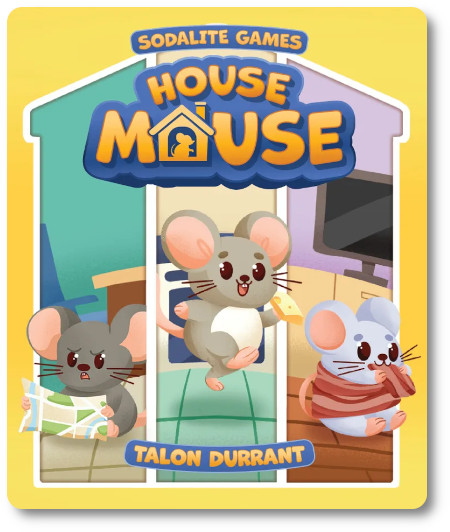
House Mouse, designed by Talon Durrant and published by Sodalite Games, is comprised of 64 Point cards, 32 Power cards, 12 Boost cards, eight Room cards, and eight wooden Mice meeples. The cards are as thick and durable as standard playing cards. Illustrations by Natalie Hvozd are bright and colorful, giving life to the game’s thematic elements.
Getting Ready to Scurry
To set up the game, follow the steps below, taking note that the game setup at the table varies depending on the number of players.
First, shuffle the Room cards and place them on the table in any order, following the instructions in the game’s rulebook regarding their placement. Each Room card represents a different location in the house, but there are no special rules associated with each room. As such, players are welcome to use any Room card they like as long as the number of cards and the layout on the gaming table match the rulebook. Any unused Room cards are returned to the game box.
Second, shuffle the Point, Power, and Boost cards together and treat them as a single deck of cards. Deal one card face down to each corner of the Room cards. Set the remaining cards off to the side and face down. This is the draw deck for the duration of the game.
Third, have each player select a Mouse meeple color of their choice. This meeple will represent the player during the game. Any unused meeples are returned to the game box.
That’s it for game setup. Determine who will go first. In reverse turn order (meaning, starting with the last player), have each player place their Mouse meeple on any unoccupied Room card corner.
A Mouse In a House
House Mouse is played in turns with no set number of turns per game. A player’s turn comprises three possible actions. Each action can be taken in any order and taken multiple times, as long as the player takes no more than three actions in total. A player is never required to use all of their actions.
Scavanage
The Scavange action allows the player to pick up the card next to their Mouse meeple. Point and Power cards are placed face-up in front of the player. The player’s collected cards are referred to as the player’s “Nest.” Each player’s Nest should be visible at all times to their opponents.
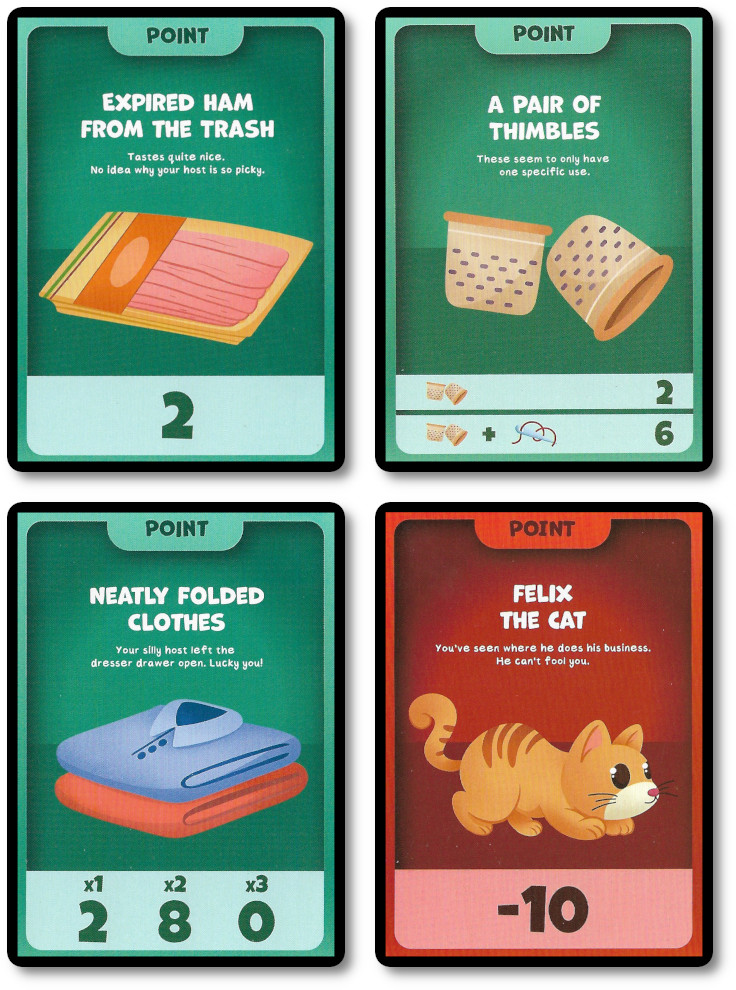
If the player collects a Boost card (explained in a moment), the card goes into the player’s hand, not their Nest.
Move
A player may move their Mouse meeple to any adjacent Room card corner that an opponent does not occupy. However, players can move through an occupied space if they use two actions to do so. Room cards that touch corners are considered to share the same corner. For example, three Room cards all touching will have one shared corner.
If a player ever moves their Mouse meeple (or is forced to move it) to a Room corner that has a face-up (visible) card, the player must collect it as a free Scavange action.
If a player moves their Mouse meeple away from a Room corner that does not have a card, they draw one now from the draw deck and place it face down to occupy the free Room corner space.
Activate Power
If the player has a Power card in their Nest, they may activate it and resolve its effect. Each Power card can only be used once per player’s turn.
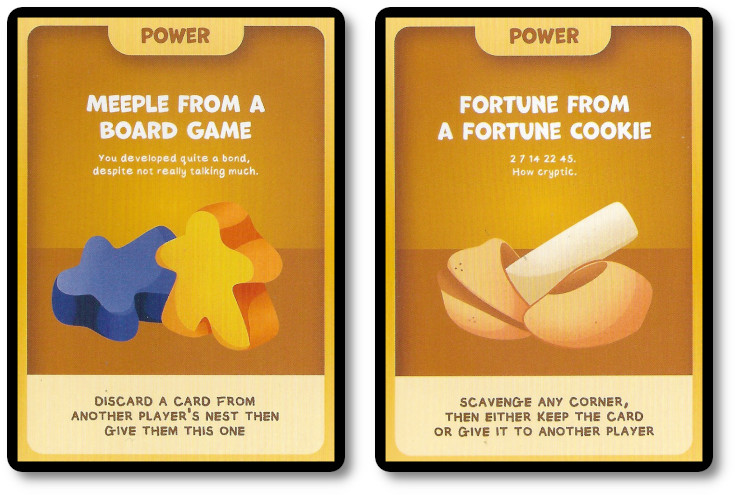
When a player collects a Power card via the Scvanange action, they may activate it as a free action before their turn is over.
Activated Power cards remain in the player’s Nest unless otherwise stated by the card’s rules. When activating the Power cards, players should take a moment to consider the order in which they are used, as players can chain Power cards to create interesting situations and opportunities to get cards and get rid of them.
Mighty Mouse
Boost cards are collected during the player’s Scavange action and go immediately to the player’s hand, not their Nest. There is no hand size limit.
Boost cards can be played at any time during the game, regardless of whether it’s the player’s turn or not. Once played and resolved, Boost cards are discarded for the duration of the game.
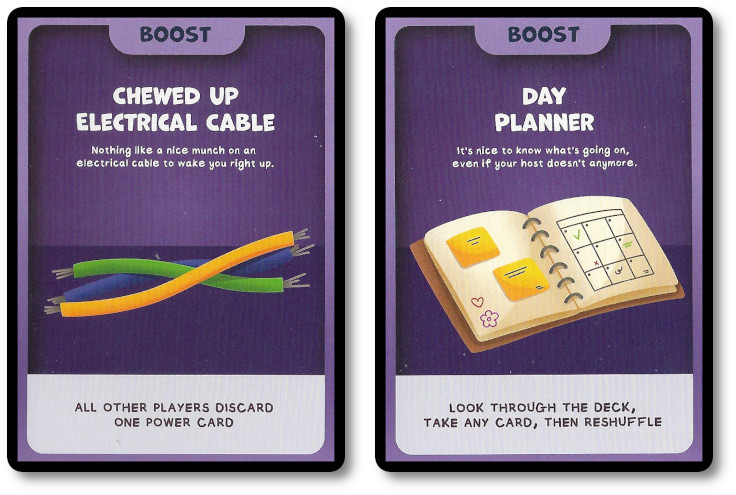
Boost cards are designed to introduce a “wrinkle” to standard gameplay, either hindering an opponent or aiding the player (often both).
Home Sweet Nest
The game continues with players taking turns in turn order sequence until one player ends their turn with 12 cards in their Nest. All players now add the number values listed on their Point cards that are in their Nest. The player with the most points wins the game. Note that Point cards can add points and reduce points, as well as give more points based on the number collected, and can even be worth more if combined with another card!
Game Variant
House Mouse can be played with two players. If only two crafty mice are available, introduce to the game Basil, a rather ambitious and highly active mouse. Basil always takes their turn last and moves to the closest face-up Point card, adding it to their own Nest. Basil has no interest in Boost or Power cards and will never scavange them for their Nest. If Basil ever has 12 cards in their Nest, they will trigger the end of the game.
To learn more about House Mouse, visit the game’s webpage.
Final Word
 The Child Geeks had a great time pretending to be an overly excited mouse running around the house collecting bits and bobs. Turning over every new card to discover something new was exciting, but sometimes left the Child Geeks feeling like they were collecting junk. According to one Child Geek, “I like how I have to discover things in the house, but I don’t like that I have to take everything I find.” Another Child Geek said, “The best part of this game is finding things. Sometimes they are good and sometimes they are bad, but they are always interesting enough for my little mouse to bring back to its nest!” When the last little mouse returned to their nest, safe and warm, the Child Geeks took a vote and all agreed that House Mouse was an excellent game for them.
 The Parent Geeks thoroughly enjoyed interacting with the players, both their family and peers, finding the game to be casual and somewhat like a race. Like the Child Geeks, the Parent Geeks didn’t like it when they were forced to take negative Point cards, but neither did they find it a significant problem overall. According to one Parent Geek, “There are cards in the game that you will be stuck with and cost you points, but they are far and few between. Most of the time, I was collecting good stuff, and that all leads to victory.” Another Parent Geek said, “I had a lot of fun with my kids and enjoyed it with my partner and friends. It is light enough to be easily played while visiting and enjoying each other’s company without upsetting the flow of the game or the decisions that need to be made.” When the last bit of cheese was whisked away, the Parent Geeks took a vote and all agreed House Mouse was a great game for their family.
 The Gamer Geeks enjoyed the game, except for one very important aspect that left a bad taste in their gaming elitists’ mouths—specifically, the blind pickup of cards during the Scavenger action. According to one Gamer Geek, “The game is well designed and entertaining, and I love the way you chain cards for more points, but it really missed the mark for me that the cards I want to collect are completely blind to me. I create Power chains and collections just by chance in most cases. Worse yet, with only 12 cards per Nest, you can collect junk that will hurt you unless you are lucky enough to find a card that allows you to move cards in and out of your Nest.” Another Gamer Geek said, “A great concept and almost flawless execution except for the blind collection of cards. I really don’t know why they did that. If I am being asked to collect the best possible cards to make the most points, then give players better visibility to the cards.” When the games were over, the Gamer Geeks took a vote, and all agreed that the blind card draw was just too big a miss to overlook, resulting in the gaming elitists removing the game from their gaming table.
 To clarify, there are cards available that enable players to view face-down cards, move cards, and take cards. However, these cards must be found – blindly – via the Scavange action or through Power cards (which were also most likely found blindly). What frustrated all our players is the obvious winning advantage a player has over their opponents if they find a card that allows them to learn what the face-down cards are or force cards to move ownership. So one-sided and overpowered is the “Power” that once it’s collected, all players hotly covet it and go out of their way to take it for their own. Which, admittedly, is not surprising but is terribly distracting and highly frustrating.
That said, out of the 64 available Point cards, only 10 of them will reduce the player’s total number of points, but some of the sets you collect will reduce your points if you don’t have enough of them or too many. It’s a strange points system in the game to be sure, as the game wants the players to explore, but then punishes them for exploring too much or even at all. The saving grace here is that House Mouse is a very light game. The set-collecting aspect, which would give players more powers and points, is an awesome idea that is poorly executed.
And yet, you can still have a good time with the game, but only if you play aggressively. There is simply no way short of exceedingly dumb luck that you’ll get the cards you want to or don’t want for set collecting. You will need to steal cards and give them away to complete sets, create Power combos, and get rid of cards that are just taking up space in your Nest. This level of aggression, however, is only possible through cards that you find at random. Yet again, the game provides a means, but the method to obtain them remains a matter of chance.
If you are looking for a fun family game of finding treasure in a house riddled with vermin, then look no further than House Mouse! While the game lacks game-play elements that put the player more in the driver’s seat when it comes to card collecting, the fast-paced action smooths out this wrinkle by providing a game that doesn’t stop until everyone is out of breath with an overly full nest of “stuff.” If this sounds like a good game to you, I encourage you to scurry to it as soon as possible.
This game was given to Father Geek as a review copy. Father Geek was not paid, bribed, wined, dined, or threatened in vain hopes of influencing this review. Such is the statuesque and legendary integrity of Father Geek.