 The Basics:
- For ages 10 and up
- For 2 to 6 players
- Approximately 45 minutes to complete
Geek Skills:
- Active Listening & Communication
- Counting & Math
- Logical & Critical Decision Making
- Strategy & Tactics
- Hand/Resource Management
Learning Curve:
- Child – Easy
- Adult – Easy
Theme & Narrative:
- To be a hero, you have to be a zero
Endorsements:
- Child Geek approved!
- Parent Geek approved!
- Gamer Geek mixed!
Overview
If the inter-web is telling me the truth (really hard to tell nowadays), the earliest known card game originated in China in the 9th century, or roughly over 1,225 years ago (as of the date of this review’s publication). Since then, humanity has continued to create and play games using cards or card-like components. Today, in a world of digital wonder, we play card games on the computer. It comes as no surprise that new games are published every year using nothing other than a deck of cards. In this game, the traditional approach to a classic card game is revised and refined for the modern age.
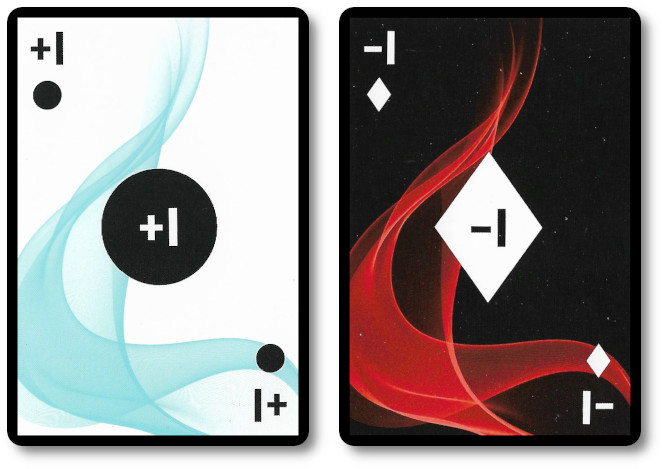
Absolute, a card game designed by Tony Diaz and published by Nonymous Games, is comprised of 88 cards. The cards are as thick and durable as your standard playing card. Illustrations are minimal, focusing on simple icons to convey a card’s number and suit.
Setting Up the Game
To set up the game, follow these steps.
First, take all the cards and shuffle them.
Second, deal each player five cards, face down. Players should look at their cards but keep them hidden from opponents until played.
Third, place the remaining deck of cards face down in the middle of the playing area. This is the draw deck for the duration of the game. Draw the top-most card and place it next to the draw deck, face-up, to start the discard pile.
That’s it for game setup. Determine who will be the first player and begin.
Running the Numbers
Absolute is played in rounds, with three rounds per game. A player’s turn during a round is summarized here.
Step One: Draw a Card
The first thinga player does on their turn is draw the top-most card from the draw deck or take the top-most card from the discard pile. Regardless of which card the player takes, it is placed in their hand.
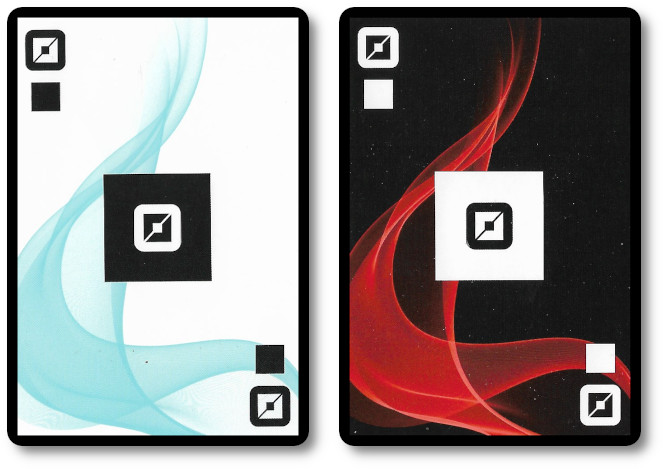
Cards represent negative and positive numbers ranging from 0 to 10 across four suits (circles, diamonds, squares, and, as the Child Geeks like to say, “ninja stars”).
If at anytime there are no more cards in the draw deck, place the top-most card on the discard pile to the side, shuffle the remaining cards in the discard pile, and then place the shuffled cards face-down to be the new draw deck. The set-aside card from the old discard pile starts the new discard pile.
Step Two: Swap Cards (Optional)
A player may, optionally, swap any two cards from their hand with any two cards currently in a set. These include sets that were played in front of the player’s opponents.
A “set” is any group of three or more cards whose sum equals zero.
A player cannot swap cards to a “locked set” (any sets owned by an opponent who has “gone out”). Any cards the player swaps out must not change the set’s sum value. For example, the player cannot swap a “-2” for a “+2” because that would change the set’s sum. A player could, however, swap a “-2” and “-3” for a single “-5” card.
Step Three: Play Cards (Optional)
A player may, optionally, play sets of three or more cards in front of them that have a total sum of zero. They can also play cards to existing sets (again, making sure the total sum remains zero), and even regroup sets.
“Regrouping” allows you to move cards from one set to another set. This is where the “zero” card is particularly powerful, as it acts as a “wild card” and can take any value from zero to ten. However, only one “zero card” can be played to a set, it can only represent a positive or neative number based on the card’s sign (positive or negative), and can only be swapped for their current represented value in the set (for example, a player could swap a zero card with a “-3” if the zero card was currently representing that value).
Step Four: End Turn
You’ll note that a player is never forced to play a card. If they decide not to, they can simply say “hold,” and their turn ends. If the player did not play a card, they can discard one from their hand. If the player played a card by swapping or setting down new sets, they must discard a card. Regrouping is not considered playing a card and does not force the player to discard at the end of their turn. Regardless if player played a card or not, they must discard down to seven cards in their hand.
This ends the player’s turn. The next player in the turn order sequence now takes their turn.
Ending the Round and Scoring
The round’s end is triggered if any player is able to discard their last card in their hand and has at least three sets played in front of them. This player has “gone out,” and all the sets in front of them are now considered “locked,” meaning they can no longer be played to, swapped, or regrouped. The round ends when the last player in the round completes their turn. The round is then scored.
Scoring is completed one set at a time and in the order listed here.
- A set’s base points are the largest absolute number value of that set (an absolute number is any number that is positive).
- Plus one point per card in a set beyond the required three cards. For example, a set comprised of five cards would score two points.
- Plus one point for each card in a positive or negative run of three or more cards.
- If the set is composed of the same suit or the set is composed of four or more of the same absolute number, the total for the set is doubled.
After finding the value of each played set, add them together and then subtract one point for every card still in the player’s hand. The sum is the player’s score for the round.
After three rounds, the player with the most points (based on adding up the total points from the three rounds) is the winner.
To learn more about Absolute, visit the game’s web page.
Final Word
 The Child Geeks were highly skeptical of a math-themed card game. As one Child Geek put it, “Will this game feel like homework?” After teaching the game and standing back to observe the Child Geeks play, it quickly became obvious that the math, while ever-present, was not in the slightest despised. In fact, “crunching the numbers” during each player’s turn became a fun exercise as each of the Child Geeks proudly belted out the results of their cards played to the table. According to one Child Geek, “I thought this was going to be nothing but a math game, but it isn’t. I also guess that every game we play uses math, but this one isn’t any different from those. It was a lot of fun!” Another Child Geek said, “I liked it. The game was fast. I had an easy time doing the math in my head, although I used my fingers a few times.” When the last game was completed, the Child Geeks crunched the number and all decided they rather enjoyed Absolute.
 The Parent Geeks immediately enjoyed the game, finding it a fun approach to a quick, yet thoughtful, card game. One Parent Geek said, “The math is easy, but you cannot slouch. I found myself constantly scanning the table for easy pickups and plays. Because the math is so easy, it made it more complicated in a way. I kept trying to optimize my numbers, really impress the other players, and as a result, had a great time.” Another Parent Geek reported, “A great card game that takes a lot of what I enjoyed as a kid playing card games with my grandma and bringing it back to me in a nice little wrapper that is easy to enjoy with friends and family.” The results of the Parent Geek’s vote? They absolutely loved Absolute.
 The Gamer Geeks enjoyed the game’s approach and speed of play. They also enjoyed how the simplicity of the math made the plays at the table easy to understand at first, then more complicated as they chased the big points and attempted to spoil opportunities for their opponents. But that wasn’t enough to win over all the gaming elitists. As one Gamer Geek put it, “This is a simple card game using a new approach to a very old concept. I think the ideas in Absolute, which is essentially a twist on Rummy, were first seen in the 19th century. Yeah, this is old. It works, not arguing that point, but it certainly isn’t new.” Another Gamer Geek said, “Despite it just reusing overly boiled game mechanics, I enjoyed it. The games were fast, engaging, and fun. I’d play this card game again on lighter game nights.” When the votes were collected, the results showed that the Gamer Geeks didn’t overly love Absolute, but nor did they dislike it.
 Absolute is very close to Rummy. If you are familiar with Rummy, you know how to play Absolute, but that’s the only advantage you’ll have at the table. This is a very “mathy” game, meaning you’ll need to know your way around quick addition and subtraction more than counting cards or playing the odds. The math, while always present, is not difficult. Our youngest player was in fourth grade and had no problem quickly adding and subtracting numbers. Yes, they used their fingers a lot to help keep track of their addition and subtraction (which was adorable), but that didn’t stop them from playing, competing, and having fun.
I have always been and most likely will be forever a fan of the classics. Like a few of the Parent Geeks, I have fond memories of playing games like Spades, Hearts, and yes, Rummy around my grandparents’ table, on picnic tables, and even in a restaurant or two. The fact that there are so many games available to you from a single deck of 52 cards is amazing. If you want to go down a rabbit hole and avoid work for a couple of hours, explore all the many, many, many games you can play with that deck of long-forgotten cards at Pagat.com. It is insane how many games have been made, revised, refined, and repackaged again and again.
Absolute is no different. It is the next generation and revision of a long-loved and played card game. Not better. Just different.
But is it worth playing? I think so. I enjoyed the game a great deal, but let us also recall that I have a lot of nostalgic love for games like Absolute. Yes, you bet it compromised my ability to remain neutral. In the same way, people love Uno because they played it as a kid and have happy memories associated with it, despite it being one of the worst games ever made and a plague to mankind. My point, beyond saying clearly that Uno is no bueno, is that nostalgia influenced our players in every way except the Child Geeks.
Do try Absolute when you get the chance. It doesn’t matter whether you are familiar with Rummy or similar games. The rules are intuitive, the gameplay is engaging, and your time at the table will be well spent. We did the math, and it all adds up: Absolute was a good time.
This game was given to Father Geek as a review copy. Father Geek was not paid, bribed, wined, dined, or threatened in vain hopes of influencing this review. Such is the statuesque and legendary integrity of Father Geek.