
Please note: This is a review of a demo/prototype game. The game is being reviewed based on the provided components and rules, with the understanding that “what you see is not what you might get” when the game is published. If you like what you read and want to learn more, we encourage you to visit the game publisher’s website or the Kickstarter campaign page.
 The Basics:
- For ages 8 and up
- For 2 to 6 players
- Approximately 30 minutes to complete
Geek Skills:
- Active Listening & Communication
- Counting & Math
- Logical & Critical Decision Making
- Reading
- Pattern/Color Matching
- Hand/Resource Management
Learning Curve:
- Child – Easy
- Adult – Easy
Theme & Narrative:
- Collect in secret and win in plain sight!
Endorsements:
- Child Geek approved!
- Parent Geek approved!
- Gamer Geek rejected!
Overview
Indian teacher, philosopher, and royal adviser, Chanakya, wrote, “The biggest guru-mantra is: never share your secrets with anybody. It will destroy you.” In this game, secrets are necessary to win. Collect your cards in secret and be careful not to inform your opponents of your intent. Subtlety might be needed, but of even greater importance is staying agile and knowing that when you collect to your secret hoard, no one way is a sure victory.
Secret Hoard, designed by Karl F. Batdorff and to be published by Batdorff Games, will reportedly be comprised of 72 cards. As this is a review of the game’s pre-published version, we are unable to comment on the game component quality or the final artwork.
Collecting In Secret
To begin, take all the cards and shuffle them. Deal each player three cards and set the remaining deck of cards in the middle of the playing area to create the draw deck. From the draw deck, draw and reveal the top three cards, placing them face-up in a separate pile to create the discard pile.
Secret Hoard is played in turns with no set number of turns per game. A player’s turn is summarized here and is completed in the sequential order listed.
One: Draw Cards
The player may either draw two cards from the draw deck, take the top two cards from the discard pile, or take one card from the draw deck and the top-most card from the discard pile. These cards are added to any other cards already in the player’s hand.
Two: Play a Card
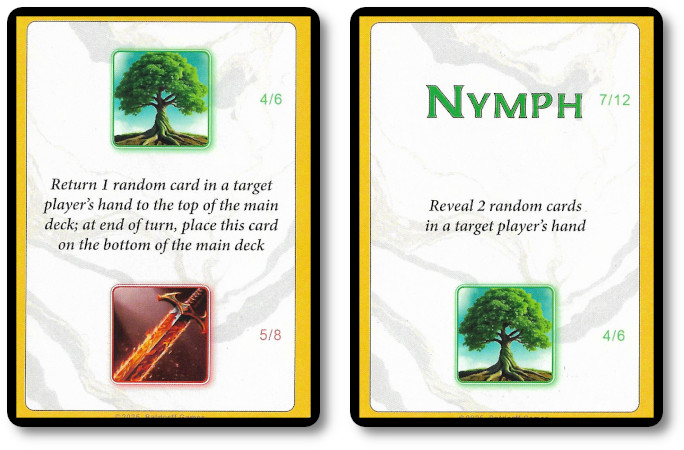
From their hand of cards, the player selects one to play, placing it in front of them face-up and reading it out loud. Every card represents two items and has a single action. Each card is unique, meaning no two cards have the same combination of items and actions. When the selected card is played, its action is resolved immediately and then discarded (unless otherwise directed by the card’s ability). Card abilities include, but are not limited to, drawing additional cards, discarding cards, and interacting with opponents’ cards.
Three: Optinoally Add to the Player’s Secret Hoard
As an optional action, the player may select any card in their hand and place it in their “Secret Hoard”, face down. Cards played here are collected by the player and protected (meaning opponents cannot mess with cards in the player’s Secret Hoard). What is placed in the hoard is up to the player, but some careful thought should be put into it.
Each item has a specific color (red, green, blue, or purple), category (shapes, symbols, images, or words), and a number value. The number value represents the number of cards needed to complete a set and the total number of this item found in the cards. For example, the “Nymph” item set (a green word) is completed after the player has seven of them in their Secret Hoard, and the “Nymph” can only be found on 12 of the 72 cards found in the deck.
Four: Optionally Switch Cards
As an optional action, the player may select one card from their hand and replace it with any card in their Secret Hoard.
Five: Discard Played Cards
The player’s last action on their turn is to discard any cards they have played on their turn.
This completes the player’s turn. The next player in the turn order sequence now takes their turn.
Letting Your Secrets Out
The game continues until one player has collected in their Secret Hoard a set of items out of a total of 16 entirely comprised of one category, or 12 cards from any category, but all share the same color. This player is the winner!
To learn more about the Secret Hoard, visit the game publisher’s website or the Kickstarter campaign page.
Final Word
 The Child Geeks had a great time playing this game, finding it easy to collect cards and play them, but the game was by no means easy to win. According to one Child Geek, “You have to really know what cards are in your hoard. Which is funny, because you want your hoard to be a secret to everyone, but I kept looking at mine over and over again.” Another Child Geek said, “I liked it. I felt like I was a dragon and was collecting treasure for my treasure piles.” When the last item was placed precariously onto the top of the Child Geeks’ ever-growing pile of secret stuff, they took a vote and collectively agreed that Secret Hoard was a great time.
 The Parent Geeks found the game to be a lot of fun with their kids, enjoying how quickly the game was played and the light, yet essential, interaction with the players. They also found the game to be entertaining with their peers, but with the same level of casual game play throughout, regardless of the audience. According to one Parent Geek, “A light and entertaining set collecting game that had me thinking harder than I thought was originally necessary, but was absolutely needed to win the game.” Another Parnet Geek said, “If this were just about collecting cards, I would be bored. With the addition of messing with my opponents’ cards, it made the game feel much more punishing at times, but with an enjoyable level of interaction.” When the Parent Geeks collected the last set, the results of their vote showed that Secret Hoard was a secret they wanted to share.
 The Gamer Geeks didn’t care for the game. Despite the player interaction, they couldn’t get past the game’s primary goal, which was set collecting. While a welcome approach found in many similar games, the light player interaction felt like an afterthought. They did, however, find an aspect of the game they enjoyed. As one Gamer Geek put it, “I don’t think this game is for me or my fellow elitists, but I did enjoy how every card was of value. I could either use it for its action, keep it for its set value, or even keep it in my hand as a decoy.” Another Gamer Geek reported, “Light and easy to learn, its greatest strength in ease of play was also what turned me off the most. I want more challenging games, and this one is just too casual for my taste.” When the Gamer Geeks revealed their secret hoard, it was found to be too small for their enjoyment.
 Secret Hoard is a lightweight and fast game. Players need to put some thought into their turns, as failing to do so will lead to missed opportunities to collect cards required to complete sets. Many times over, the Child Geeks elected to attempt to win the game by collecting colors, which was a great move if you don’t want to collect a set, but the Parent Geeks and the Gamer Geeks found that the road to victory was shorter if set collecting was the focus. Shorter, but by no means easier. A few of the Child Geeks beat the Parent and Gamer Geeks to the victorious punch because they focused on colors. The games were always close, however.
Of note was the energy at the table when the game was played. Have you ever played a game of Bingo with a large group of people? You know that feeling you get when you start to see multiple possible ways to collect a “bingo?” You just need one more number or just one more specific pattern to win? That’s what this game felt like. It’s very easy to find your momentum and damn hard at times to keep it going. The same level of enthusiastic yells of victory in Bingo were met with the same levels of loud grumbles (and for the parents, many swear words) when said victory was proclaimed. Each game was close, and each player reported they only needed “just one more card” to win.
If you are in the mood for a fast, set-collecting card game with light player interaction, look no further than Secret Hoard. Give the game a try at your next gaming session to see if it’s worth keeping around for many games to come.
This game was given to Father Geek as a review copy. Father Geek was not paid, bribed, wined, dined, or threatened in vain hopes of influencing this review. Such is the statuesque and legendary integrity of Father Geek.