
 The Basics:
- For ages 7 and up
- For 2 to 6 players
- Approximately 15 minutes to complete
Geek Skills:
- Counting & Math
- Logical & Critical Decision Making
- Hand/Resource Management
Learning Curve:
- Child – Easy
- Adult – Easy
Theme & Narrative:
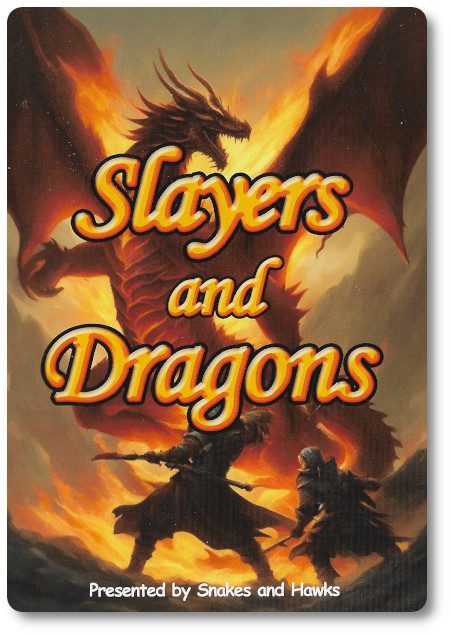
- Hunt the dragon or hunt the would-be slayer in this easy-to-learn trick-taking card game
Endorsements:
- Child Geek approved!
- Parent Geek approved!
- Gamer Geek rejected!
Overview
Dragons and their would-be slayers have had a tumultuous relationship at best since the very beginning. My earliest memories of dragons included knights rescuing kidnapped maidens in my kids’ books from the library. Later, they were the “big baddy” in the dungeon, asleep on their pile of gold (as inspired by J.R.R. Tolkien). Dragons come in all types of forms and stories to this day, from friends to children to living primordial forces of destruction. In this game, there are dragons around every possible corner, but if fantasy stories and hours, upon hours, of playing Dungeons and Dragons have taught me nothing else, there is always a slayer of monsters to be had.
Slayers and Dragons, created by Carey Suber and published by Snakes and Hawkes, is comprised of 60 cards. The cards are as thick and as durable as your standard playing card. Illustrations are limited, appearing only on eight cards, leaving the remaining cards to represent colors and numbers. Not included with the game, and necessary to play, is some means to keep track of individual players’ scores. A pen or pencil and some paper will do just fine.
Preparing for the Hunt
To set up the game, complete the following steps.
First, remove a certain number of cards from the deck based on the number of players.
Second, shuffle the remaining cards and deal an equal number to each player.
Third, have each player select three cards from their dealt hand and place them face down in the middle of the playing area. Do not combine the discard pile. There should be one discard pile per player in the game.
Fourth, the player who dealt the cards now gives each player one of the discard piles, adding it back to their hand.
Fifth, the dealer will now pick a penalty color (yellow, red, blue, or black). Any cards the player has at the end of the hand that match this color will cost them points, which they do not want.
That’s it for game setup. The player to the left of the dealer goes first. Time to get slaying!
Slaying Dragons
Slayers and Dragons is played in hands and turns with no set number of hands per game. The player to the left of the dealer goes first and plays any card from their hand. The first card played is called the “lead card”. Play then continues clockwise. Each player must play to the color of the lead card. However, if the player does not have a card of that color, they may play any card they like.
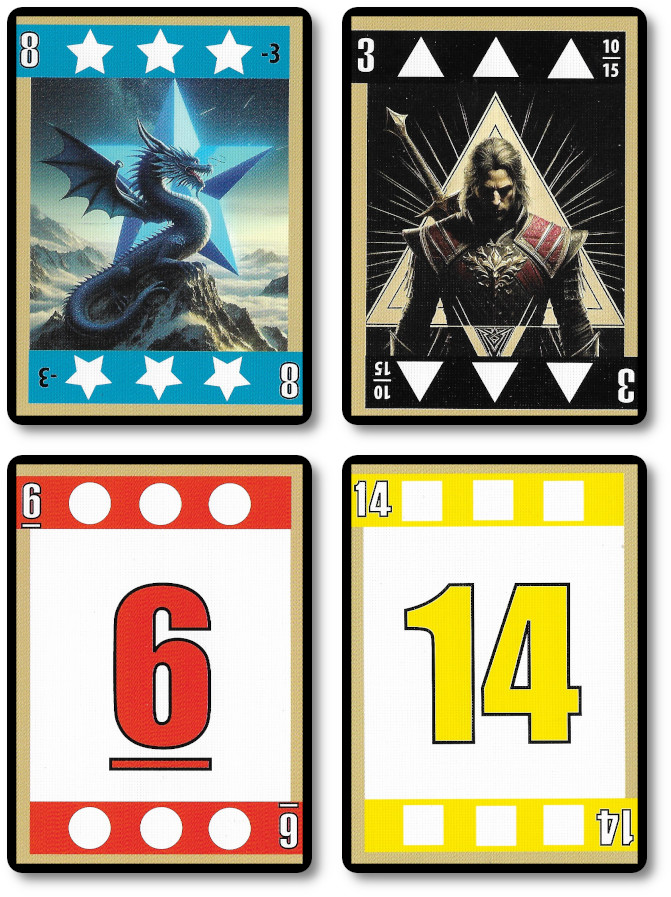
After each player has had a chance to play a card, the player who played the highest valued card that matched the lead card’s color collects the cards to create a “book,” which is just a fancy way of saying “take all the cards currently played and put them in an orderly stack in front of you.”
The hand then continues with the player who collected the book playing a new lead card. And around and around you go until all the cards have been played from the players’ hands.
Counting Scales
After the hand has been fully played, points are scored. Players should count their own cards as follows:
- Plus 1 point for every card collected that matched the penalty color
- Plus 10 points for every Slayer collected that does not match the penalty color
- Plus 15 points for a Slayer collected that matches the penalty color
- Minus 3 points for each Dragon collected of any color
- Minus 50 points if the player collects all four Slayer cards
A new hand now begins with a new dealer.
The game continues as noted until, at the end of the hand, one player has 200 or more points or fewer than 100 points. The player with the fewest points wins the game.
Game Variants
Included with the game are rules for team play and changing the number of points needed to end the game.
To learn more about Slayers and Dragons, visit the game’s web page.
Fina Word
 The Child Geeks quickly learned to play the game, having previously played trick-taking card games similar to Slayers and Dragons. According to one Child Geek, “I guess it’s a new game because it has dragon hunters and dragons, but the game is just like other games I play with my family, like Hearts or Spades. I like playing with my grandpa the best. He’s really good at cards and likes dragons, too.” Another Child Geek said, “I like the game, OK. It is fun to try to give other players points, but it doesn’t feel good when you have to take the cards.” When the last dragon was put down, the Child Geeks took a vote and decided that the game was just “OK” and nothing to get excited about.
 The Parent Geeks didn’t have a strong feeling about this game, finding it remarkably similar to other card games. According to one Parent Geek, “It’s not that this is a bad game. Far from it. It’s just a game that feels too similar to warrant excitement. It doesn’t bring anything new to the table beyond a dragon-fantasy theme and some complicated scoring. I will say that the scoring is interesting, but it doesn’t make for a better game. Still, I do like the new take on the scoring, which made the game unique enough to play several times.” Another Parent Geek said, “The game was fine. Easy to learn and fast to play. It seemed like a game I’ve played before, having all the elements of other card games I enjoy, like Hearts and Spades. I left the game feeling satisfied, but not overly excited about it.” When the votes were taken, the casual players still enjoyed their time hunting dragons and slayers, giving it a thumbs up.
 The Gamer Geeks thought the game was forgettable at best. When asked by the Gamer Geeks what they thought of the game, they said “it’s fine” or “it’s OK.” None of our gaming elitists thought the game was bad or misrepresenting what it was attempting to do at the gaming table. The general sentiment was that the game was bland, had already been done, and was altogether unnecessary. As one Gamer Geek put it, “This is a solid game for those who like simple card games and dragons. Trick-taking card game lovers are also going to find real joy here. I can see why some would gravitate towards it, but for me, no thanks.” Another Gamer Geek said, “The artwork looks messy, the scoring requires too much thinking, and the game itself isn’t novel enough to me to care. I’ll give it a pass.” When the votes were taken, the Gamer Geeks said “no thanks.”
 Slayers and Dragons is a simple card game that does require thought to play. Proper hand management is the only level of difficulty to speak of, and no player should expect to go into the game thinking they have an advantage. The game plays quickly, is somewhat easy to score, and stays at the table just the right amount of time. In all respects, it’s a good game.
But it wasn’t entertaining. It was exceptionally routine, one might say. No surprises. No new tricks. No new traps. Just smart card play. Which is exactly the kind of game that many casual players would enjoy. Or, at minimum, not feel overly negative towards, as was observed during our review with the Child and Parent Geeks.
Do try Slayers and Dragons if you and your fellow gamers enjoy a casual trick-taking card game that is easy to teach and easy to play. Just don’t expect this game about dragons and their would-be hunters to bring much heat to your gaming table.
This game was given to Father Geek as a review copy. Father Geek was not paid, bribed, wined, dined, or threatened in vain hopes of influencing this review. Such is the statuesque and legendary integrity of Father Geek.