
 The Basics:
- For ages 7 and up
- For 2 to 4 players
- Approximately 30 minutes to complete
Geek Skills:
- Active Listening & Communication
- Counting & Math
- Logical & Critical Decision Making
- Pattern/Color Matching
- Strategy & Tactics
- Hand/Resource Management
Learning Curve:
- Child – Easy
- Adult – Easy
Theme & Narrative:
- Break your opponents’ codes through deductive reasoning, but only after you do some smart card playing
Endorsements:
- Child Geek approved!
- Parent Geek mixed!
- Gamer Geek rejected!
Overview
In the world of espionage, knowing how to get information is just as important as the information itself. Spies will spend weeks or even years embedding themselves deep into organizations to get their hands on intelligence that can only be found by a trusted few. In this game, you won’t need to go covert and skip your day job to play. You will, however, have to outthink your opponents through clever card plays and math, and then take any opportunity to crack their secret code to expose their secrets. This is a game in two parts, and you’ll only be able to win if you can do both of them well.
Mystic Codes, designed by Carey Suber and published by Snakes and Hawks, is comprised of 76 playing cards, 120 double-sided color tokens, 80 Answer tokens, and four Barrier shields. The game components are of excellent quality with solid cardboard and durable cards. Illustrations, also by Carey Suber, are colorful and visually interesting but do not contribute to the game’s theme or narrative.
Setting Your Code
Complete the following steps to set up the game.
First, give each player a Barrier shield, which they place in front of themselves, providing them with a private space hidden from their opponents.
Second, have each player secretly select three color tokens. These are placed behind the player’s Barrier shield. Note that colors can repeat, but once set, they should not be reordered or flipped. Place the remaining colored tokens and the Answer tokens in their own piles (or pools) off to one side and within easy reach of all the players.
Third, shuffle the deck of cards and deal 16 cards face down to each player. Place the remaining cards to the side. They are out of play until the next round.
This concludes game setup. The player to the left of the dealer is considered the “first player.”
Cracking Codes
Mystic Codes is played in turns and rounds with no set number of rounds per game. Each round is split into two different phases. These phases are summarized here.
Phase A: Play Cards
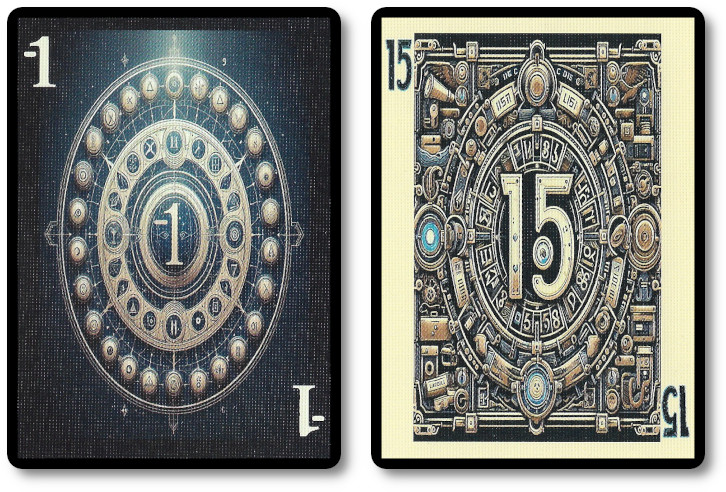
The first player can play any single card from their hand to the center of the play area to start the round. After that, each player plays one or more cards from their hand to the center of the playing area. Cards range in value from -4 to 15. The cards played must do one of the following:
- Play any single card of any value
- Play one or more cards where the mathematical sum is equal to the previous card played, then play any other single card from their hand (which becomes the card the next player must play to).
After a player plays one or more cards, the next player in the turn order sequence takes their turn. This continues until one player runs out of cards. The phase ends immediately, and the player who ran out of cards first proceeds to the next phase.
Phase B: Guess the Mystic Code
The winning player in Phase A now attempts to guess the Mystic Code belonging to their opponents. Three colors for each opponent are collected from the color token pool and placed in front of each opponent’s Barrier shield in a row.
Each opponent now evaluates the row just placed in front of them and first determines whether the color tokens that were just placed match their Mystic Code. If it does, they lift their Barrier shield and are out for the duration of the game.
If the color tokens just placed do not match their Mystic Code, they take the corresponding Answer tokens to identify how many colors are correct and how many are in the right position. They are placed, in any order, next to the row of color tokens just placed. Not on or next to any specific color token. As the game progresses, more and more information becomes openly displayed, slowly cracking the code behind the player’s Barrier shield.
This completes one round of gameplay. All of the cards are collected, the deck is resuffled, and a new hand of cards is dealt by a new dealer.
Codemaster
The game continues until only one player remains with an unbroken code. This player is the winner.
To learn more about Mystic Codes, visit the game’s webpage.
Final Word
 The Child Geeks enjoyed the game but were continually frustrated when they didn’t win the hand and, as a result, were unable to guess another opponent’s code. The upside is that every round ended by providing a lot of information to the table. The downside is that if a single player wins several times in a row, they have a very clear advantage over their opponents. According to one Child Geek, “I like how the game is played in two parts, but I don’t like how you don’t get to try to crack codes unless you win the card part of the game. Sometimes you just don’t have the cards, and that hurts.” Another Child Geek said, “I don’t know what’s more fun: the code guessing or the card playing. I like both, and I liked the game.” When the last code was broken, the Child Geeks took a vote and agreed they enjoyed the game, even though they were not always able to crack their opponents’ codes.
 The Parent Geeks enjoyed the game but were just as quickly frustrated by its gated second phase, which required them to win a card game. The Parent Geeks began to feel that this was not a two-part game, but two games, weirdly put together in the same box. According to one Parent Geek, “The first part of the game is a fun card game. I really liked how you could spend more cards to do some rather mathy means to get rid of a lot of cards fast. The second part reminded me of another game, Mastermind, where you first make a really dumb guess and then slowly start to gain more and more knowledge to make more intelligent guesses. I like both of them, but putting them together felt awkward. Not sure if I like the idea that a strong card player could win the game simply because they block out their opponents from ever guessing.” Another Parent Geek said, “I like it, and I didn’t like it. When you don’t win the hand – and only one player can do that – you lose any option to advance yourself forward to possibly win the game. Felt like punishment when you didn’t get to guess a code.” When all the games were over, the Parent Geeks took a vote, and the results were mixed.
 The Gamer Geeks did not care for this game whatsoever, finding it to be a blatant ripoff of Mastermind, with a bland trick-taking card game thrown in. Worse of all, they could not get over the fact that the card game actually determined the winner, even though the entire game was focused on breaking an opponent’s code. According to one Gamer Geek, “I don’t think this is anything else other than a logic puzzle gated by a card hand. I don’t like the concept, and I really dislike the execution. You might as well give players dice to roll to determine who gets to guess the codes. Roll a six-sided dice, and the player with the highest number guesses everyone’s code. Dumb, and that is exactly how it felt.” Another Gamer Geek said, “Two games in one, and that is fine, but the interaction and what is determined by the two different games doesn’t make much sense. I like the card game and the logic puzzle, but I do not like them together. For example, I like smoked fish and peanut butter, but I don’t want them together, ever. Some games shouldn’t be mixed.” When the Gamer Geeks had their fill, they took a vote and quickly decided that Mystic Codes was not for them.
 So, here’s the thing when it comes to Mystic Codes, based on our observations. You will not really love it, but nor will you really hate it. You’ll also only really like one aspect of the game, not both. I know I didn’t. I enjoyed the card game portion and tolerated the code-cracking. Other players really only enjoyed the code-cracking, but couldn’t do that unless they won the card game they didn’t enjoy. This made everyone feel that one part of the game was always a “means to an end” rather than an enjoyable component of the whole. To be fair, a number of players did enjoy it, but they didn’t make up the majority.
On a positive note, I do believe this game has a home on many game shelves. For those not familiar with Mastermind (which is exactly what the second part of the game is), Mystic Codes will provide a great deal of new insight into the world of deduction games. The card game portion is elegant and quick, requiring the player to do some quick math to be as expedient as possible in getting rid of their cards. I guess, if you like, buy the game and get two for one.
Both games are fun, and neither feels right being joined at the hip. Give it a try with your gaming family and friends and see if you can crack the code on this game to find the fun.
This game was given to Father Geek as a review copy. Father Geek was not paid, bribed, wined, dined, or threatened in vain hopes of influencing this review. Such is the statuesque and legendary integrity of Father Geek.