
 The Basics:
- For ages 14 and up
- For 2 to 8 players
- Approximately 30 minutes to play
Geek Skills:
- Active Listening & Communication
- Counting & Math
- Logical & Critical Decision Making
- Reading
- Strategy & Tactics
- Risk vs. Reward
- Visuospatial Skills
- Cooperative & Team Play
- Hand/Resource Management
Learning Curve:
- Child – Easy
- Adult – Easy
Theme & Narrative:
- To join an ancient order of assassins, you must first prove you can survive and kill
Endorsements:
- Child Geek approved!
- Parent Geek approved!
- Gamer Geek approved!
Overview
The Order of the Blade has existed since the first day someone wanted another’s death and was willing to pay for such a service. Since its initial humble beginnings as nothing more than a group of hired thugs, it has become a worldwide underground organization of elite assassins. Today, they are holding openings to determine if any new talent is worthy of joining their shadowy exploits. You believe you have what it takes and have joined the tournament. The rules are simple: survive. In this game, however, death is too often the victor.
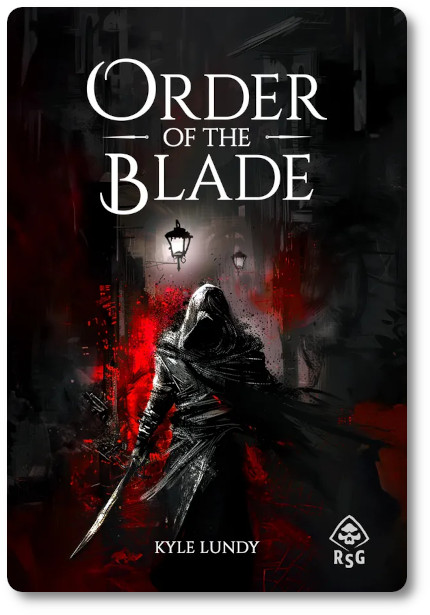
Order of the Blade, designed by Kyle Lundy and published by Rogue Skull Games, is comprised of eight Character cards, eight Player pawns, one Dodge die, one Cooperative Challenger Character card, one Shadow Guard Intensity Tracker card, 10 Shadow Ability coins, two Flare tokens, 20 Smoke Bomb tokens, nine City Tiles (double-sided), 10 Elite Shadow Guard cubes, 60 Shadow Guard cubes, 10 Tracker clips, one card stand, and 72 Shadow cards. The artwork is excellent, depicting highly detailed, gritty characterizations of the assassins on the Character cards, Shadow cards, and in the arena where they will die. Very clean and enjoyable to look at. The game component quality is also excellent, with durable bits and bobs throughout.
Preparing Your Blades
To set up the game for normal play, complete the following steps. Additional game modes and options of play are summarized in the Game Variants section of this review.
First, shuffle the City tiles and arrange them into a 3×3 square. The tiles are double-sided, so feel free to reverse them if you don’t like what you draw or simply go through the City Tile cards and pick the ones you want.
Second, shuffle the Character cards and deal one to each player in the game. Again, optionally allow players to select their character. Be cautious, however, if you give the Character cards to the players to select from. Each is unique and will require players to do much more thinking for game setup than might be warranted or than the time available to play allows.
Third, have each player take the matching colored Player pawn, one Shadow Ability coin, and a Tracker clip. Players should place the Tracker clip on the “10” spot of their Character cards to represent the character’s starting health.
Fourth, take the Shadow Guard Intensity Tracker card and place another Tracker clip on the “1” spot.
Fifth, take the Shadow cards and build the deck. The rulebook does a great job of describing the process, but in summary, players will build the deck using available cards based on the preferred level of game difficulty and the number of players.
Sixth, have each player roll the dice to determine turn order. The highest roller goes first and picks their Character pawn’s starting position on the City tiles. Turn order is then set clockwise, allowing each player, in turn order, to place their Character pawn. Players cannot place their pawns in the same space as another pawn or building square. The available areas on each tile are described in the rulebook.
That’s it for game setup.
Knives Out
Order of the Blade is played in turns with no set number of turns per game. A player has three actions on their turn, which can be taken in any order and even repeated. An action must be completed before another action can be taken. For example, a player could not take the Play action until they finished their Move action.
Each available action is summarized here.
Move
Movement on the game board is tracked by the squares. The Player’s pawn can move up to three squares both diagonally and orthogonally. However, movement is not possible through an opponent’s Player pawn or through any of the buildings (which look like walls at first glance). Note that a Character ability can bend this rule.
Play
The cards in the game provide the player with different ways to interact with the game board and their opponents. Unless otherwise specified by the card’s specific rules, when a player takes this action, they select any card in their hand and place it in their discard pile face-up. They then resolve the card. What the card represents determines the outcome.
Weapon cards allow the player to attack their opponents. Each weapon will have a Weapon Value, the distance it can be used if ranged, and a damage value (noted by skulls). The target of the attack rolls the die and must roll higher than the Weapon Value or take the damage listed (with ties going to the attacker). Note that a player can only hit a target with a ranged attack if the line of sight is not blocked by a building.
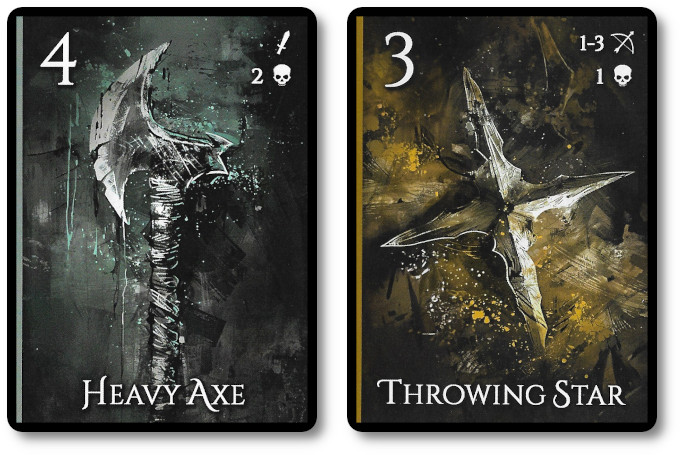
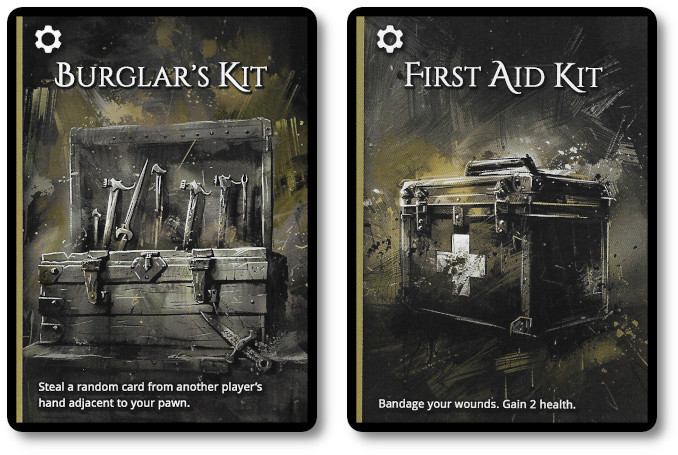
Utility cards are resolved in the same fashion as Weapon cards, but do not initiate an attack. This is not to say that a few of the Utility cards are unable to assist in combat by providing advantages and disadvantages.
Event cards will never be in your deck for long, as they are immediately played when drawn. As such, they are not a valid card for the Play action. But since I’m talking about all the cards, let’s make sure we discuss these nasty little cards. Once available, they are immediately shown, read out loud, and resolved. But instead of going to the discard pile, they are placed in a unique Event discard pile. That is, unless the Event has a lasting effect. If so, the Event card is placed in front of the player and remains active until it is no longer valid. At which point, it is placed in the Event discard pile. Note that Event cards do not count as the player’s Draw.
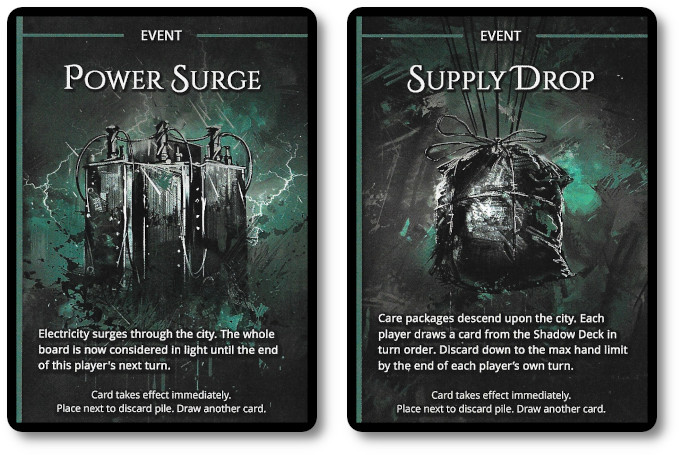
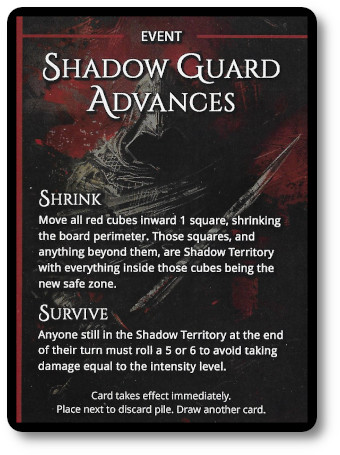
A special Event card worth noting is “Shadow Guard Advances.” This triggers the advancement of the Shadow Guard cubes, which in turn restricts the playable area.
Draw
The player draws a card, adding it to their hand. The hand size limit is set to eight cards, which will force the player to discard if they have too many, but only at the end of their turn.
Bonus
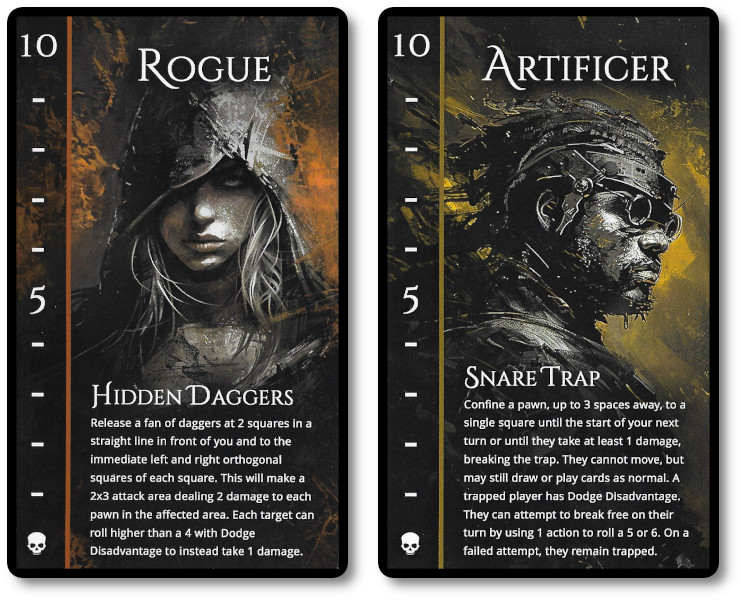
Each character has a special ability it can use during the game. These can be triggered by the player, but at the cost of spending Shadow Ability coins. It is also worth noting that this action doesn’t count as one of the three possible actions the player can perform in total. Each ability is noted on the Character cards. In summary:
- Archer can fire a barrage of arrows
- Artificer can set a trap
- Ghost can move invisibly through opponents
- Knight can ram through opponents
- Monk can attack targets surrounding them
- Ninja can traverse buildings
- Rogue can throw a fan of daggers
- Thief can steal cards
Sheltered in Darkness and Death in the Shadows
Lack of light is both a good and a bad thing in this game.
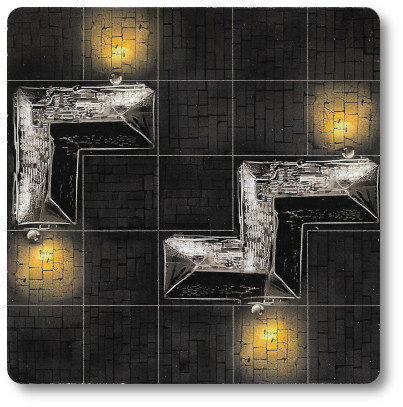
The game board is a mix of lighted and darkened squares, which represent the amount of light available in each square. If a Player’s pawn is in a lighted space, they are considered “always visible,” which makes them a huge target. Hiding in the shadows, however, gives the player an advantage in dodging some attacks and even being unseen.
The Shadow Guard are the footmen of the Order. At first, they are not present, but upon the reveal of their Event card, the red cubes are placed along the edges of the game board. Every Shadow Guard event card drawn thereafter moves the cubes inwards, shrinking the available safe space to play. Any Player pawn outside of the safe area is said to be in “Shadow Territory” and will need to roll a “5” or a “6” in order to avoid taking damage. The amount of damage taken is determined by the Shadow Guard Intensity level, which will only increase as the game continues.
The Rewards of Death
When a player is able to strike the last point of damage that reduces the opponent’s Character’s health to zero, the opponent’s Player pawn is removed from the game. In addition, the player now has access to their opponent’s special character ability, plus receives one Shadow Coin and any cards in the opponent’s hand.
Last Assassin Standing
The game continues until only one player remains. This player is the winner.
Game Variants
The game comes loaded with alternative modes of play, offering plenty of opportunities to enjoy Order of the Blade in new and entertaining ways.
- Introduce Elite Shadow Guards who allow removed players to continue enjoying the game as the Order’s most elite soldiers.
- A faster version of the game, designed as a mini-royale, which includes a lot less space to maneuver.
- Let players control two assassins instead of one, pitting different guild factions together.
- A team variant where assassins join together to take down common rivals.
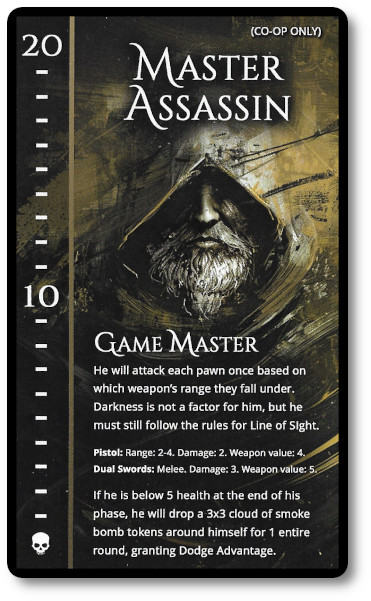
- A cooperative means of play where all the players are trying to survive the onslaught of the Order’s Master Assassin.
To learn more about Order of the Blade, visit the game publisher’s website.
Final Word
 The Child Geeks absolutely loved this game. They immediately recognized several elements of the board game’s gameplay that closely matched experiences found in the video games they loved (specifically Call of Duty and Fortnite). Right from the start, they jumped in and began slaughtering each other. It became clear that aggressive gameplay was the way to approach victory. To which all of the Child Geeks leaned heavily. According to one Child Geek, “This game is great! I like it because it reminds me a lot of the video games my mom only lets me play a little bit. But I can play this with my friends anytime I want!” Another Child Geek reported, “This game made me super mad but also really glad. I was always happy to have played it, but not always happy about losing. But that was also always OK because I was able to act as an Elite guard and take out the bozzo who took me out of the game!” When the last blade was sunk in its target, the Child Geeks took a vote and enthusiastically voted to approve Order of the Blade.
 The Parent Geeks, after calming down their Child Geeks, had their turn at the game and quickly discovered two very important things. First, their Child Geeks slammed them in game play, taking out the Parent Geeks in record time. Second, that an aggressive game like this truly rewards engagement and swift tactical decisions. And while none of that sounds even remotely casual, even the casual game players (noted for only enjoying “cozy games”) fell into the game with delightful bloody glee. Oh, the carnage! As one Parent Geek put it, “This game is fast, tactical, and above all, ruthless. Even if you are winning, you are always a target. I really enjoyed the change of pace this game provided!” Another Parent Geek said, “I do not like games where you need to attack other players. But in the case of this game, I’ll make an exception. I don’t like being attacked, but I do so very much enjoy attacking the other players. This game felt like an episode of the movie John Wick!” When the final assassin was removed, the Parent Geeks took a vote and agreed the game was top-notch.
 The Gamer Geeks were also very impressed and pleased with the game. If you thought the Parent and Child Geeks were aggressive, nothing would have prepared you for the level of aggression I observed while watching the Gamer Geeks learn and play the game. Oh, boy. Right from the start, the Gamer Geeks were jumping into the shadows and sneaking around, stabbing each other in the back. When the Shadow Guards came out, they utilized the shrinking area to move in close (and personal) to their target to make the final blow. All the while, the Gamer Geeks laughed evily, swore colorfully, and killed with reckless abandon. They loved it. According to one Gamer Geek, “Yes. Yes. Yes. This is a great example of a ‘beer and pretzels’ game I have so very much missed as of late. But not really all that light and most definitely full of tactical goodness. I really enjoyed it and would warmly welcome it back. Hell, I’m going to get my own copy!” Another Gamer Geek said, “This is the kind of game I loved as a kid and love now as an adult, but only on special occasions. Most of the time, I want a game that is deep in strategy and tactics, takes a long while to orchestrate, and has a huge payoff when orchestrated well. This game is all about stabby-stabby as fast as you can. Brutal and beautiful. I’ll take it.” When the Master Assassin of the Order called for a vote, the Gamer Geeks all pledged their undying loyalty to the Order of the Blade.
 Wow! What a whirlwind of a game! I had originally thought this game would only take a few weeks to play with all of my groups and publish the review.
WRONG!
This game was very hard to get out of my playing group’s hands once they had it at their table. As a consequence, each family and gaming group had the game almost twice as long as expected. One family had it for almost a month (on and off). Needless to say, when the game publisher sends you a quick “Hey, where is my game review?” I knew it was time to pull the game back to finalize the review effort. I made a number of geeks very unhappy as a result, but I promised to release it again as soon as possible.
Let’s get to the core of this game: aggression. This is a game that is all about being up front, active, and highly aggressive with your opponents. You, as a result, take a lot of risk, and that risk, my friends, does not always play out well. Play too aggressively, and you become a target. However, if you plan to just spend time hiding in the shadows, you also become a target. The best way to survive is to be an opportunist assassin, taking any and all shots when you can and then quickly getting the hell out of there, escaping into the darkness. A very viable tactic and a lot of fun play.
Speaking of which, do play Order of the Blade the first chance you get. It was a great deal of fun for all of us and a game that will leave a positive – if not frustrated – impression on you and everyone you play it with. Give it a shot and see if this game really hits the mark.
This game was given to Father Geek as a review copy. Father Geek was not paid, bribed, wined, dined, or threatened in vain hopes of influencing this review. Such is the statuesque and legendary integrity of Father Geek.