
The Basics:
- For ages 10 and up
- For 2 to 5 players
- Approximately 25 minutes to complete
Geek Skills:
- Active Listening & Communication
- Counting & Math
- Logical & Critical Decision Making
- Reading
- Risk vs. Reward
- Hand/Resource Management
- Auctioning
Learning Curve:
- Child – Easy
- Adult – Easy
Theme & Narrative:
- Spend your coin wisely and spell your words quickly!
Endorsements:
- Child Geek approved!
- Parent Geek approved!
- Gamer Geek rejected!
Overview
I remember my one and only spelling bee I participated in. I was in second grade, wore a red shirt with an alligator on it, and had just recently had a haircut. I remember these details because the spelling bee in question was a traumatic experience, and my brain has weirdly held on to strange aspects of that ill-fated day. I was asked to spell a word and failed. No, not just failed. Spectacularly fumbled. I have since then healed and moved on, but spelling in public – and even writing on a whiteboard in front of my professional peers – remains an activity that I attempt to avoid at all costs. Let’s see if this game about spelling words – even really small and simple words – can help me with my phobah…phobyah…phobo… You know what I’m trying to spell…
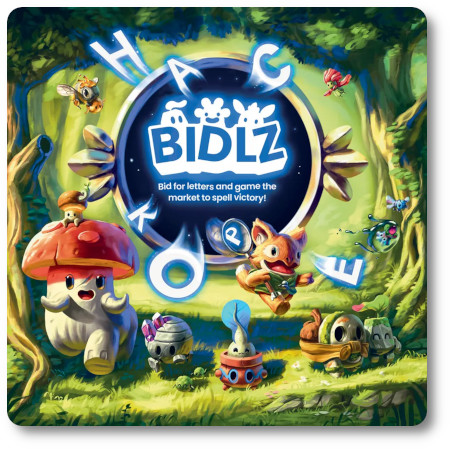
Bidlz, designed by Zac Burns and published by Ex Systemate, includes 80 Silver coin tokens, 16 Gold coin tokens, 54 cards, and five Screens. The tokens are made of thick cardboard, and the cards are as thick and as durable as your standard playing card. The Screens, while not as thick as I would like, are nonetheless durable enough to withstand your gaming table shenanigans without issue. Also included, though not needed to play, is a bestiary that summarizes each unique creature in the game. All illustrations, by Matthis Schroeder, are bright, colorful, and whimsical, adding visual delight to the gameplay.
Prepping for Spelling
To set up the game, follow these steps.
First, take all the cards and shuffle them together. Depending on the number of players, deal a specific number of cards to each player. These cards are “secret” and should remain hidden from opponents until played. Place the remaining deck face down within easy reach.
Second, give each player a Screen to unfold and place in front of them. Players may now put their secret cards behind their Screen.
Third, give each player 10 Silver coins and one Gold coin. Place these behind the player’s Screen. Place all remaining coins in a pile off to the side. This is considered the “bank” for the rest of the game.
This concludes game setup. Let’s play!
Word Games
Bidlz is played in rounds with no set number of rounds per game. Each round has two phases. Players simultaneously play during each phase of the round. A game round is summarized here.
Phase One: The Auction
The first phase of each round is the auction. The auction begins with one player flipping over the topmost card of the deck. The deck contains three different types of cards.
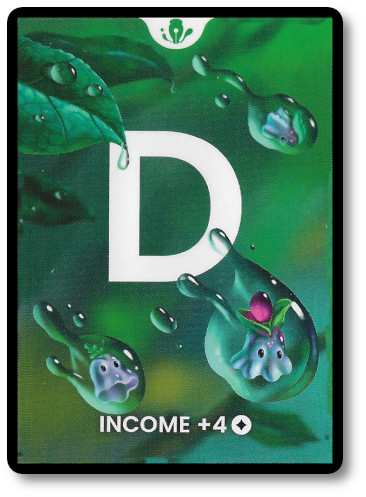
Most cards are “Letter” cards. Some of them also have the words “Income + 4”. If you draw this card, leave it face up. If it includes the income statement, give each player four coins from the bank. The card is then auctioned.
During an auction, all players bid simultaneously using their coins, placing them in one hand and keeping their hand closed so they don’t reveal the number and value of coins being used. Once everyone is ready, players reveal how many coins they are using.
The player with the highest coin value wins the auction. This player deposits a number of coins equal to the second-highest bid to the bank and takes the card as their own. Placing it face up in front of their player Screen. For example, if the player’s highest bid was “5” and the second-highest was “4”, the player who won the auction pays “4” coins to the bank.
All other players return their coins to the back of the Screen. If, however, a player auctions zero coins, they collect one Silver coin. In this way, players with no money will soon be back in the auction game.
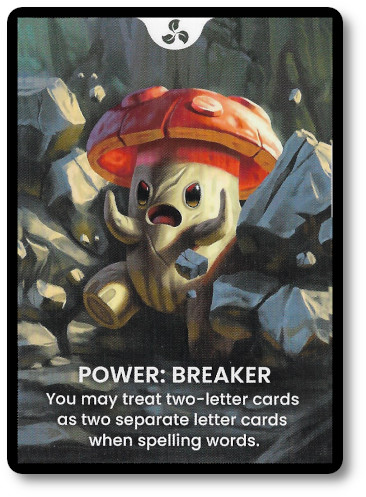
If a “Power” card is revealed, complete the auction as described above. The winning player places the “Power” card in front of them. The player resolves their “Power” card at any time (based on what the power does). Some “Power” cards are discarded after use.
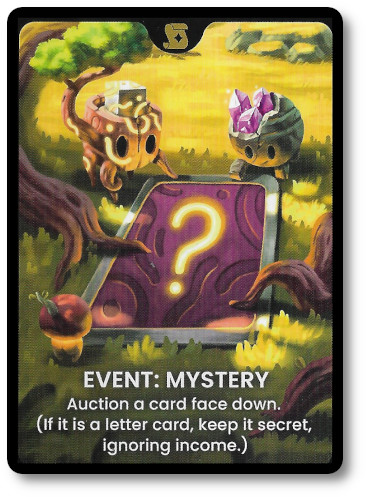
There are also “Event” cards. If revealed, resolve the card’s action, then discard it. Play continues to the next step without an auction.
Phase Two: Spelling
After the auction, players can spell a word using any cards they won during the auction and any cards they have behind their player screen. Players can use any number of cards to spell a word, but each “Letter” card can be used only once. The goal is to attempt to spell a word using five or more “Letter” cards.
If no players can spell a word using five or more “Letter” cards, the round ends and a new round begins.
Winning the Game
The first player to spell a word using five or more cards during the Spelling phase of a turn wins the game. Feel free to play another game immediately!
To learn more about Bidlz, visit the game’s web page.
Final Word

The Child Geeks enjoyed the game, especially the bidding aspect, finding it a reasonable and engaging way to not only get the cards you need to spell a word, but also stop other players from forming words themselves. According to one Child Geek, “I don’t like spelling games, but I like this one. Reminds me of the time Dad tried to teach me Poker. I don’t remember the cards I needed, but I know how to spell words.” Another Child Geek said, “I really like it when you win cards, especially when you win a card you don’t need, but you stop another player from getting the card you know they want.” When the last card was dealt, the Child Geeks all agreed that Bidlz spelled “fun.”

The Parent Geeks also enjoyed the game, finding it to be much more entertaining than other word and spelling games they have played lately. Like the Child Geeks, they were won over by bidding on the cards, but they also greatly enjoyed the Event and Power cards when they came into play. According to one Parent Geek, “I really enjoyed it. My only criticism is that I would have enjoyed more Event cards to shake up the gameplay. The Power cards were also fun, but I thought there were just the right amount of those.” Another Parent Geek said, “What set this game apart for me was the auction. I love that you do it blind, but you can also see what the other players are trying to spell, so you can put a lot of devious thought into possibly making another player pay more than they want. And you can even get cards cheap!” When all the games were over, the Parent Geeks gave Bidlz a perfect “A.”

The Gamer Geeks were not impressed. Even with the Power and Event cards, they still found the game mediocre. As one Gamer Geek put it, “I felt this was a game that tried to put too much gameplay into itself. At its core, you are building words with cards you know and cards you might want. This didn’t give any player a big advantage, and I never really needed to try to outbid another player if all the bids were resolved blind. I like some of the game’s concepts, but not the game itself.” Another Gamer Geek said, “I would give this game my heartfelt approval if playing with kids, as I think it brings a lot of engagement to a game about spelling. As a gamer, I wanted more. It fell flat for me, but was loved by my kids.” When the final vote was cast, the Gamer Geeks found Bidlz to fall short of their expectations.

Bidlz was a lot of fun and a bit frustrating with the Child Geeks, as the auction portion of the game can be borderline absurd when it comes to how much people are bidding on a card or how badly they suddenly realize they did want it, but didn’t bet enough. For our youngest players, this hurt more than it reasonably should. For our older and more mature players, it caused nothing more than pivots to spelling words. This proved to be a real benefit to the game’s final vote, as players are never forced to use all their cards to spell the five-or-more-card word. Ties were also easy to evaluate, as the winner was always the player with the longer word or the most coins. This meant every game had a clear winner.
At this point in my gaming career, I am not drawn to games where the primary emphasis is on spelling words. Games like Scrabble and Upwords were fun when I played them, but that is no longer the case. As such, I was surprised by how much I enjoyed Bidlz. Not because of the spelling, but because of the level of player interaction and the game’s speed. This made for an intense and socially engaging activity that I greatly enjoyed.
The big downside of Bidlz, and any game that gives older players an insurmountable advantage against younger players, is the spelling itself. This is at the core of the game. Older players dominated younger players simply because they had a larger vocabulary and spelled better. This is only a skill players can bring to the table based on their years in school and reading, not the total number of games played or other games experienced. As such, when you play this game, make sure your player base is appropriately balanced. No fun for the second graders if they are competing against a Harvard Nobel laureate who specializes in language.
Do give Bidlz a try when you get the chance. This is especially true if you are new to the gaming hobby and want to try your luck against other players with a similar level of life experience in a race to spell really simple words. Avoid the Nobel laureates at all costs.
This game was given to Father Geek as a review copy. Father Geek was not paid, bribed, wined, dined, or threatened in vain hopes of influencing this review. Such is the statuesque and legendary integrity of Father Geek.